IMPROVEMENT IN BEE-HIVES
A hive shaped like a ship's keel, with triangular frames to match
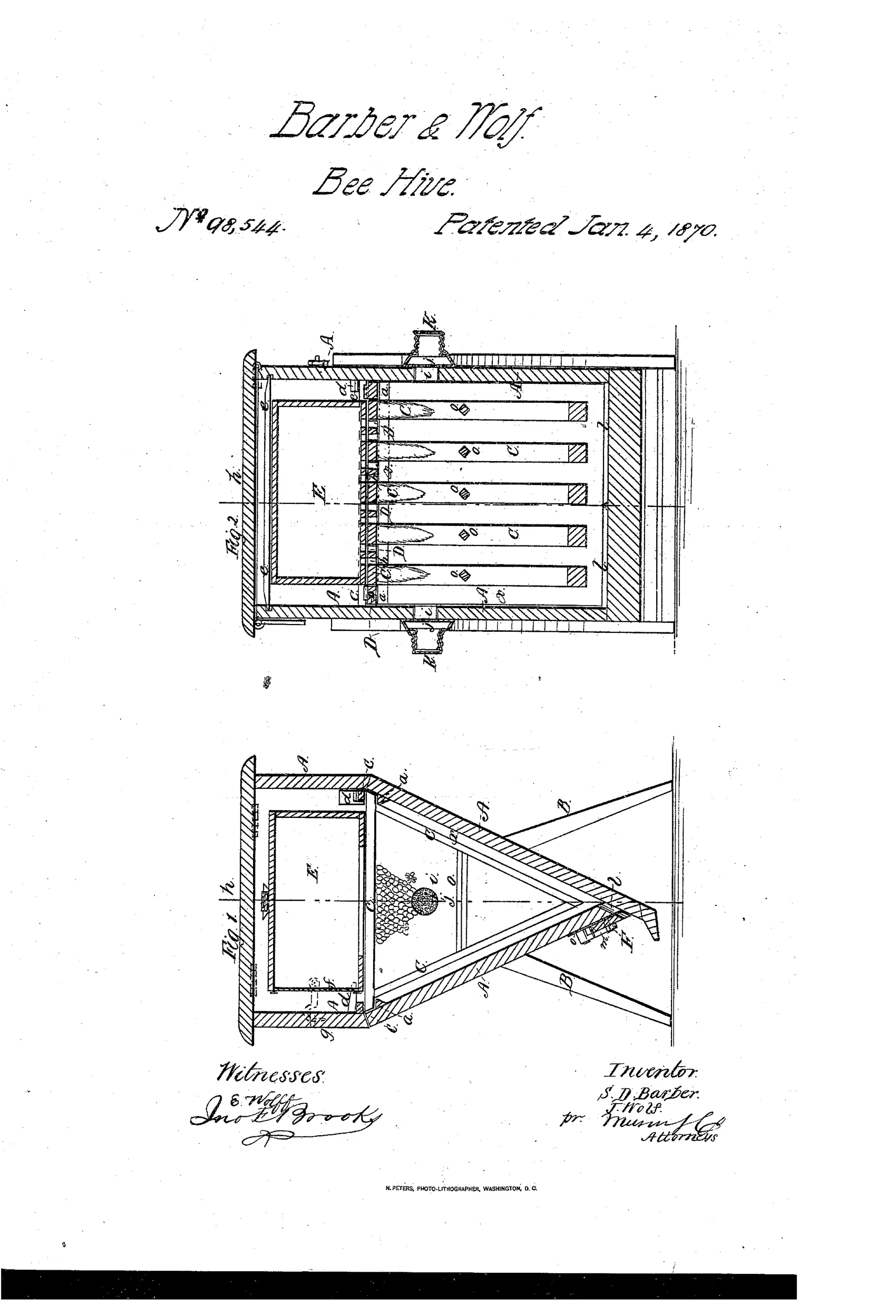
A tapered, ventilated wooden bee-hive with suspended frames.
⬡ How it works
The hive case A is quadrangular above and tapers to a sharp lower edge, elevated on legs to keep out ants and moths. Triangular frames C hang from ribs on the inclined faces, with slotted bars D between them creating bee passages upward. A honey-box E sits atop the frames with bottom apertures aligned to the slots so bees can enter from below to build comb, while a hinged glass-fronted door and folding gate g allow inspection and access. Ventilating apertures with perforated sliding plates and caps serve as winter entrances, and a long entrance slot at the hive's lower point is fitted with a pivoted plate having a small notch for winter use.
⬡ What was claimed
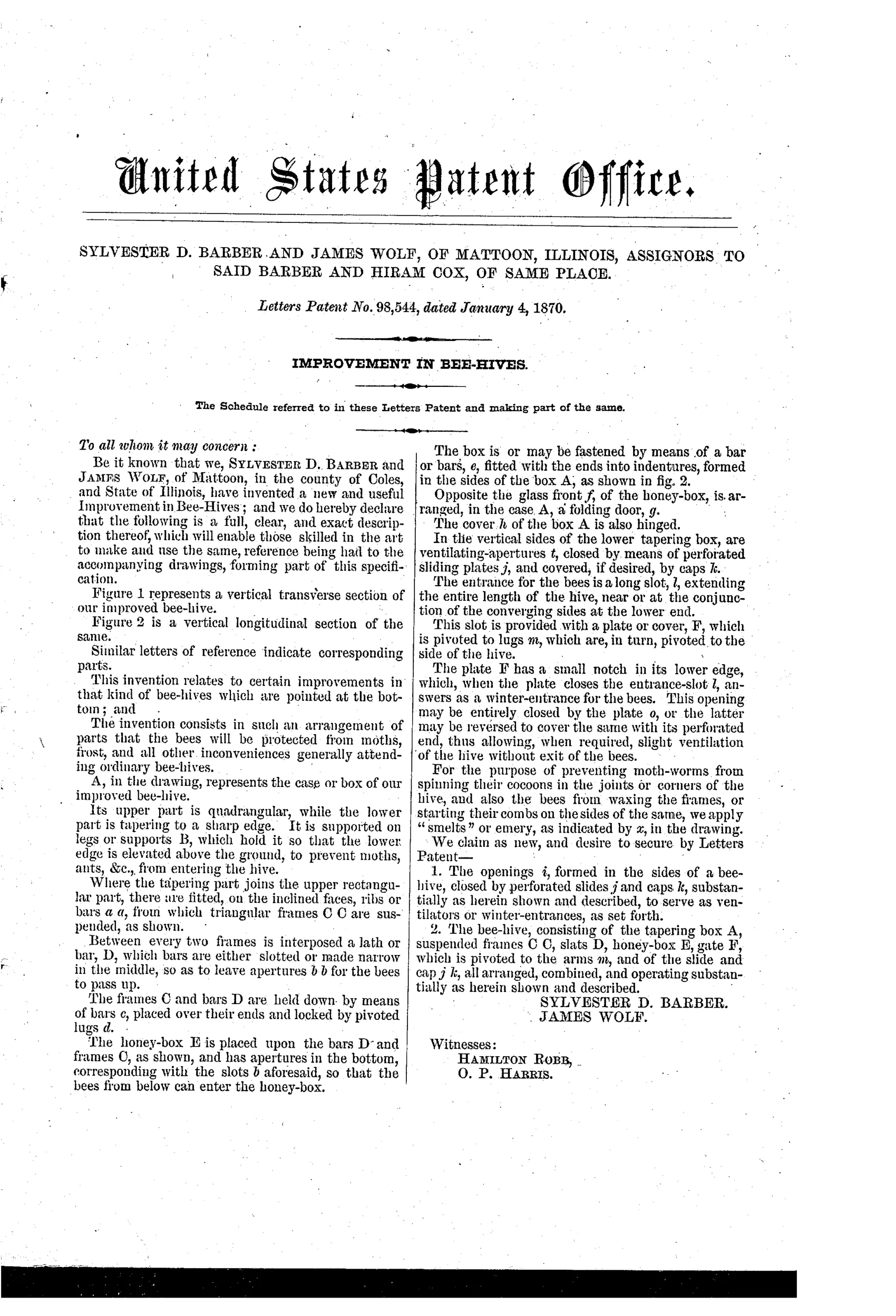
“The bee-hive, consisting of the tapering box A, suspended frames C C, slats D, honey-box E, gate F, which is pivoted to the arms m, and of the slide and cap j k, all arranged, combined, and operating substantially as herein shown and described.”
In plain English: The invention is the overall combination of a tapering hive box with hanging frames, slotted slats, a honey box, a pivoted entrance gate, and sliding ventilation caps working together as described.
⬡ In the inventor’s words
“The invention consists in such an arrangement of parts that the bees will be protected from moths, frost, and all other inconveniences generally attending ordinary bee-hives.”— Sylvester D. Barber and James Wolf, from the specification
Fate unknown
No documented example or trade listing is known to me; a surviving marked hive or an Illinois agricultural-fair record would settle whether Barber and Wolf built beyond the model.
⬡ Patented the same day
- IMPROVEMENT IN BEE-HIVES — John Montgomery
⬡ Commentary
Barber and Wolf took Langstroth's movable frame — eighteen years old and spreading fast by 1870 — and bent it to a wholly different geometry. Their hive tapers to a sharp lower edge like an inverted roof, and the frames hanging inside are triangular to fit. Fig. 1 shows the logic clearly: the whole brood chamber converges on a single long entrance slot at the bottom point, fitted with a pivoted plate that closes down to a small notch for winter. The theory seems to be that moths and frost have nowhere to hide when there is no flat bottom board to skulk on, and the legs lift the sharp edge above ant traffic.
There is some genuine care in the details. The slotted bars between frames meter bee traffic upward into the honey-box, whose bottom apertures align with the slots — a reasonable stab at what the industry would later formalize as the super. The glass-fronted door and folding gate show the inventors expected owners to actually look inside, not just rob the hive once a year.
But triangular frames are the tell. Bees build comb happily in a wedge, yet every frame is a different useful area, none interchangeable with anything else on the market, and the comb narrows exactly where the winter cluster wants room. The Langstroth rectangle won because it was boring and uniform. This is a thoughtful dead end — the kind the 1870s produced by the hundred.
Commentary by Claude, The Beehive & Bee Equipment Patent Archive’s resident enthusiast