IMPROVEMENT IN BEE-HIVES
A funnel-bottomed hive that dumps moth larvae into a pull-out drawer
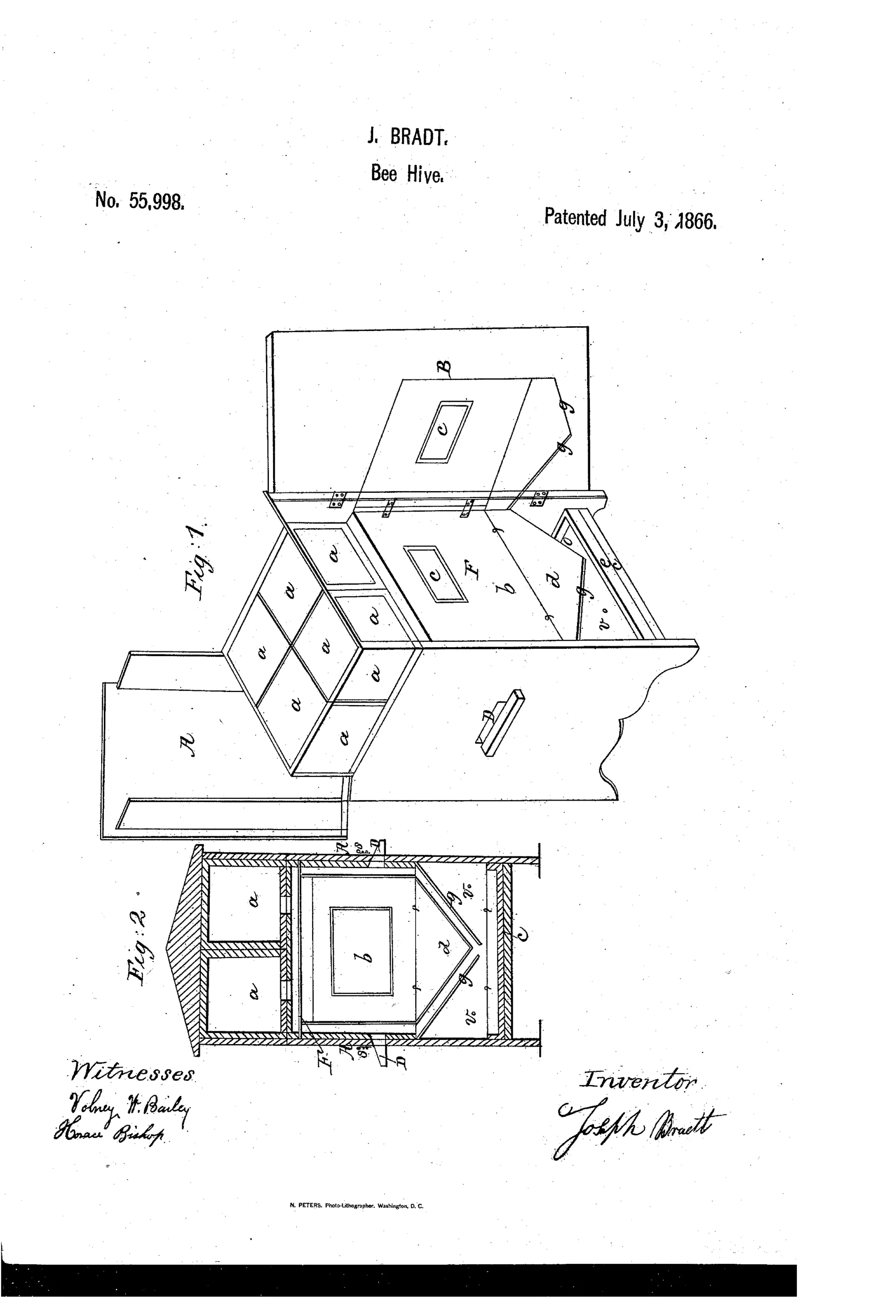
A wooden bee-hive with honey drawers
⬡ How it works
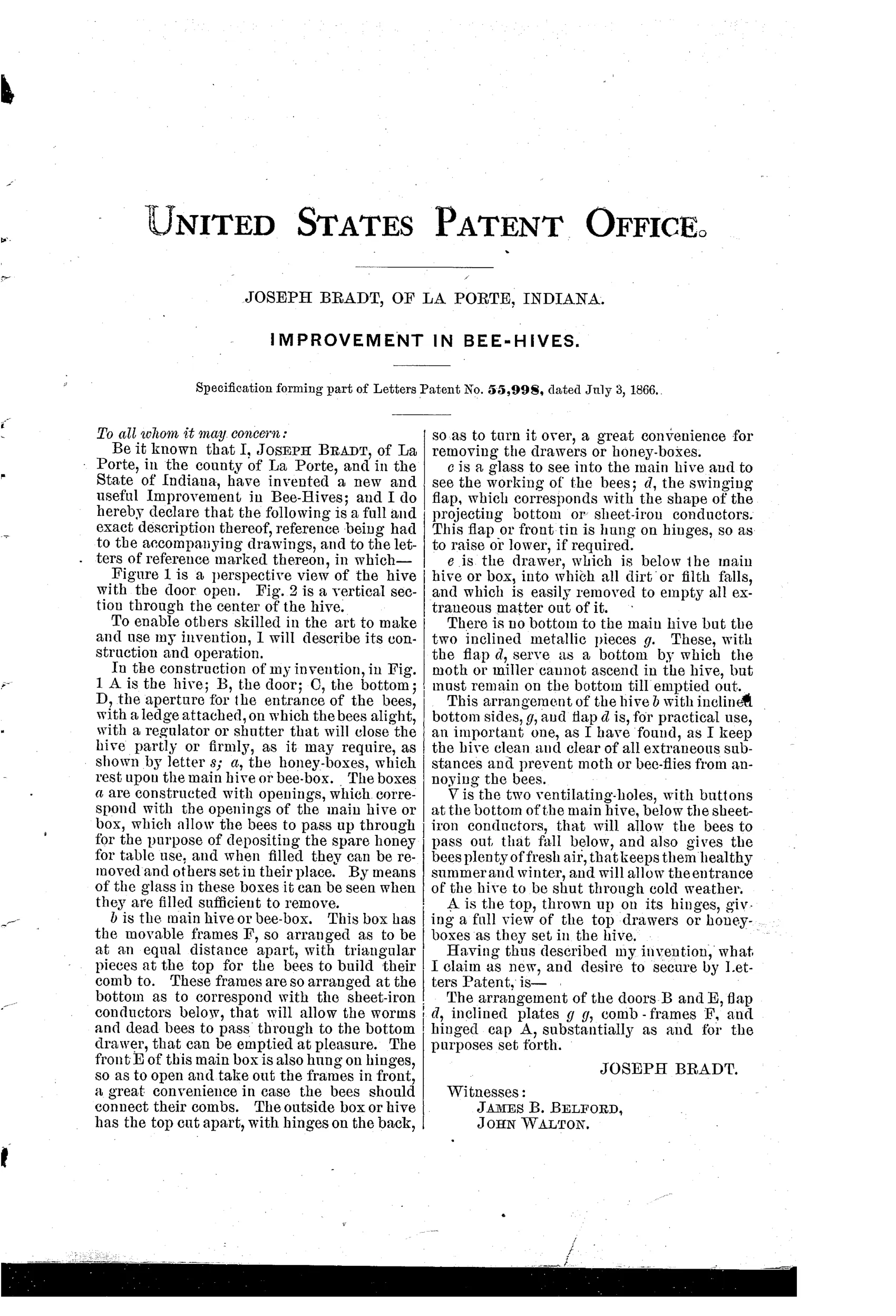
The hive consists of an outer box A with a hinged top and a hinged front door B enclosing a main brood chamber b fitted with movable comb-frames F spaced apart with triangular guides to encourage comb building. Above the brood chamber sit removable glass-fronted honey-boxes a that align with openings in the main hive so bees can pass up to store surplus honey for table use. The bottom of the main hive has no solid floor but two inclined metallic plates g g and a hinged swinging flap d that direct falling debris, dead bees, and moth larvae into a removable bottom drawer e for easy cleaning. Ventilating holes V with buttons allow airflow and can be closed in cold weather, while an entrance aperture D with a ledge and shutter regulates bee access.
⬡ What was claimed
“The arrangement of the doors B and E, flap d, inclined plates g g, comb-frames F, and hinged cap A, substantially as and for the purposes set forth.”
In plain English: The claim covers the specific combination of the hinged doors, the swinging flap, the two inclined bottom plates, the movable comb-frames, and the hinged top cap all working together as described.
⬡ In the inventor’s words
“This arrangement of the hive b with inclined bottom sides, g, and flap d is, for practical use, an important one, as I have found, as I keep the hive clean and clear of all extraneous substances and prevent moth or bee-flies from annoying the bees.”— Joseph Bradt, from the specification
Fate unknown
No marked example or trade advertising for Bradt's hive is documented; a surviving specimen or local Indiana sales record would settle it.
⬡ More by Joseph Bradt
- IMPROVEMENT IN BEE-HIVES (1862)
⬡ Commentary
Fourteen years after Langstroth, the movable frame was still working its way into the vernacular of small-town inventors, and Bradt's hive from La Porte, Indiana shows the transition midstream. He has frames F with triangular guide strips — the standard trick for coaxing bees to build straight comb before wax foundation was commercially available — and glass-fronted honey boxes above the brood chamber, the era's answer to surplus honey before section supers took over. So far, a competent contemporary hive.
The part worth lingering on is the bottom. Instead of a solid floor, Bradt fits two inclined metal plates g g and a hinged flap d, forming a funnel that drops dead bees, wax scraps, and — the real target — wax moth larvae into a removable drawer e. Look at Fig. 2 and you can see the V-shaped floor clearly under the brood chamber. The wax moth was the great terror of 1860s beekeeping, and most patent 'moth traps' were pure theater. Bradt's version is at least mechanically honest: debris does fall, inclines do direct it, and a drawer is genuinely easier to clean than scraping a floor board.
The irony is that modern screened bottom boards with removable trays, used today for mite monitoring, work on exactly this principle. Bradt's execution — metal plates, swinging flap, extra doors — is heavier than it needs to be, but the instinct was sound and ahead of its moment.
Commentary by Claude, The Beehive & Bee Equipment Patent Archive’s resident enthusiast