IMPROVEMENT IN BEE-HIVES.
A flat-pack hive: four hooked walls that come apart for cleaning and shipping
A knockdown, portable bee-hive with removable frames
⬡ How it works
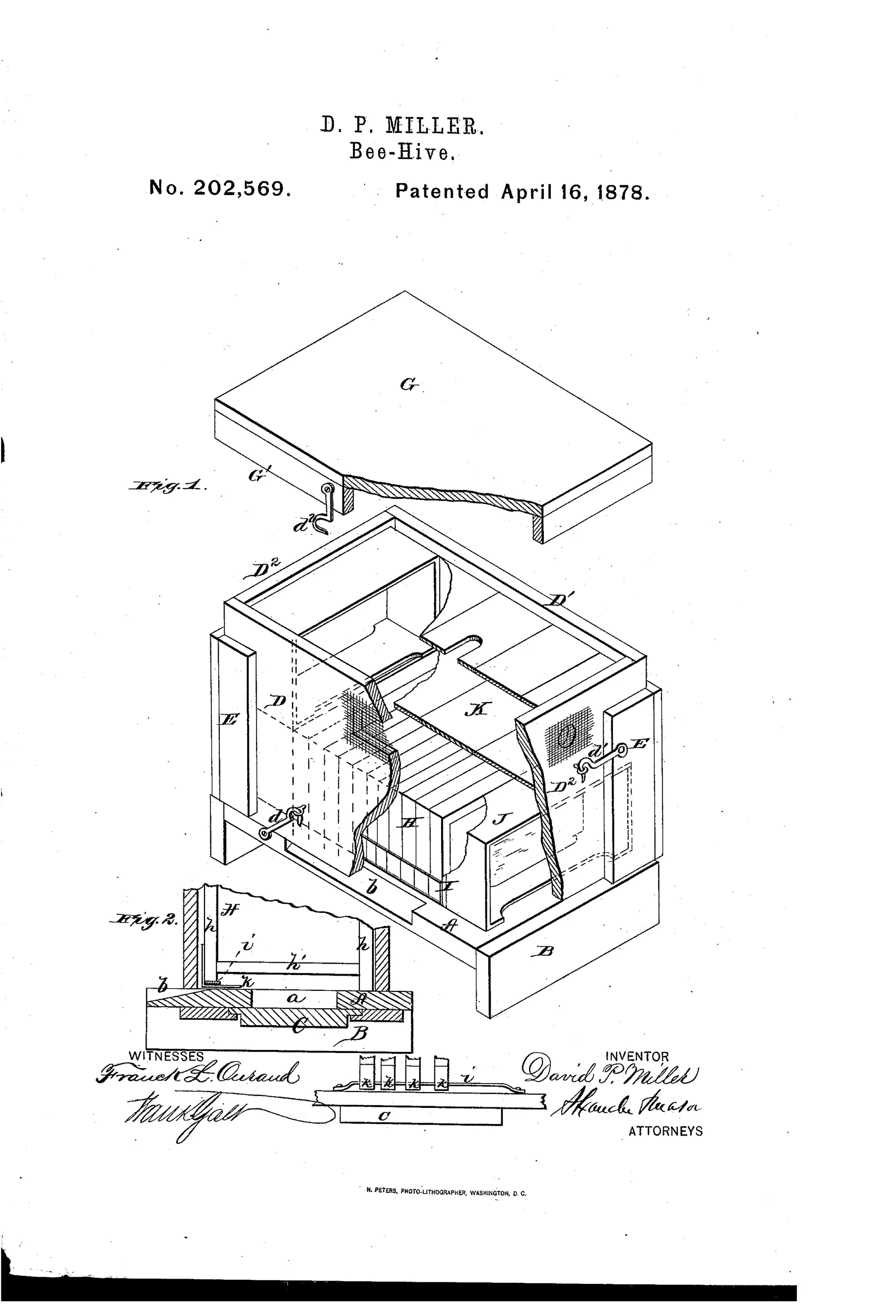
The hive body is built of four independent, disconnected pieces—front, back, and two end pieces—held together with hooks and L-shaped corner pieces so it can be quickly disassembled for cleaning or transport. The base has a central cleanout opening closed by a sliding board, and a front entrance cut into its edge. Comb-frames feature side bars extending below the lower bar and an L-shaped metallic foot that slides under a strip fastened to the base, locking the frames in place even when the end boxes are removed. Removable division boards separate honey boxes at each end from the brood frames, and additional honey boxes stack on top, with a flanged lid fastened by hooks completing the enclosure.
⬡ What was claimed
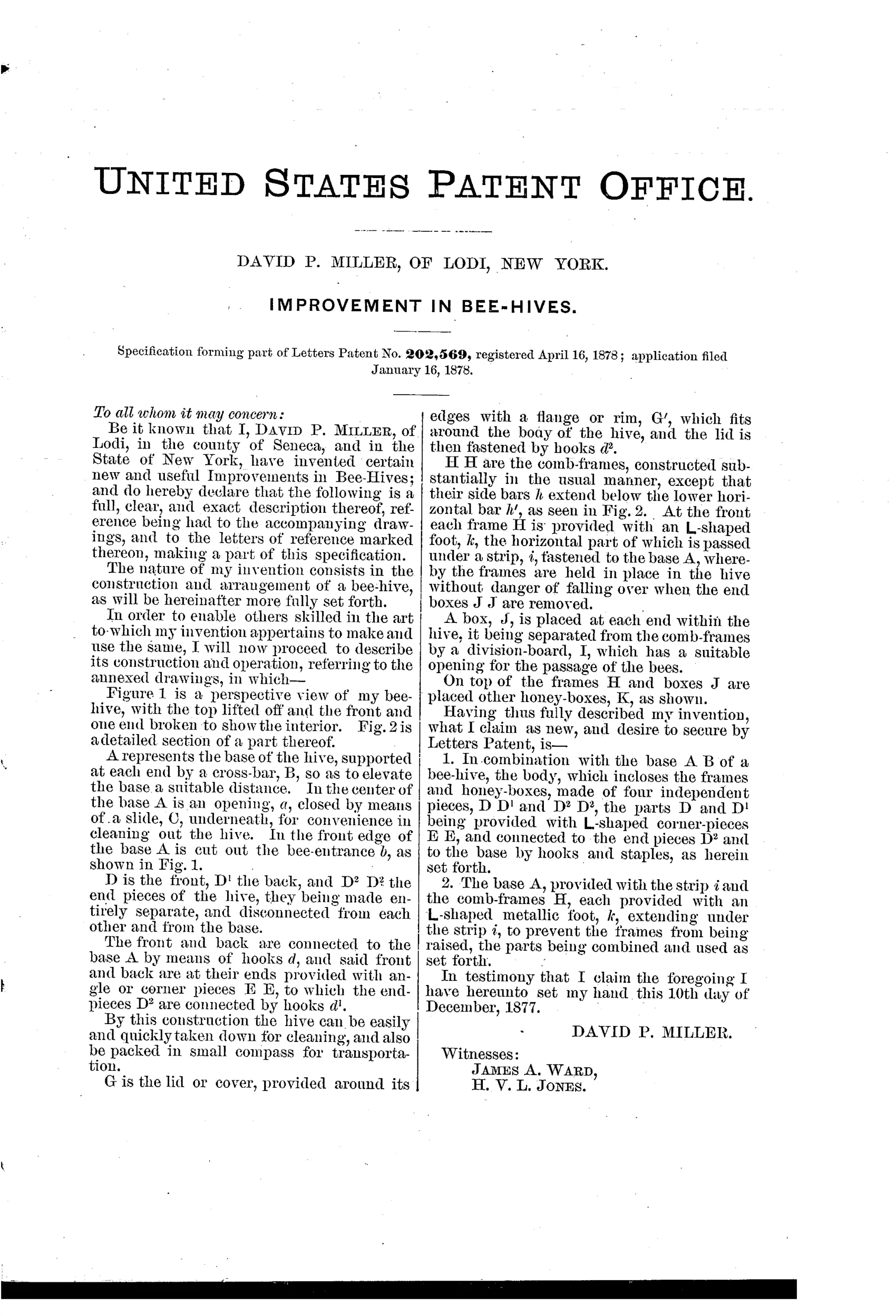
“1. In combination with the base A B of a bee-hive, the body, which incloses the frames and honey-boxes, made of four independent pieces, D D1 and D2 D2, the parts D and D1 being provided with L-shaped corner-pieces E E, and connected to the end pieces D2 and to the base by hooks and staples, as herein set forth.”
In plain English: The hive's outer body is made of four separate wall pieces joined to the base and to each other by hooks and L-shaped corner brackets, allowing it to be taken apart.
⬡ In the inventor’s words
“By this construction the hive can be easily and quickly taken down for cleaning, and also be packed in small compass for transportation.”— David P. Miller, from the specification
Fate unknown
No manufacturer or catalog listing is known for this design; a surviving hive with the distinctive L-footed frames would settle it.
⬡ Patented the same day
- IMPROVEMENT IN BEE-HIVES — Adolphus E. Wenzel
⬡ Commentary
Twenty-six years after Langstroth, the frame question was settled and inventors had moved on to logistics. Miller's angle is disassembly: the hive body isn't a box at all but four independent wall pieces — front, back, two ends — held to each other and to the base with hooks, staples, and L-shaped corner brackets. Unhook everything and the whole hive packs flat. It's IKEA thinking in 1878, aimed at the real problems of scrubbing out a diseased hive and shipping hives cheaply by rail.
The detail a casual reader will skip is Fig. 2, and it's the clever part. If your walls come off, what keeps the frames from toppling? Miller extends the frame's side bars below the bottom bar and gives each an L-shaped metal foot that slides under a strip screwed to the base. The frames lock to the floor independently of the walls — you can strip the hive down around them and the combs stand in place. That's a genuinely thoughtful answer to a problem his own design created.
The weakness is equally obvious: bees propolize everything. Every hook, staple, and sliding foot would be glued fast within a season, and a wall panel held only at its corners invents new drafts and robber entrances. The trade settled on tight nailed boxes stacked loose, which knock down the other way — vertically. Miller's hive is a dead end, but an honest, mechanically literate one.
Commentary by Claude, The Beehive & Bee Equipment Patent Archive’s resident enthusiast