IMPROVEMENT IN BEE-HIVES.
A hive that hangs from a tree branch, nineteen years after Langstroth
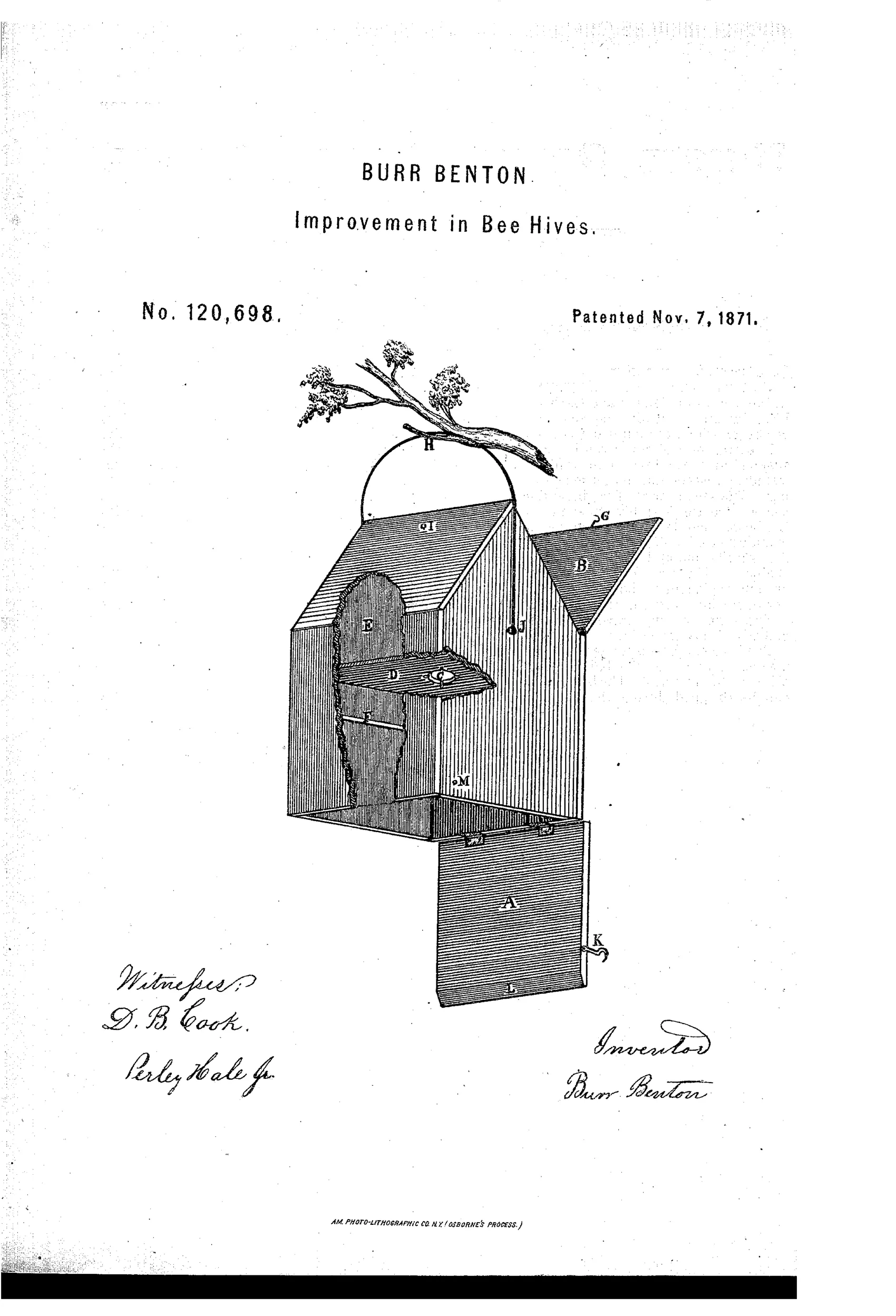
A tree-suspended, drop-bottom, hinged-roof bee hive.
⬡ How it works
The hive hangs from a tree branch or pole by a pivoted bail H secured to the end walls at J, keeping it clear of ground pests. The interior is divided into two chambers by a partition D with a central opening C, letting bees pass from the lower chamber to the upper chamber E, while strips F in the lower chamber support the combs. A hinged bottom A can be dropped open during the working season or in cold weather for ventilation and to prevent moth and miller accumulation, and is fastened shut by hook K and staple M, its beveled edge L then forming a bee entrance passage. One side of the angular roof forms a hinged lid B that can be lifted on hinges and fastened with hook G and staple I, allowing removal and replacement of caps in the upper chamber without disturbing the bees.
⬡ What was claimed
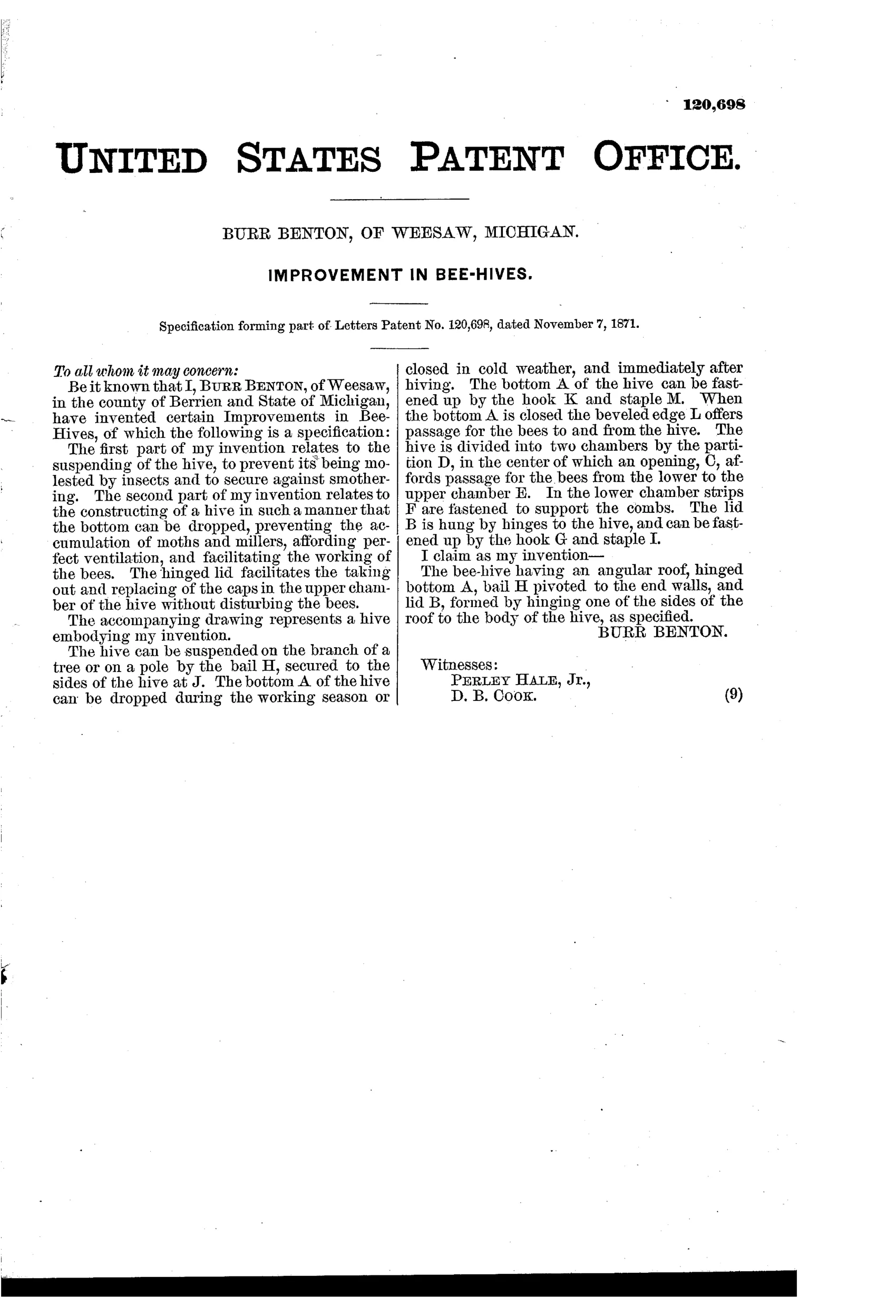
“The bee-hive having an angular roof, hinged bottom A, bail H pivoted to the end walls, and lid B, formed by hinging one of the sides of the roof to the body of the hive, as specified.”
In plain English: The invention is a bee hive with a sloped roof, a hinged drop-down bottom, a pivoting carrying bail, and a hinged roof panel that serves as a lid.
⬡ In the inventor’s words
“The first part of my invention relates to the suspending of the hive, to prevent its being molested by insects and to secure against smothering.”— Burr Benton, from the specification
Paper patent — likely never produced
A frameless suspended hive in 1871 was already obsolete on issue; no manufactured example or trade listing is known, and the swinging-weight problem makes production implausible.
⬡ Patented the same day
- IMPROVEMENT IN BEE-HIVES — William R. Clark
- IMPROVEMENT IN BEE-HIVES — Abraham Mutersbaugh
⬡ Commentary
Burr Benton of Weesaw, Michigan, decided the way to beat ants, mice, and wax moths was to get the hive off the ground entirely — hang it from a branch by a pivoted bail, like an oversized lantern. The drawing plays this straight: the artist has even given us the leafy limb. It's a genuinely different answer to the pest question that obsessed 19th-century hive patentees, most of whom went for traps, moats, or moth-catching drawers. Benton just removed the crawling route.
The rest of the hive is a sensible bundle of period features: a drop-open hinged bottom for ventilation and debris clearance (a real idea — screened bottom boards do this job today), a partition with a central passage separating brood space from an upper chamber where honey caps can be lifted out through a hinged roof panel. Note what's missing, though: frames. Nineteen years after Langstroth's US 9,300, Benton's bees still build comb on fixed strips, which means harvesting is still destructive and inspection is still guesswork.
And the suspension idea carries its own tax. A full hive runs sixty pounds or more; hanging from a bail, it swings in wind, and every drop of that bottom door requires working overhead on a swaying box. Bees tolerate a lot, but beekeepers with ladders have limits. Charming, earnest, and pointed at real problems — but the movable frame had already answered most of them better.
Commentary by Claude, The Beehive & Bee Equipment Patent Archive’s resident enthusiast