IMPROVEMENT IN BEE-HIVES
Two Iowa brothers declare their moth trap 'must necessarily be successful'
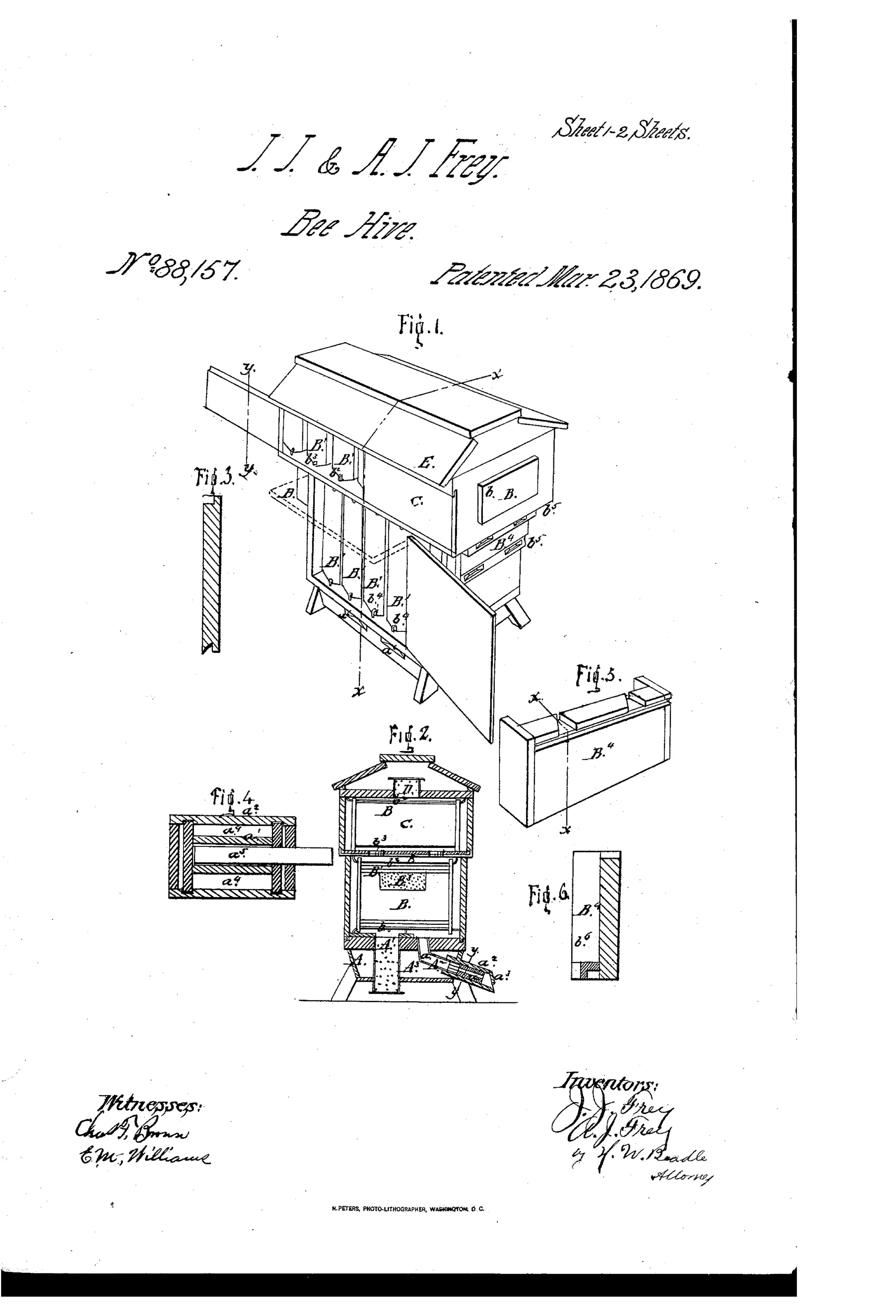
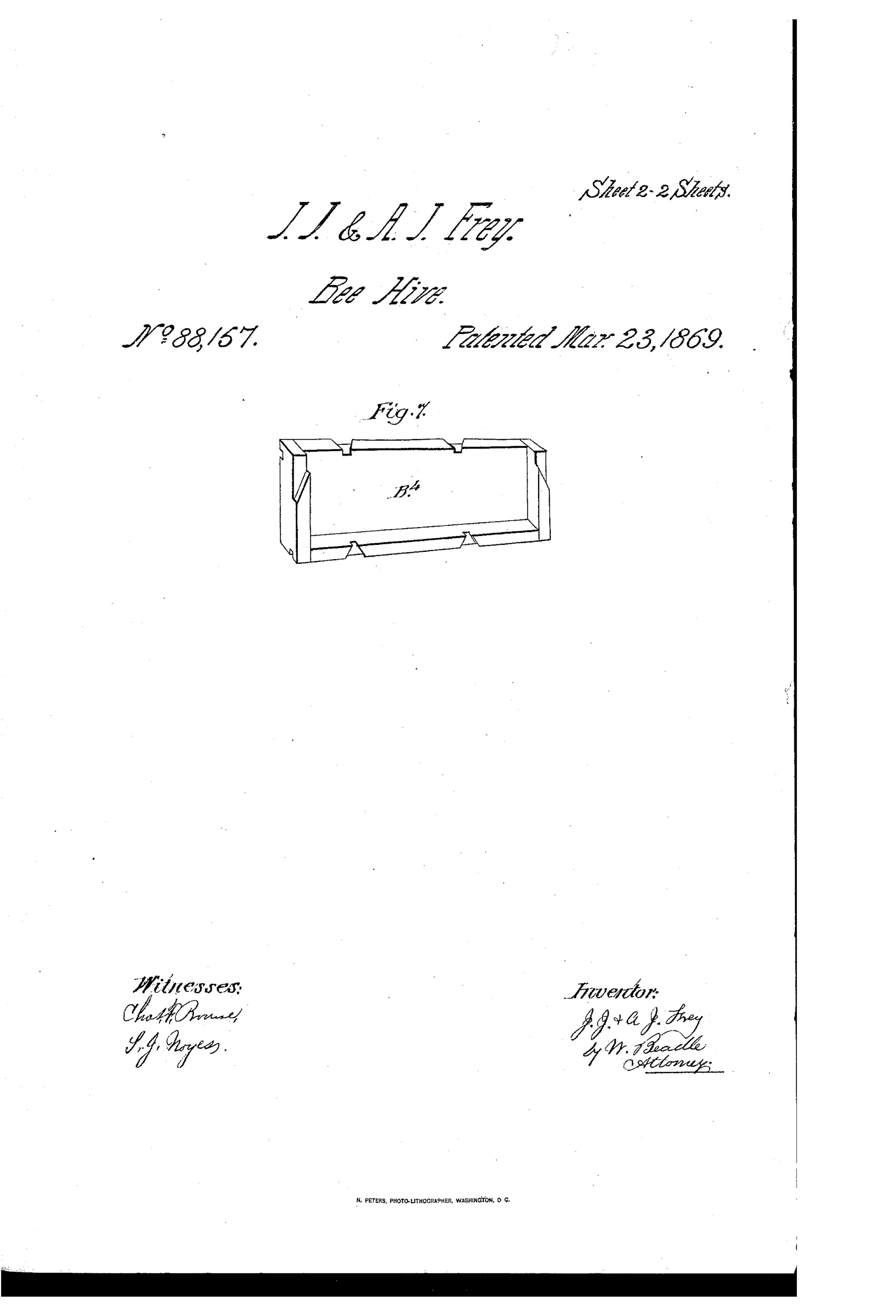
Ventilated, moth-proof beehive with sliding frames
⬡ How it works
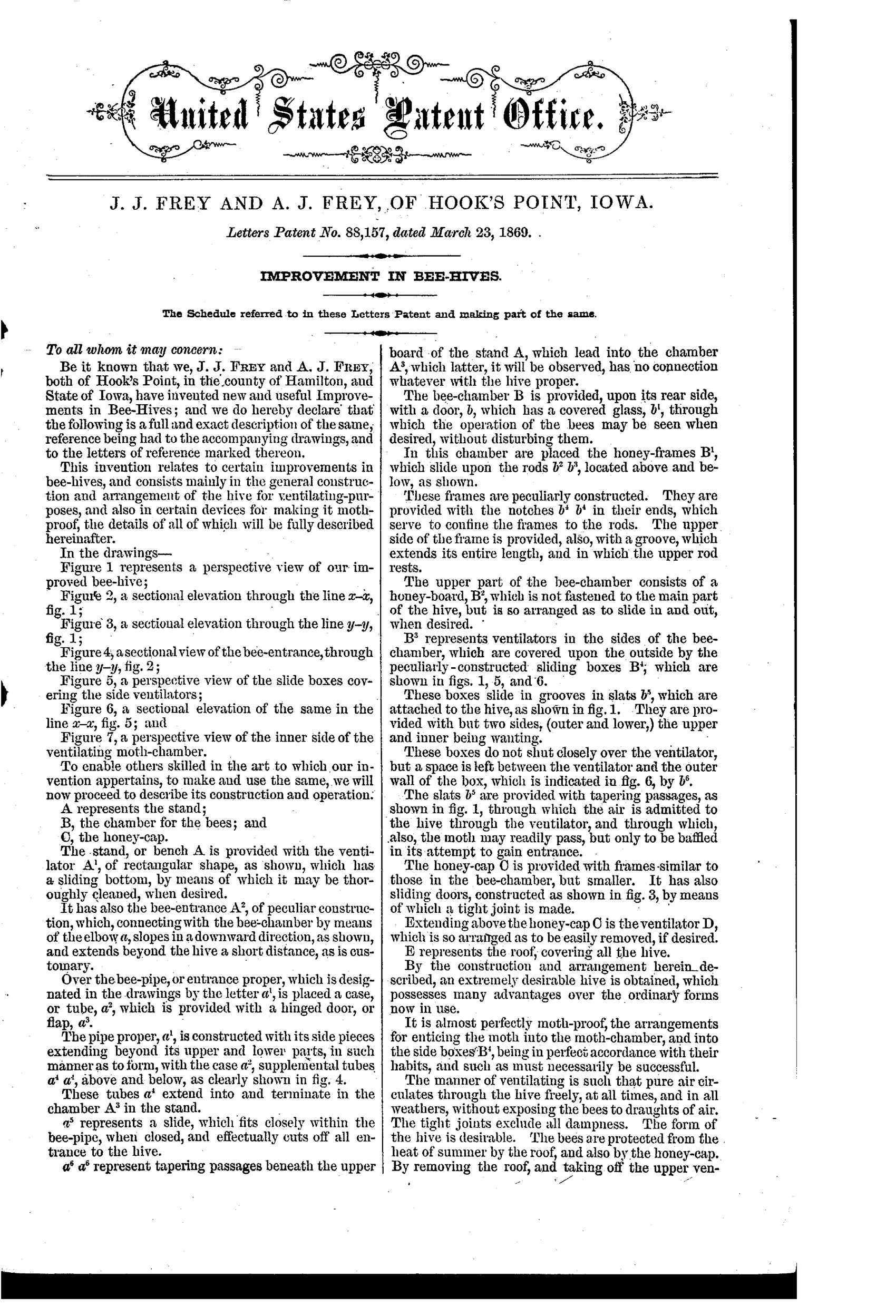
The hive stand contains a moth-chamber with tapering passages and tubes that admit moths but trap them away from the bee-chamber. The bee-entrance is a sloping pipe fitted with a removable slide to close it entirely, and supplemental tubes lead air into the moth-chamber below. The bee-chamber holds movable honey-frames that slide on rods and are notched to stay in place, with a removable honey-board above them. Side ventilators are covered by sliding boxes that admit air through slatted, tapering passages while blocking moth entry, and the honey-cap above has its own sliding-door frames and a removable roof ventilator.
⬡ What was claimed
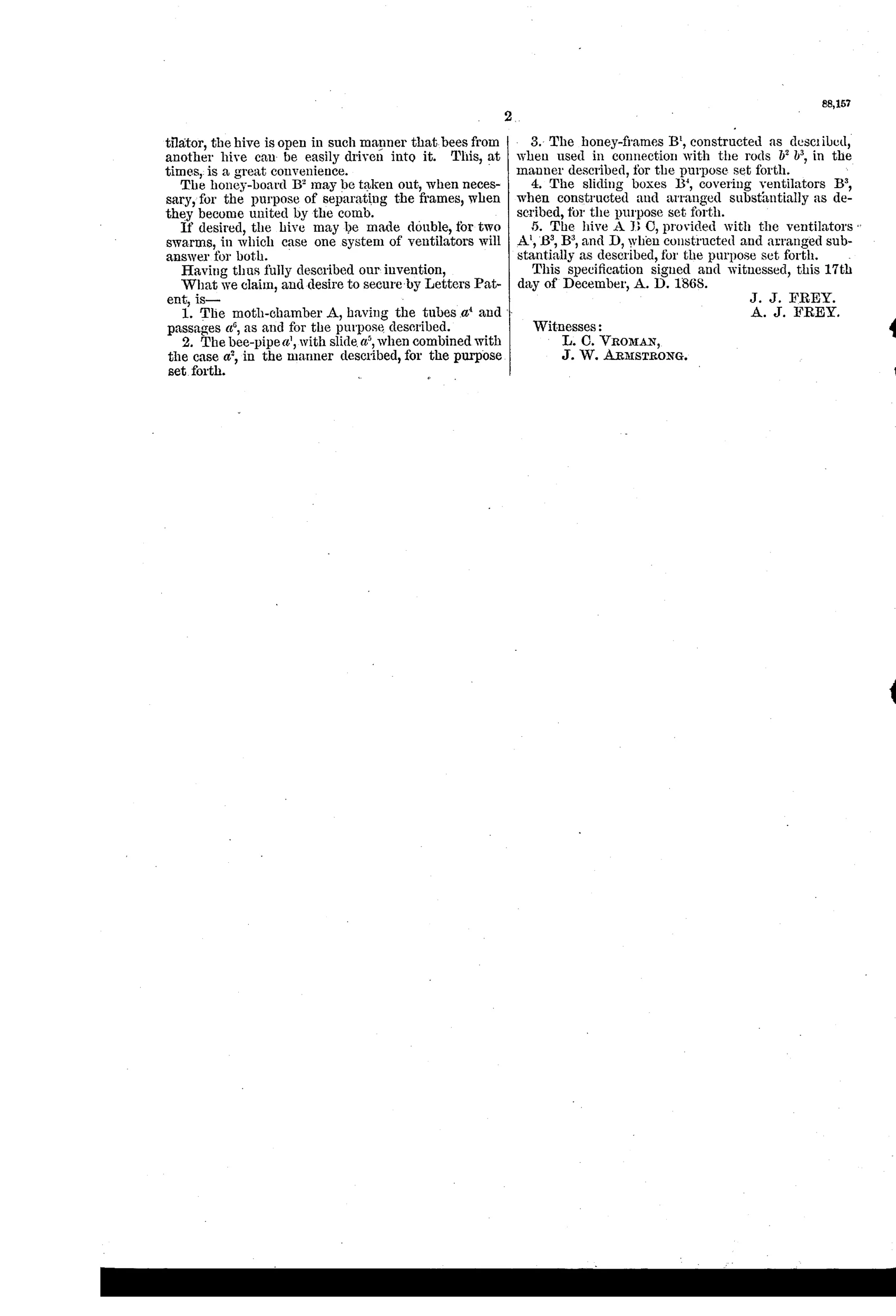
“1. The moth-chamber A, having the tubes a4 and passages a6, as and for the purpose described. 2. The bee-pipe a1, with slide a5, when combined with the case a2, in the manner described, for the purpose set forth. 3. The honey-frames B1, constructed as described, when used in connection with the rods b2 b3, in the manner described, for the purpose set forth. 4. The sliding boxes B4, covering ventilators B3, when constructed and arranged substantially as described, for the purpose set forth. 5. The hive A B C, provided with the ventilators A1, B3, B3, and D, when constructed and arranged substantially as described, for the purpose set forth.”
In plain English: The inventors claim the moth-trapping chamber with its tubes and passages, the closable bee-entrance pipe, the notched sliding honey-frames on rods, the sliding ventilator-cover boxes, and the overall hive assembly with its several ventilators, all built and used as described.
⬡ In the inventor’s words
“It is almost perfectly moth-proof, the arrangements for enticing the moth into the moth-chamber, and into the side boxes B4, being in perfect accordance with their habits, and such as must necessarily be successful.”— J. J. Frey and A. J. Frey, from the specification
Fate unknown
No manufacturing record or surviving example is documented; a marked hive or a local Iowa sales notice would settle it.
⬡ Commentary
The Frey brothers of Hook's Point built their whole hive around the wax moth, the great bogeyman of 19th-century beekeeping. The stand is a dedicated moth-chamber with tapering passages and tubes meant to lure moths in and keep them away from the brood; the side ventilators get sliding cover boxes with slatted, tapering channels — air passes, moths supposedly don't. Their claim that the design is 'in perfect accordance with their habits, and such as must necessarily be successful' is the era's confidence in miniature. In practice, no passive labyrinth ever sorted moths from air. A strong colony polices moths itself; a weak one is doomed regardless of the carpentry.
What saves this from pure folly is the interior. The honey-frames slide on rods and are notched to hold position — a genuine movable-frame arrangement, seventeen years after Langstroth, showing the frame idea had reached rural Iowa even if the bee-space discipline behind it hadn't fully sunk in. Look at Fig. 2 and you'll see a proper honey-board over the frames and a separate honey-cap above, the same brood-below, surplus-above logic modern hives still use.
So it's a hybrid: a sound skeleton wearing an armor of moth gadgetry. Every one of those slides, pipes, and tubes is a joint to warp, propolize, or leak — the exact complexity the industry shed on its way to the plain Langstroth box.
Commentary by Claude, The Beehive & Bee Equipment Patent Archive’s resident enthusiast