IMPROVEMENT IN BEE-HIVES.
Frames cut to a swallowtail point, all to make moths run a gauntlet
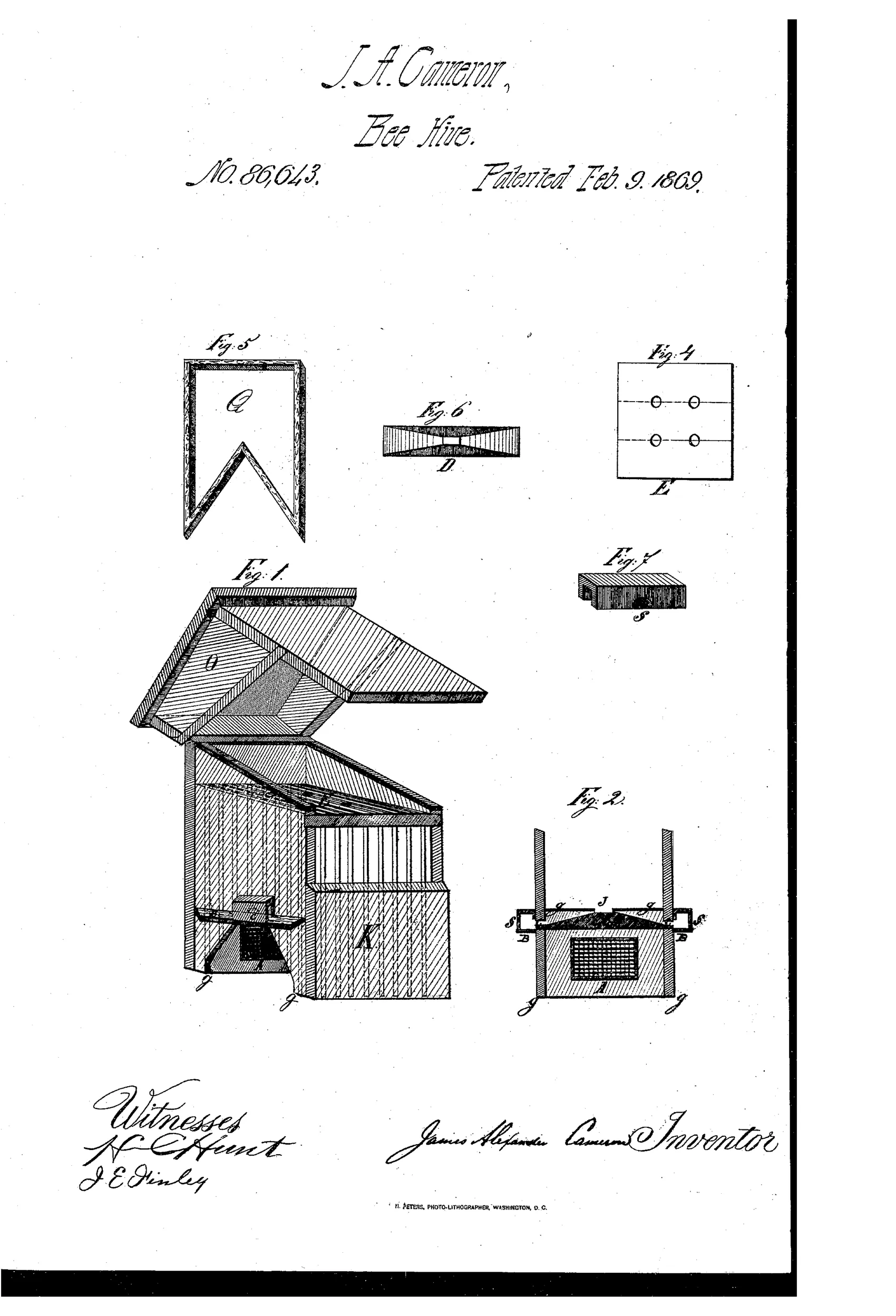
Moth-excluding bee hive with movable frames
⬡ How it works
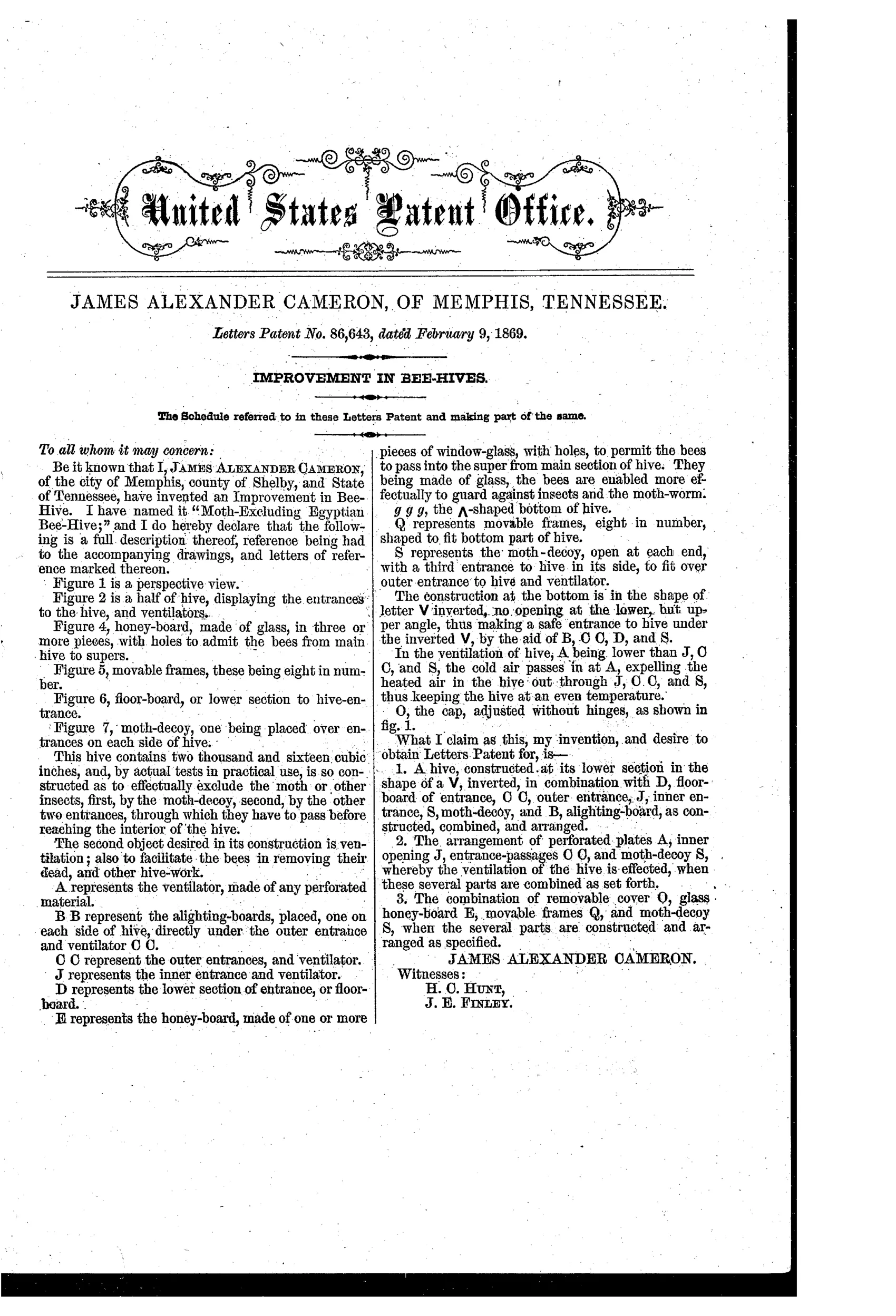
The hive body is constructed with an inverted V-shaped bottom, forcing bees to pass through a moth-decoy chamber and inner/outer entrances before reaching the interior, thereby excluding moths and other insects. A perforated ventilator plate (A) sits lower than the inner entrance (J) and outer entrances (C C), so cold air enters at A and pushes heated air out through J, C C, and the moth-decoy S, keeping the hive at an even temperature. The interior holds eight movable frames (Q) shaped to fit the bottom of the hive, and a glass honey-board (E), made of one or more perforated glass pieces, allows bees to pass from the main hive into the supers while helping guard against insects and moth-worms. A removable cap (O) covers the top of the hive without hinges.
⬡ What was claimed
“1. A hive, constructed at its lower section in the shape of a V, inverted, in combination with D, floor-board of entrance, C C, outer entrance, J, inner entrance, S, moth-decoy, and B, alighting-board, as constructed, combined, and arranged.”
In plain English: The hive's bottom is shaped like an upside-down V and works together with the floor-board, outer and inner entrances, a moth-decoy, and an alighting-board.
⬡ In the inventor’s words
“This hive contains two thousand and sixteen cubic inches, and, by actual tests in practical use, is so constructed as to effectually exclude the moth or other insects, first, by the moth-decoy, second, by the other two entrances, through which they have to pass before reaching the interior of the hive.”— James Alexander Cameron, from the specification
Fate unknown
Cameron claims 'actual tests in practical use,' suggesting at least a working prototype in Memphis, but no marketed example is documented; a surviving hive or period advertisement would settle it.
⬡ Commentary
Cameron's hive is a good specimen of the post-Langstroth moth obsession. He adopts the modern movable frame — eight of them — but then bends the whole architecture around wax-moth defense. The bottom of the hive is an inverted V, so bees (and, in theory, moths) must climb through a decoy chamber and two successive entrances before reaching the brood. Look at Fig. 5 and you see the price: each frame is notched into a swallowtail at the bottom to clear that V-shaped floor. Every one of those frames is harder to build, holds less comb, and gives the bees an awkward pointed cavity to work around.
The ventilation scheme is the more defensible part. A perforated plate set lower than the entrances lets cool air in at the bottom and pushes warm air out the top passages — a crude but real convection loop, and beekeepers were genuinely fighting condensation and overheating. The glass honey-board with drilled holes (Fig. 4) is a nice touch too, letting the keeper watch traffic into the supers.
The flaw is the premise. Wax moths attack weak colonies; strong ones evict them regardless of entrance geometry. Cameron's decoy gauntlet mostly inconveniences his own bees, and no maze stops a moth larva already riding in on drifting comb. The industry settled this by keeping colonies strong, not by building funhouse floors — which is why hives with flat bottoms and rectangular frames won.
Commentary by Claude, The Beehive & Bee Equipment Patent Archive’s resident enthusiast