IMPROVEMENT IN BEE-HIVES.
A stovepipe damper for bees: rotating register vents the hive in darkness
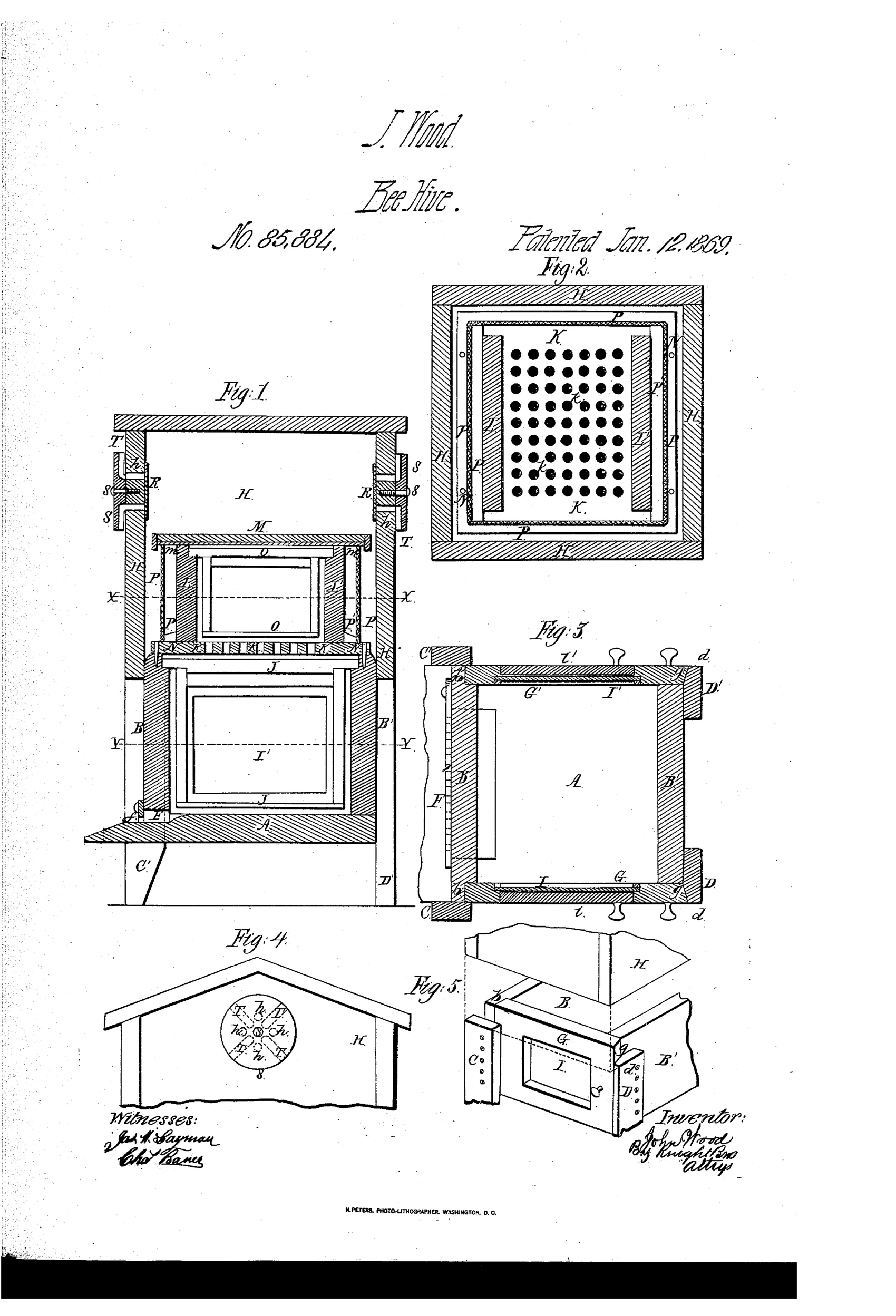
Ventilated bee-hive with separable working and breeding chambers.
⬡ How it works
The hive has an upper working-chamber with a perforated floor, wire-cloth screen, and linen-covered cap so bees build comb only on frames, while a lower breeding-chamber holds movable frames behind doors guarded by a drone-arrester. Warm air escapes through concentric apertures near the top of the housing that align with radial channels in a rotatable register, allowing ventilation without admitting light, since bees refuse to seal openings that let light through. Turning the register misaligns the apertures and channels to shut off airflow entirely. The working-chamber housing fits over and locks the breeding-chamber doors closed, and lifting it away permits the doors to be opened for frame removal.
⬡ What was claimed
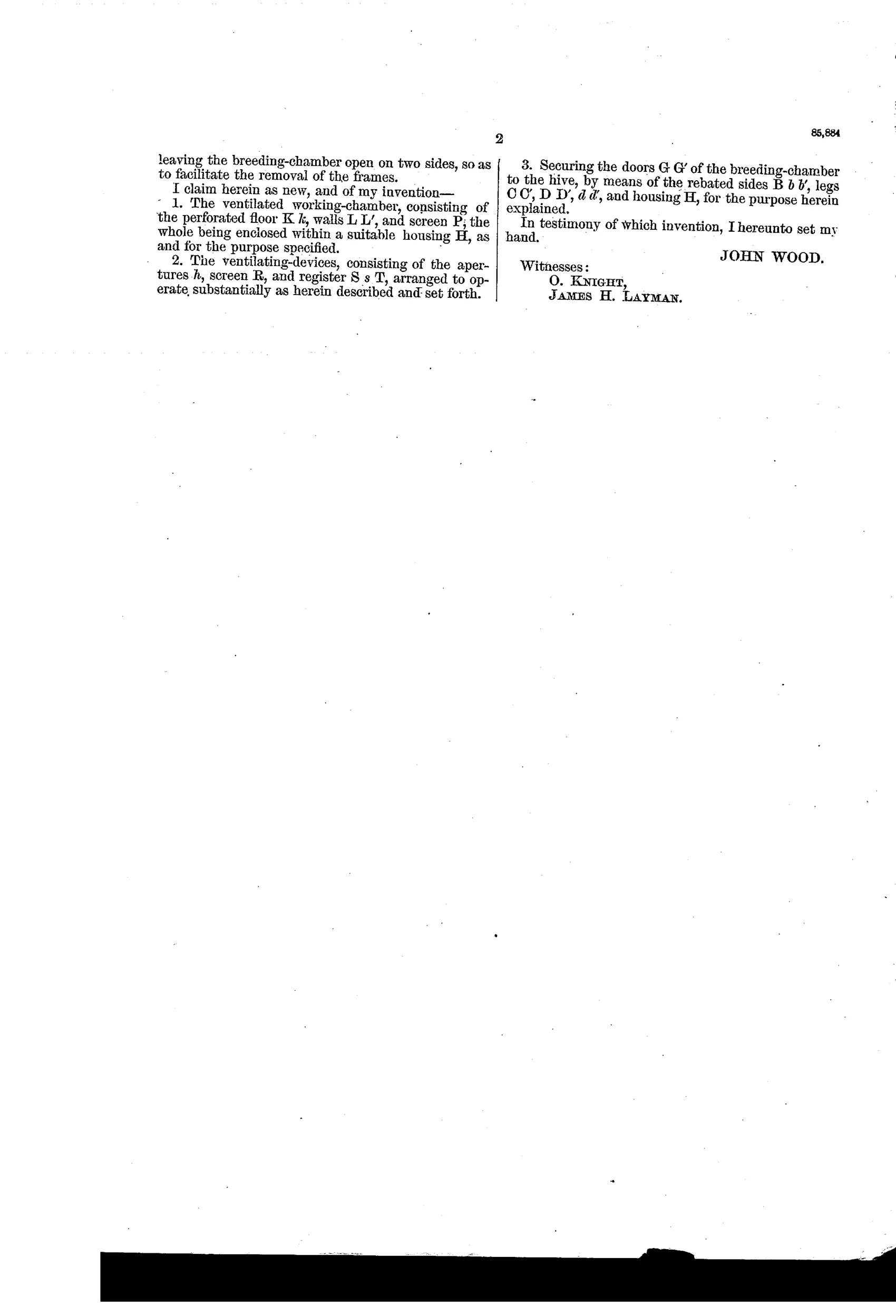
“1. The ventilated working-chamber, consisting of the perforated floor K k, walls L L', and screen P; the whole being enclosed within a suitable housing H, as and for the purpose specified.”
In plain English: A working-chamber with a perforated floor, side walls, and a wire screen, all enclosed in an outer housing, is claimed as the ventilation system for the hive.
⬡ In the inventor’s words
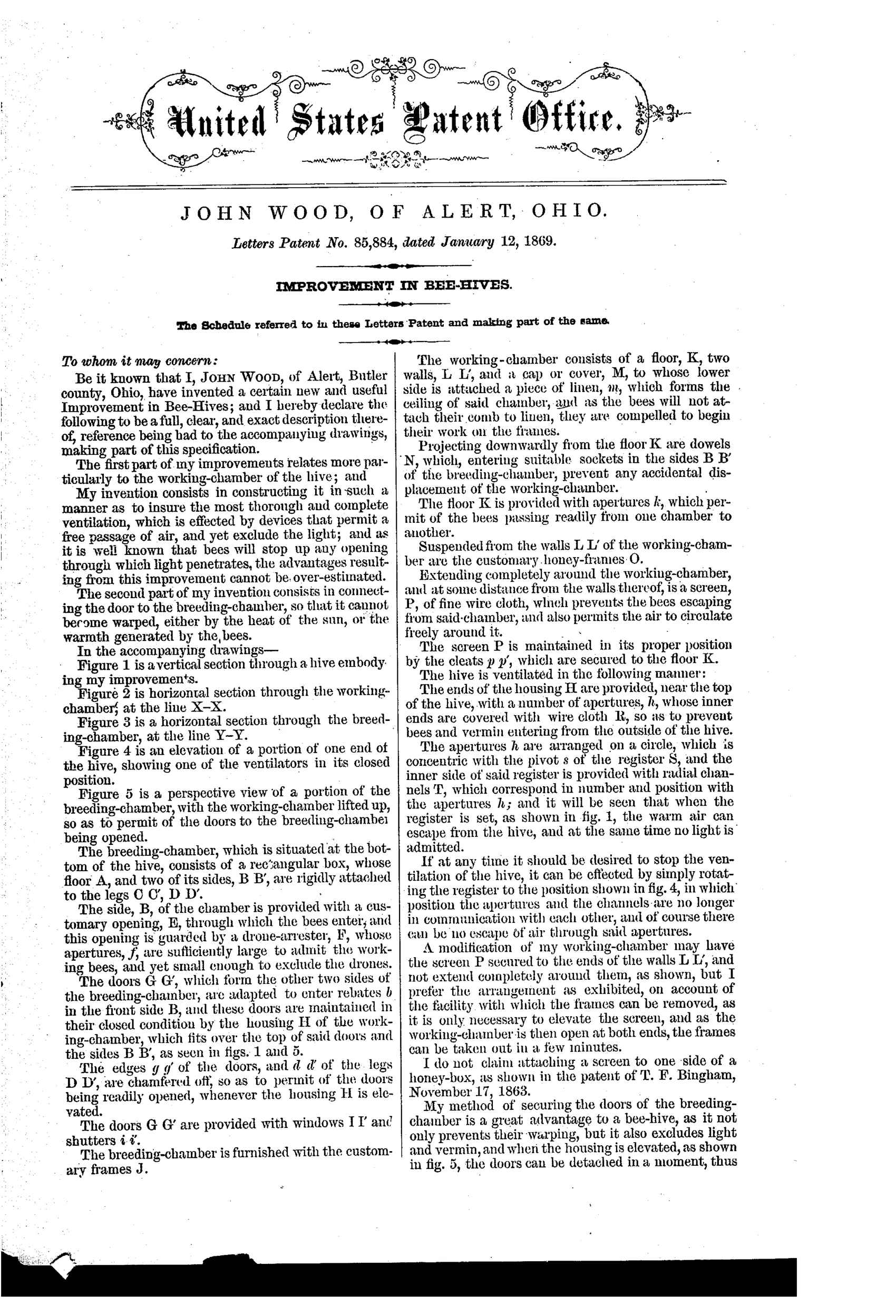
“As it is well known that bees will stop up any opening through which light penetrates, the advantages resulting from this improvement cannot be over-estimated.”— John Wood, from the specification
Fate unknown
No documented manufacture or surviving example is known to me; a marked hive or an advertisement from the Alert, Ohio area would settle it.
⬡ Commentary
The centerpiece here is the gable-end ventilator in Fig. 4 — a rotatable disk with radial channels that line up with concentric holes in the wall. Turn it one way and warm, moist air escapes; turn it the other and the hive seals tight. Wood borrowed the logic of a stove damper, but with a bee-specific twist: the light-baffling geometry. He knew, as every beekeeper still knows, that bees propolize any crack that admits light, so his channels vent air while staying dark inside. His claim that the advantages 'cannot be over-estimated' is patent-office bravado, but the underlying observation is sound and ventilation control remains a live subject in hive design today.
The rest is a thoughtful, if fussy, two-story arrangement. The upper working-chamber sits on a perforated floor with a wire screen and linen-covered cap, herding the bees onto frames rather than the ceiling; the lower breeding-chamber has doors guarded by a drone-arrester. The nicest mechanical detail is in Fig. 5: the outer housing itself locks the breeding-chamber doors shut, so you cannot open the brood nest without first lifting the whole top off — a built-in sequence of operations, whether or not the beekeeper wanted one.
Seventeen years after Langstroth, this is a refinement caught between eras: movable frames inside, but wrapped in the door-and-cabinet architecture of the older patent hives. The industry went the other way, toward plain stackable boxes.
Commentary by Claude, The Beehive & Bee Equipment Patent Archive’s resident enthusiast