IMPROVEMENT IN BEE-HIVES.
Four hives in one cabinet, connected by slides to share bees and dodge swarming
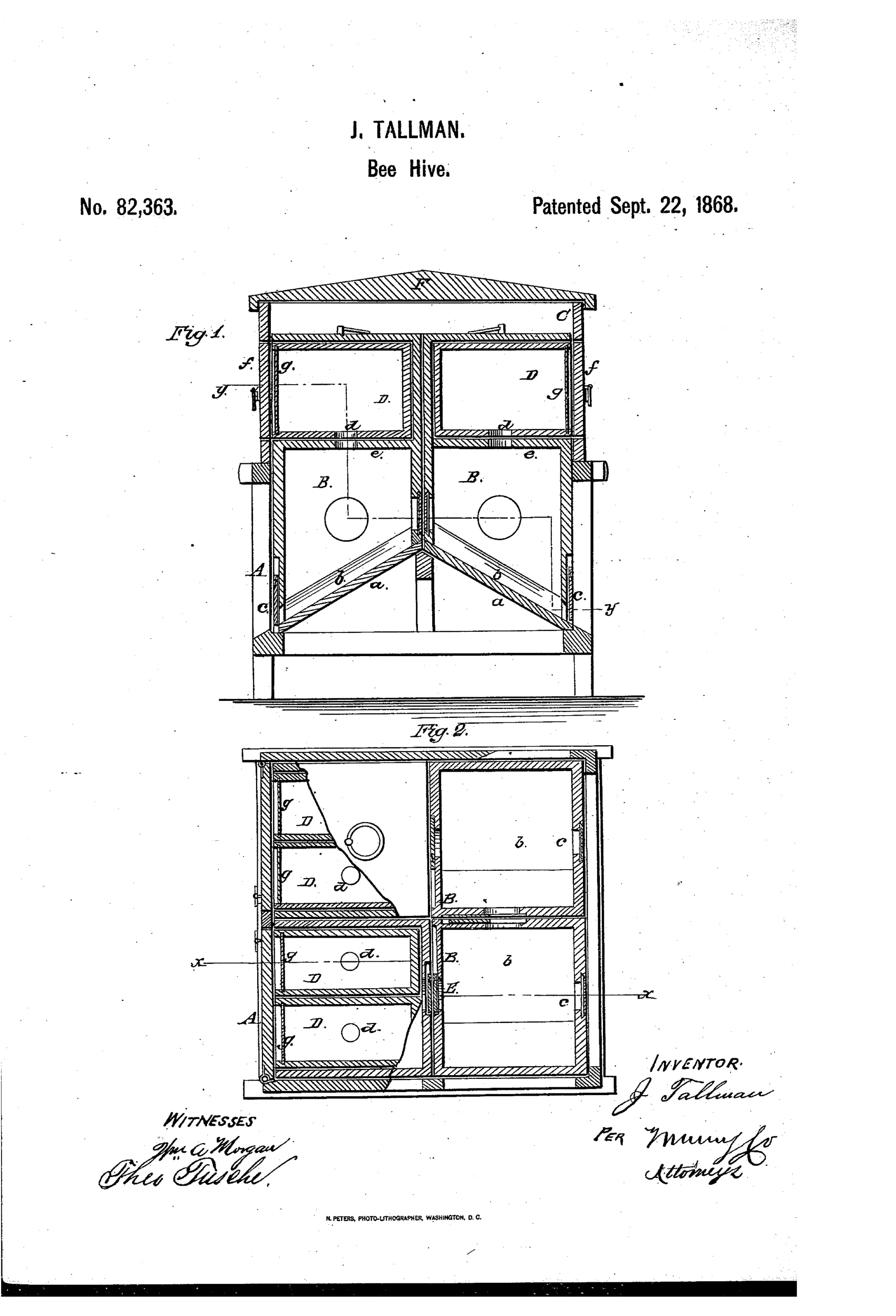
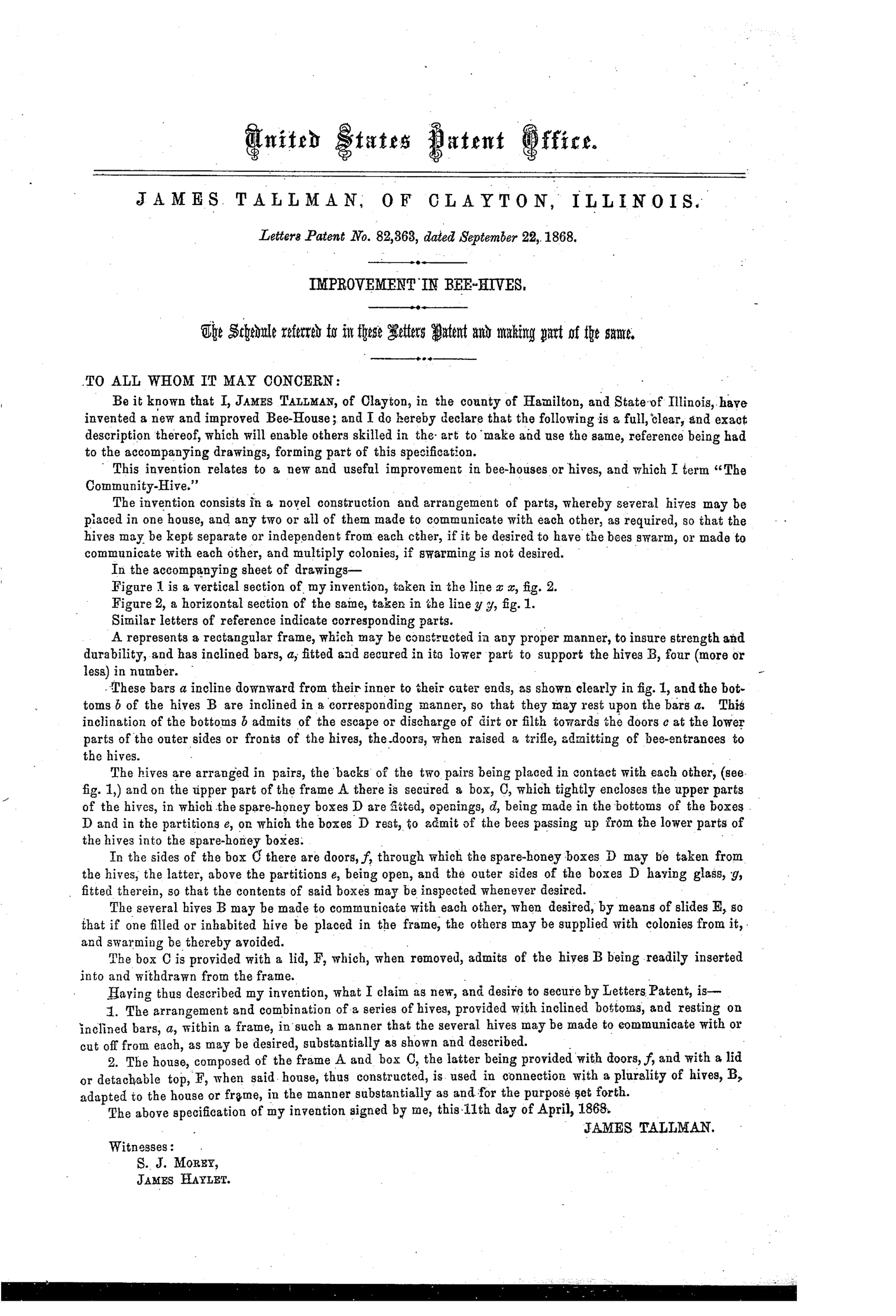
A multi-hive community bee house
⬡ How it works
A rectangular frame holds inclined bars that support four hives with correspondingly inclined bottoms, letting dirt drain out toward doors at the front entrances. The hives are paired back-to-back within the frame, and a box on top encloses spare-honey boxes above partitions with openings for bees to pass upward. Slides between hives allow them to be connected or closed off, letting a strong hive supply colonies to others and thereby avoid swarming. A removable lid on the top box allows the hives to be inserted or withdrawn from the frame.
⬡ What was claimed
“The arrangement and combination of a series of hives, provided with inclined bottoms, and resting on inclined bars, a, within a frame, in such a manner that the several hives may be made to communicate with or cut off from each, as may be desired, substantially as shown and described.”
In plain English: A group of hives with slanted bottoms resting on slanted support bars inside a frame, which can be connected to or separated from each other as needed.
⬡ In the inventor’s words
“This invention relates to a new and useful improvement in bee-houses or hives, and which I term "The Community-Hive."”— James Tallman, from the specification
Paper patent — likely never produced
The multi-colony connecting-slide scheme runs against bee behavior and the trade's direction in 1868; no manufactured example or advertising for Tallman's design is known.
⬡ Patented the same day
- IMPROVEMENT IN BEE-HIVES — George Eason
⬡ Commentary
Tallman's "Community-Hive" is a bee tenement: four hives paired back-to-back inside a single frame, with sliding gates between them so the beekeeper can throw compartments open to each other or wall them off. The theory is that a strong colony's surplus bees will drift into a weak neighbor's quarters instead of swarming — swarm prevention by plumbing rather than management. It's an appealing idea on paper, and it almost never works in practice: bees are fiercely territorial about their own colony's boundaries, and connecting two queenright colonies through a slide is a recipe for fighting, not sharing.
The part that actually holds up is humbler. Look at those diagonal bars in Fig. 1: each hive has an inclined bottom resting on inclined rails, so debris slides down and out the front entrance by gravity. That's genuine hygienic thinking, decades before screened bottom boards, and the whole-hive removability through the lidded top box shows Tallman thought about maintenance, not just architecture.
By 1868 Langstroth's movable frame was sixteen years old, and this patent claims a cabinet arrangement rather than any frame system — Fig. 2's cross-section shows chambers, not frames. It sits squarely in the bee-house tradition that the frame hive was already making obsolete. A dead end, but one with a good floor.
Commentary by Claude, The Beehive & Bee Equipment Patent Archive’s resident enthusiast