IMPROVEMENT IN BEE-HIVES
A ventilation scheme thought through season by season, plus a purpose-built box lifter
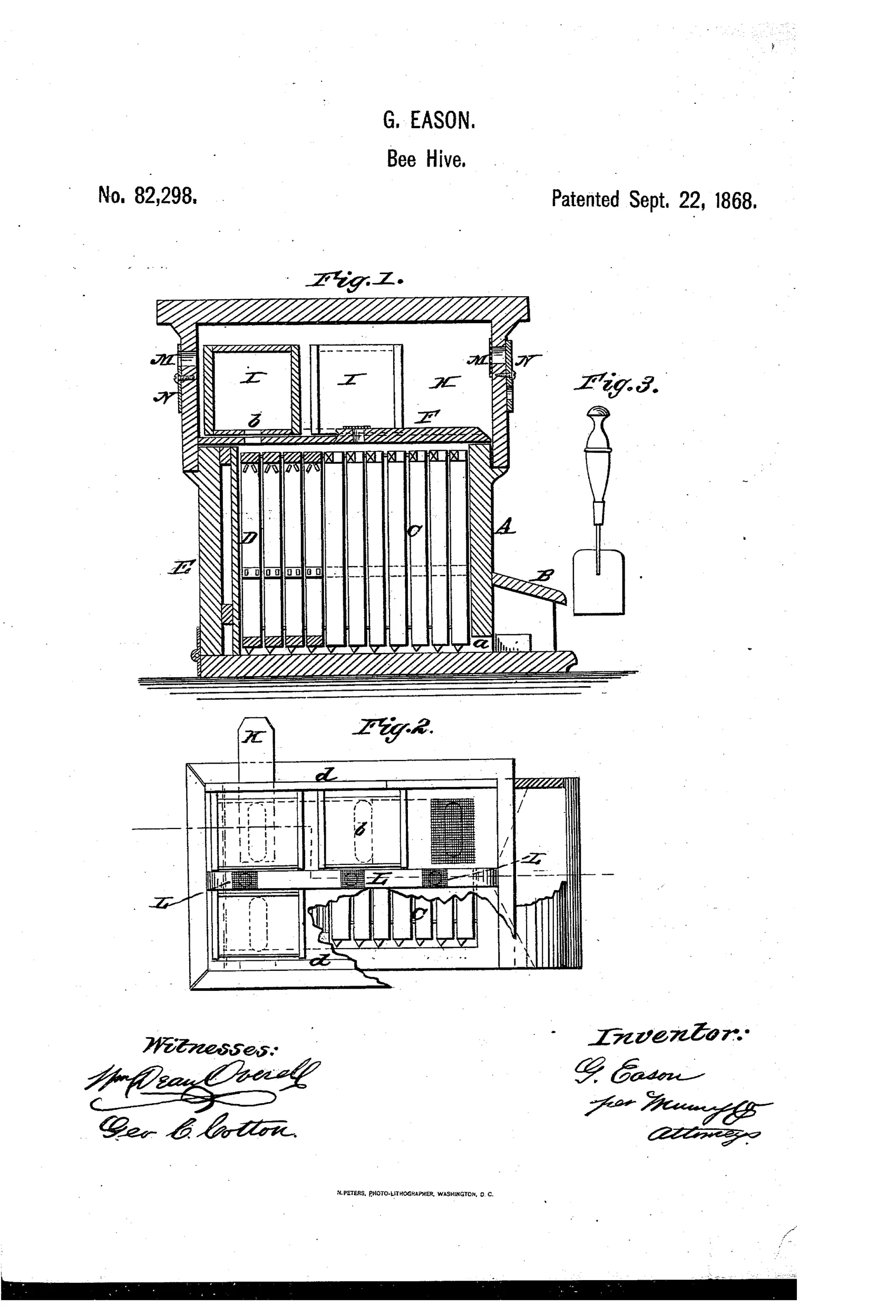
Improved wooden bee-hive with removable honey boxes
⬡ How it works
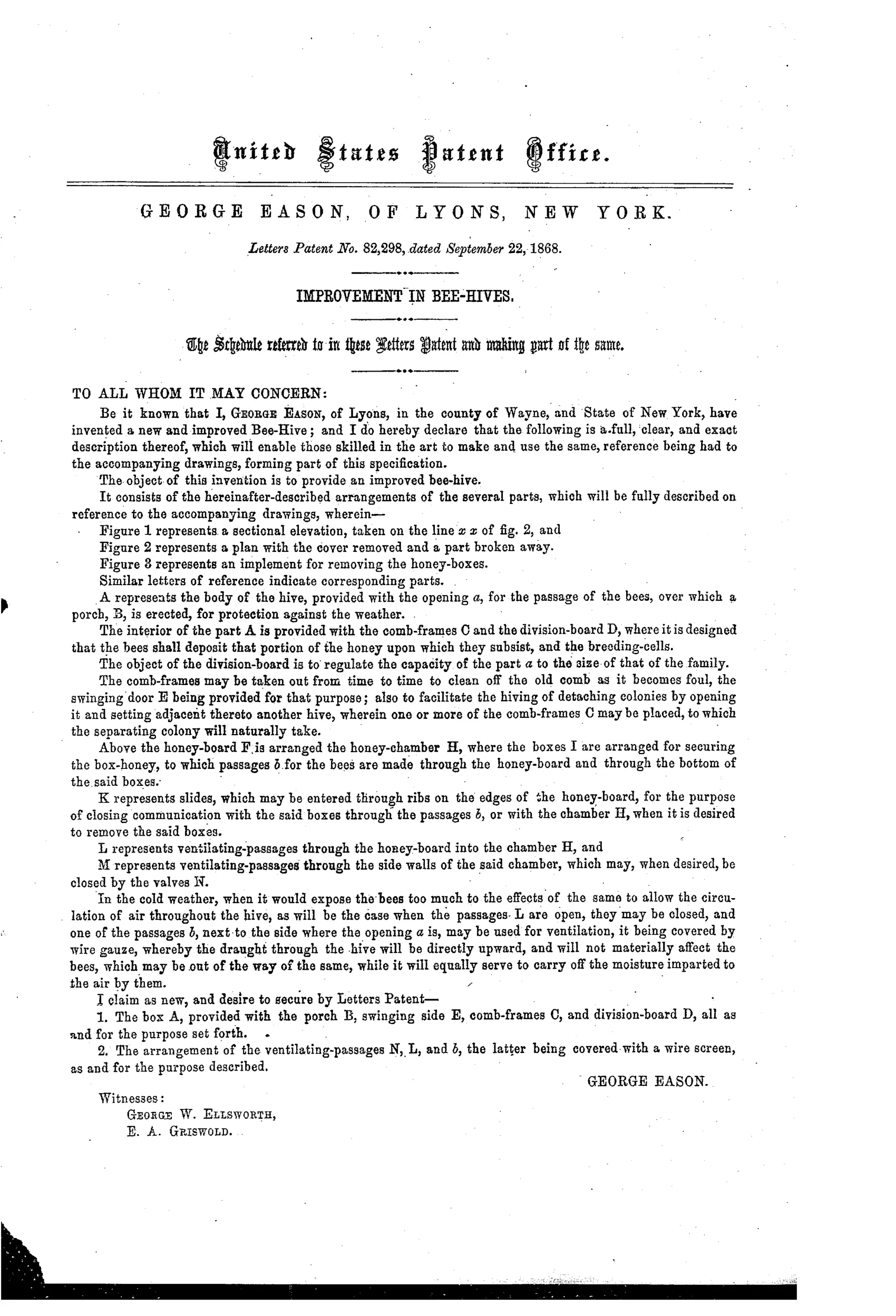
The hive body A holds comb-frames C and a division-board D that limits brood-chamber size to the family's needs, with a swinging door E for removing old comb or splitting colonies. Above the honey-board F sits a honey-chamber H containing removable boxes I, each connected by passages b that can be closed with slides K to seal off boxes for removal. Ventilation is provided by side passages M (closable with valves N) and honey-board passages L, allowing airflow to be adjusted or, in cold weather, redirected through a wire-gauze-covered passage b near the entrance a. A porch B shelters the entrance, and a special implement (fig. 3) is used to lift out the filled honey boxes.
⬡ What was claimed
“1. The box A, provided with the porch B, swinging side E, comb-frames C, and division-board D, all as and for the purpose set forth. 2. The arrangement of the ventilating-passages N, L, and b, the latter being covered with a wire screen, as and for the purpose described.”
In plain English: The claim covers the hive box with its porch, swinging access door, removable comb-frames, and adjustable division-board, plus a ventilation system using side vents, board vents, and a wire-screened passage.
⬡ In the inventor’s words
“In the cold weather, when it would expose the bees too much to the effects of the same to allow the circulation of air throughout the hive, as will be the case when the passages L are open, they may be closed, and one of the passages b, next to the side where the opening a is, may be used for ventilation, it being covered by wire gauze, whereby the draught through the hive will be directly upward, and will not materially affect the bees, which may be out of the way of the same, while it will equally serve to carry off the moisture imparted to the air by them.”— George Eason, from the specification
Fate unknown
No manufacturing record or surviving marked hive is documented; a period apiary catalog listing or a stamped specimen from the Lyons, NY area would settle it.
⬡ Patented the same day
- IMPROVEMENT IN BEE-HIVES. — James Tallman
⬡ Commentary
Sixteen years after Langstroth, the movable frame was no longer the novelty — Eason takes it as given. What he actually claims is the packaging around it: a porch over the entrance, a swinging side door for pulling old comb or splitting a colony, a division board to shrink the brood chamber to fit the family, and above all a ventilation system with three separate routes for air. That last part is the interesting bit. Most patent hives of the era treat ventilation as a hole somewhere; Eason works out a winter mode, closing the honey-board passages and routing air through a single wire-gauze-screened channel near the entrance so the draft runs straight up past the cluster instead of through it. That's a genuine observation about how bees sit out cold weather, and about condensation — he explicitly frames it as carrying off the moisture the bees exhale, which is exactly the killer in an unventilated winter hive.
Don't skip Fig. 3, the odd mushroom-headed tool off to the right. It's a dedicated implement for lifting filled honey boxes out of the chamber after the slides seal the bees below — an early nod to the fact that harvesting comb honey with bare hands and a full super is miserable work.
As a whole it's a refinement, not a turning point: one of hundreds of 1860s frame hives adding doors and valves to Langstroth's architecture. But the winter ventilation reasoning is sounder than most of its cohort.
Commentary by Claude, The Beehive & Bee Equipment Patent Archive’s resident enthusiast