IMPROVEMENT IN BEE-HIVES.
A hive of hives: glass-sided boxes you can seal and swap between colonies
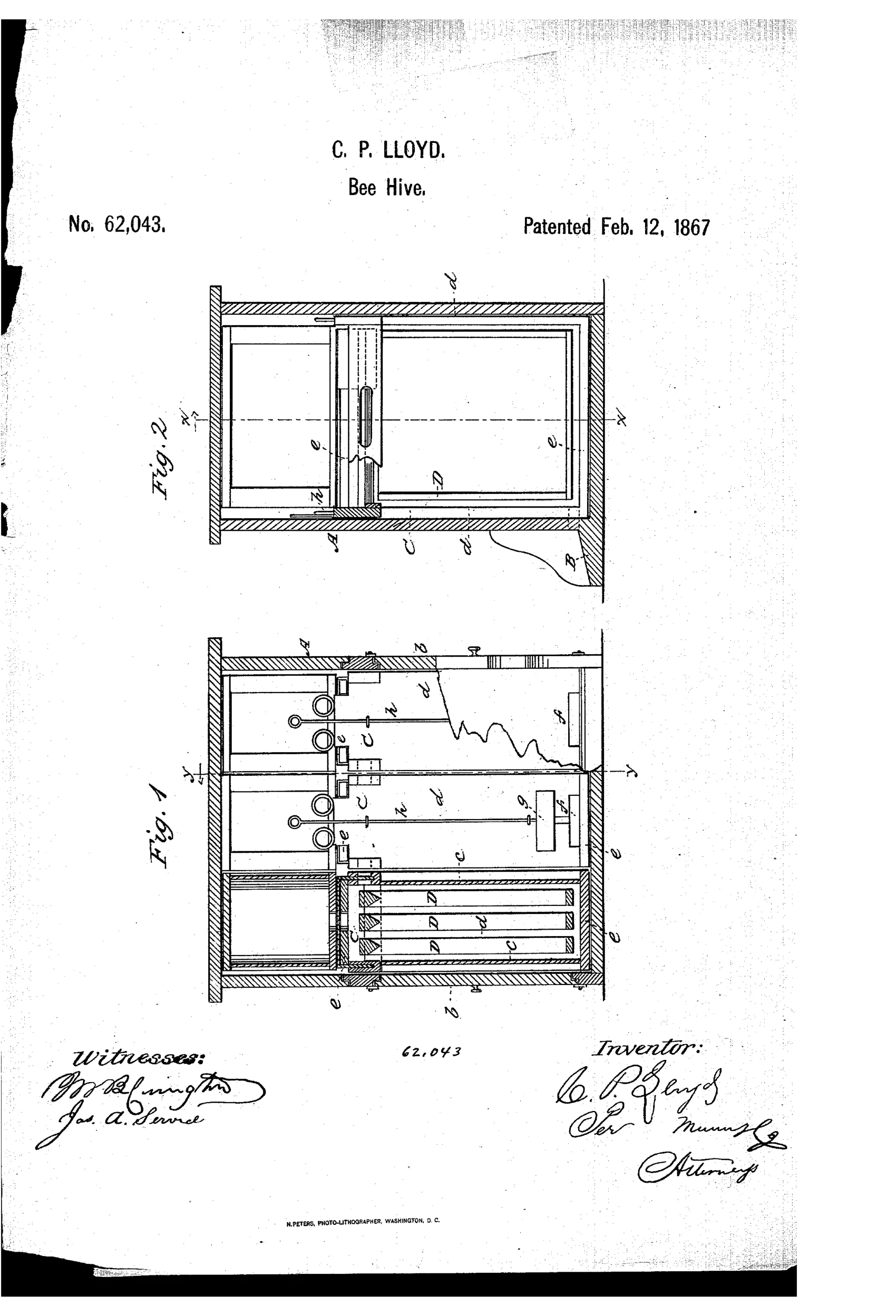
Sectional bee-hive with removable glass-sided boxes
⬡ How it works
The hive body holds several removable boxes each fitted with glass sides so the bees can be observed. Each box has an opening in its lower front end that can be closed by a slide operated via a rod extending to the top. Inside each box hangs a set of movable comb-frames suspended from a detachable top, allowing the frames to be lifted out. By closing the slides, an entire box can be removed from the case without releasing or harming the bees, and boxes can be swapped between hives to multiply colonies and prevent swarming.
⬡ What was claimed
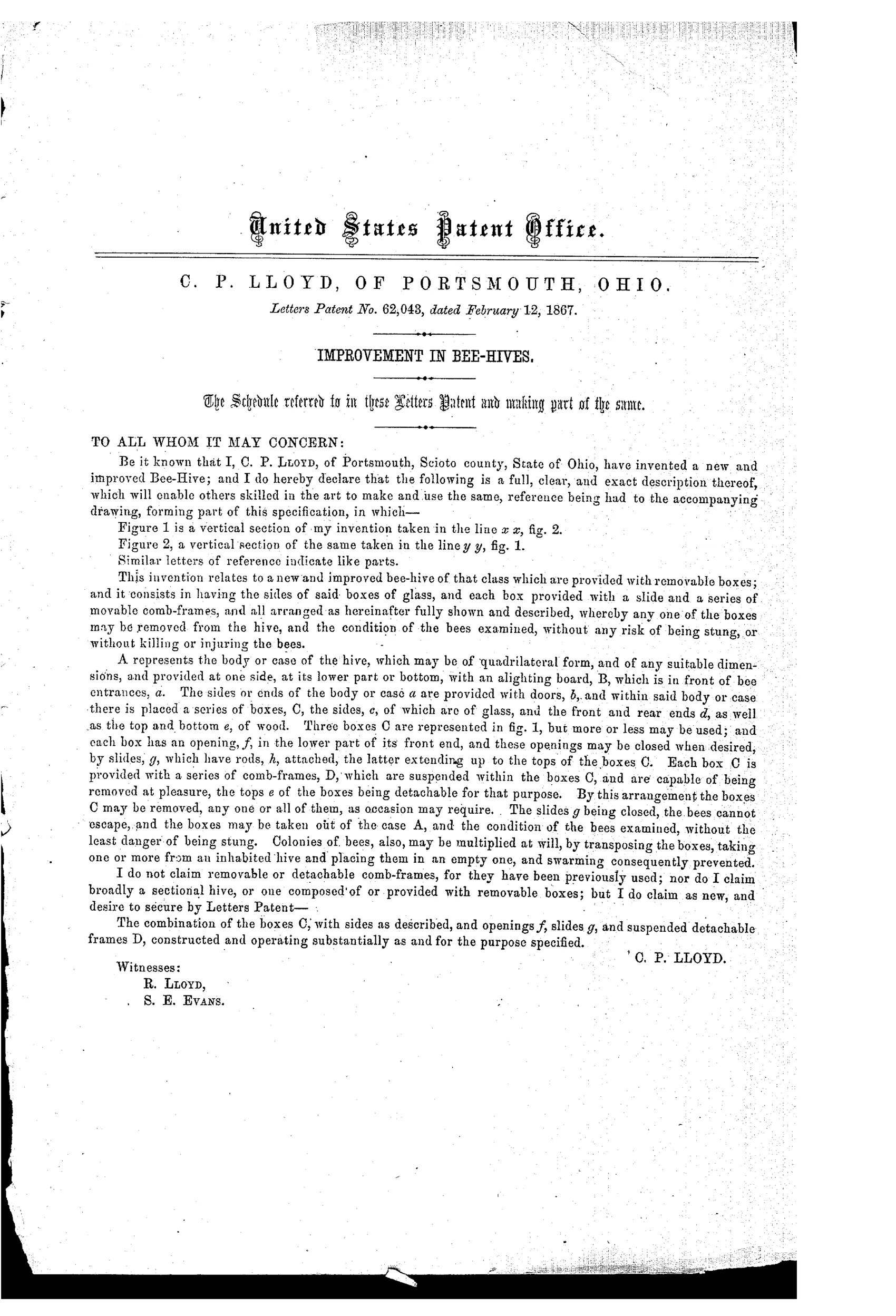
“The combination of the boxes C, with sides as described, and openings f, slides g, and suspended detachable frames D, constructed and operating substantially as and for the purpose specified.”
In plain English: The patent claims the specific combination of glass-sided removable boxes with front openings, closing slides, and hanging detachable comb-frames, all working together as described.
⬡ In the inventor’s words
“Colonies of bees, also, may be multiplied at will, by transposing the boxes, taking one or more from an inhabited hive and placing them in an empty one, and swarming consequently prevented.”— C. P. Lloyd, from the specification
Paper patent — likely never produced
The sealed multi-box arrangement runs against colony behavior and I know of no manufactured example, though absence of a marked specimen isn't absolute proof.
⬡ Commentary
Lloyd's idea, fifteen years after Langstroth, is to treat the hive not as one chamber but as a case full of smaller sealed units. Each interior box has glass sides, a single front opening, and a slide that closes it — operated by a rod reaching up through the top, so you can shut the bees in without opening anything. Close the slide, lift the box out, carry it to an empty case. His pitch is artificial swarm control: 'Colonies of bees may be multiplied at will, by transposing the boxes.'
The drawing rewards a close look. Fig. 1 shows the rods with ring-pulls at the top running down to each slide — the whole apparatus is designed so the keeper never confronts loose bees. Inside each box, Fig. 2 shows frames hung from a detachable top, so the box itself opens like a miniature movable-frame hive. It's Langstroth's principle nested one level down.
The trouble is what any working beekeeper will spot: a colony doesn't respect box boundaries. Bees build brood nest and stores as one organism across whatever cavity they occupy; partitioning them into sealed sub-boxes with single small entrances invites propolized slides, divided clusters, and chilled brood. The glass sides add cost and condensation. As observation-hive novelty it's charming; as production equipment it fights the bees. This is the era's characteristic mistake — clever carpentry solving problems bees don't have — executed with more mechanical care than most.
Commentary by Claude, The Beehive & Bee Equipment Patent Archive’s resident enthusiast