IMPROVED APPARATUS FOR EXTRACTING HONEY FROM THE COMB
Langstroth himself, fifteen years after the hive, tackles getting honey back out
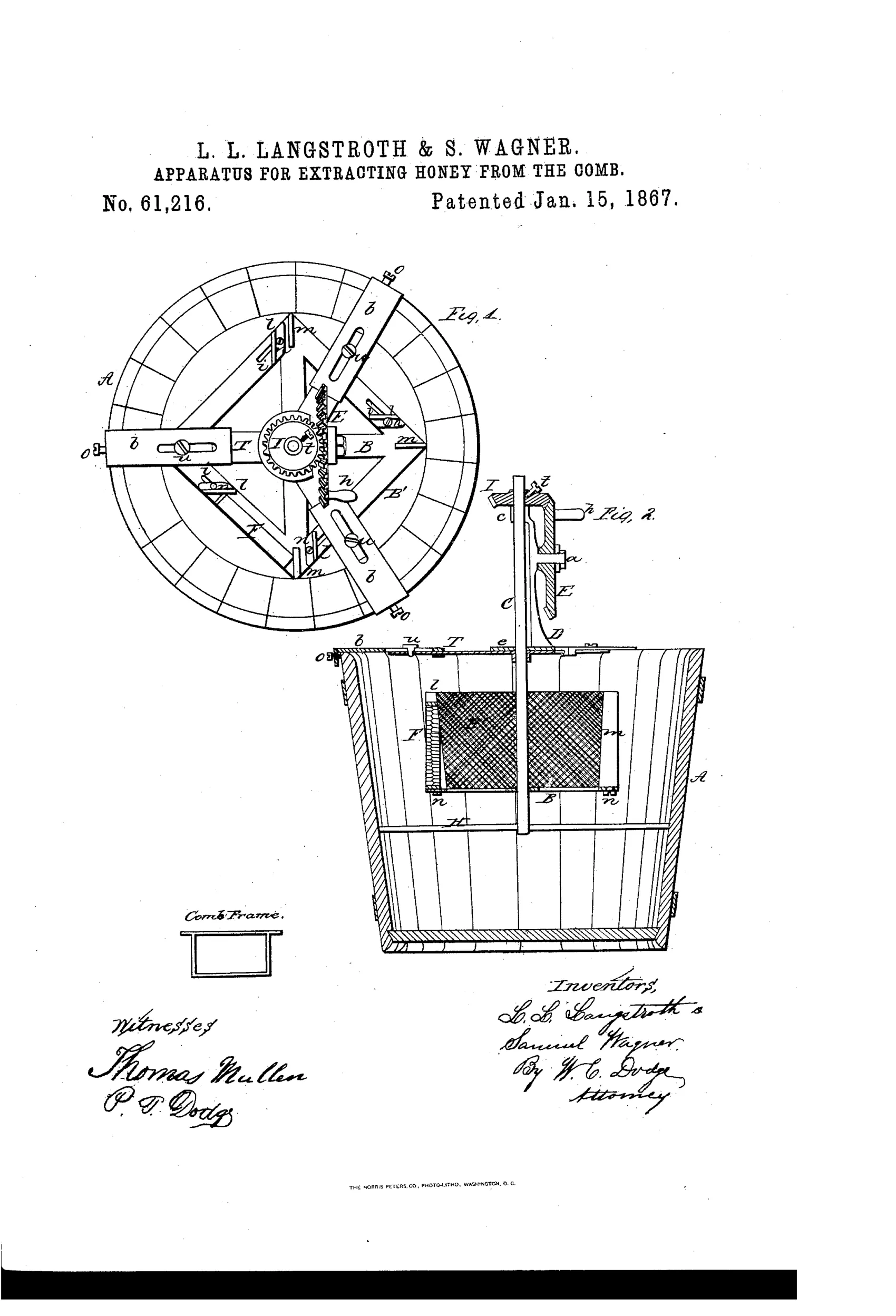
Centrifugal machine for extracting honey from comb
⬡ How it works
A skeleton frame T with adjustable radial arms b clamps to the top of a tub or barrel A, supporting an upright D with gearing. A bevel-wheel E driven by a crank turns a smaller bevel-wheel I on a vertical spindle C, which spins an inner frame B holding the comb frames against wire gauze screens B'. Rapid rotation throws honey out of the uncapped comb cells by centrifugal force, leaving the comb intact for return to the hive.
⬡ What was claimed
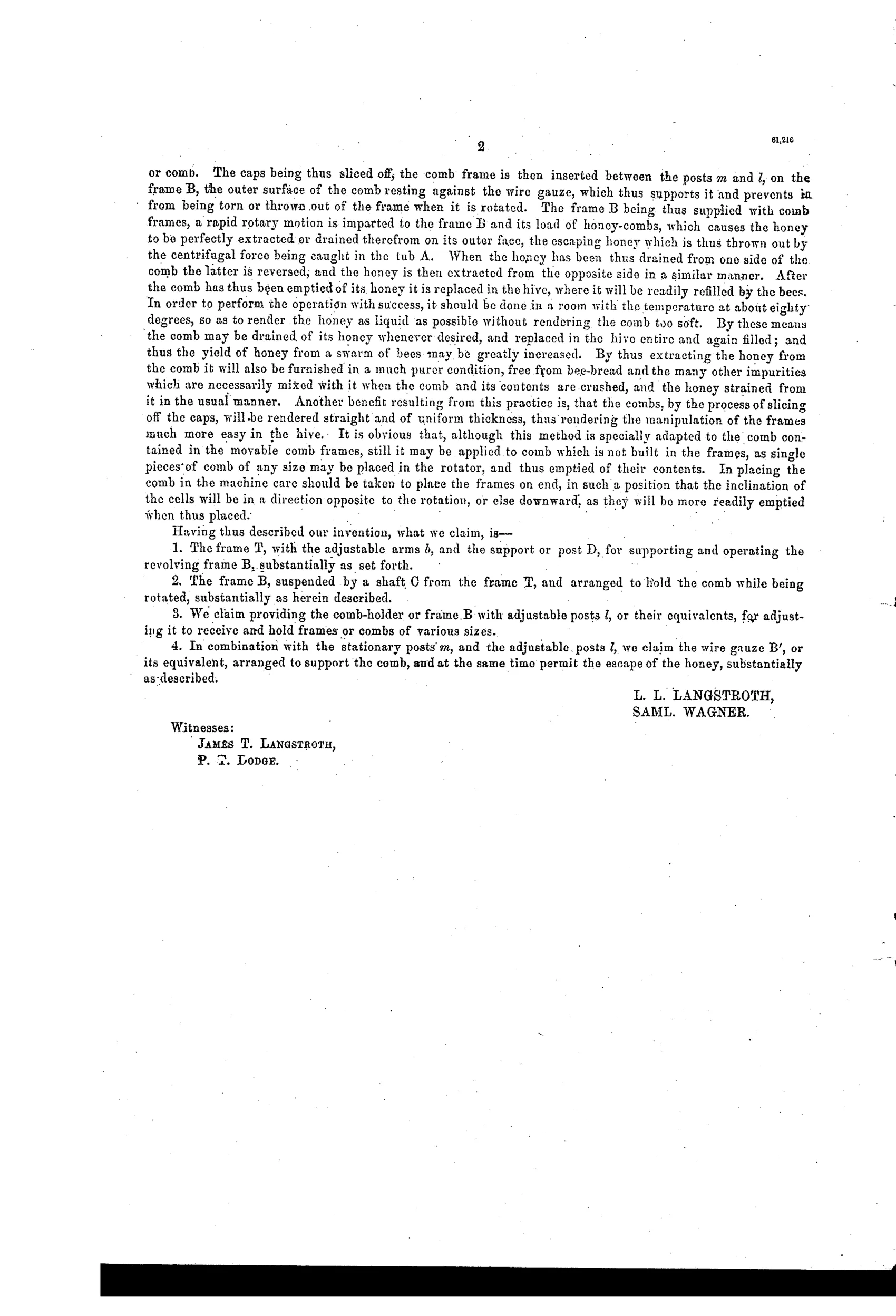
“1. The frame T, with the adjustable arms b, and the support or post D, for supporting and operating the revolving frame B, substantially as set forth.”
In plain English: A top frame with adjustable arms and an upright post that supports and drives the spinning inner comb-holder frame.
⬡ In the inventor’s words
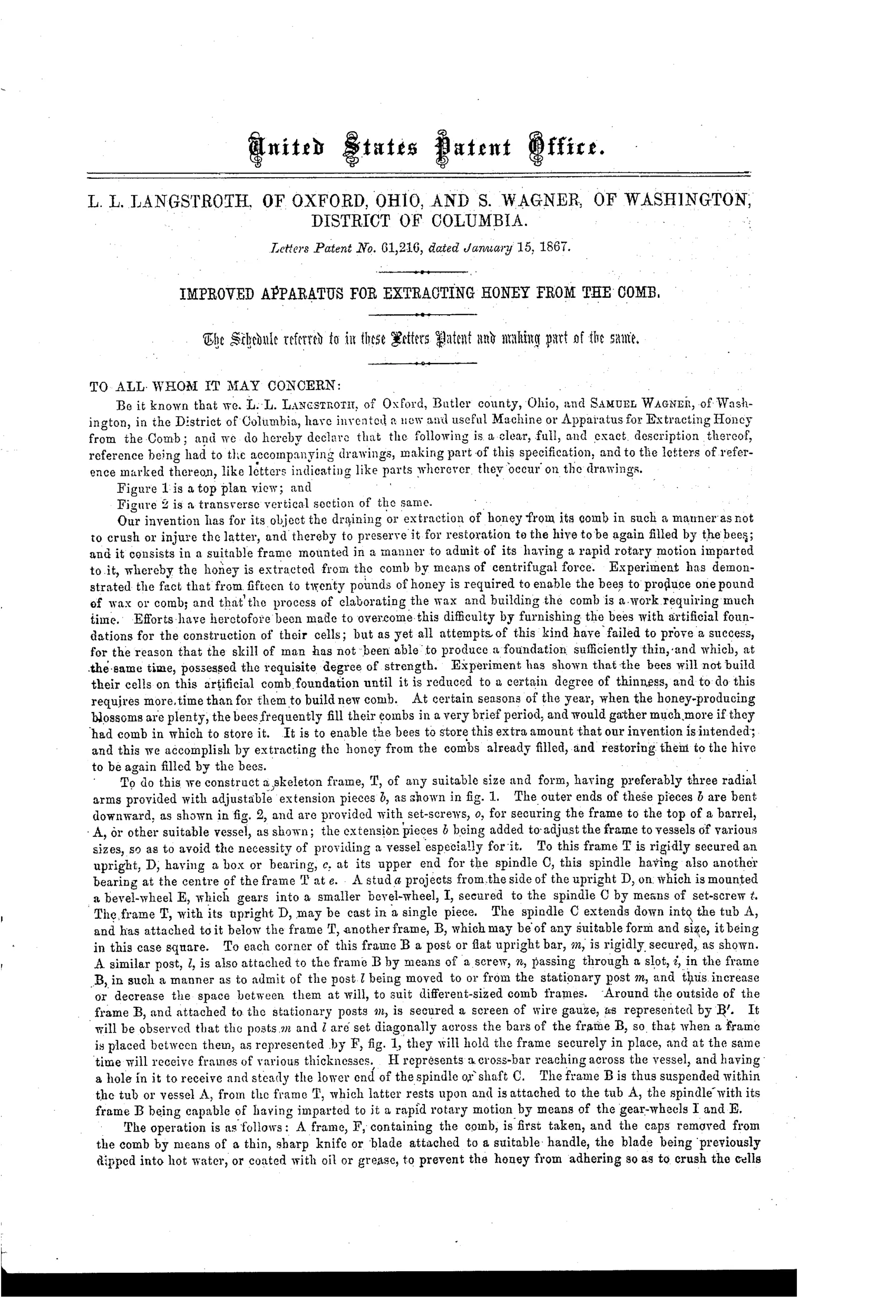
“Our invention has for its object the draining or extraction of honey from its comb in such a manner as not to crush or injure the latter, and thereby to preserve it for restoration to the hive to be again filled by the bees.”— L. L. Langstroth and S. Wagner, from the specification
Fate unknown
The extractor concept unquestionably succeeded, but commercial machines of the 1870s (Peabody, Root's Novice) used different designs; no marked example of this clamp-on apparatus is documented.
⬡ Commentary
This one carries the most famous name in the whole category. Fifteen years after Langstroth patented the movable-frame hive, he and Samuel Wagner (his collaborator and founding editor of the American Bee Journal) filed on the machine that made frames pay off: a centrifugal extractor. Franz von Hruschka had demonstrated the principle in Europe around 1865, and word crossed the Atlantic fast. This is one of the earliest American attempts to turn that idea into working hardware.
The clever part is the top frame T with its adjustable radial arms. Rather than build a dedicated tank, the whole works clamps onto any tub or barrel a farmer already owned — the gearing, spindle, and spinning basket ride on that skeleton frame. The bevel-gear crank drive turns the vertical spindle, and the comb frames rest against wire-gauze screens so the soft comb doesn't blow out under centrifugal load. That gauze backing is the detail casual readers miss; without it, warm comb slumps and tears.
Note the little 'Comb Frame' inset at bottom left: the patent quietly assumes the world has adopted movable frames, which in 1867 was still a live campaign. The extractor and the frame hive are two halves of one system — comb goes back to the bees to be refilled, roughly doubling a colony's honey output. This is a foundational document, whether or not this exact geometry ever left the drawing board.
Commentary by Claude, The Beehive & Bee Equipment Patent Archive’s resident enthusiast