BEEHIVE
A hive on wheels that jacks itself up to swallow another story
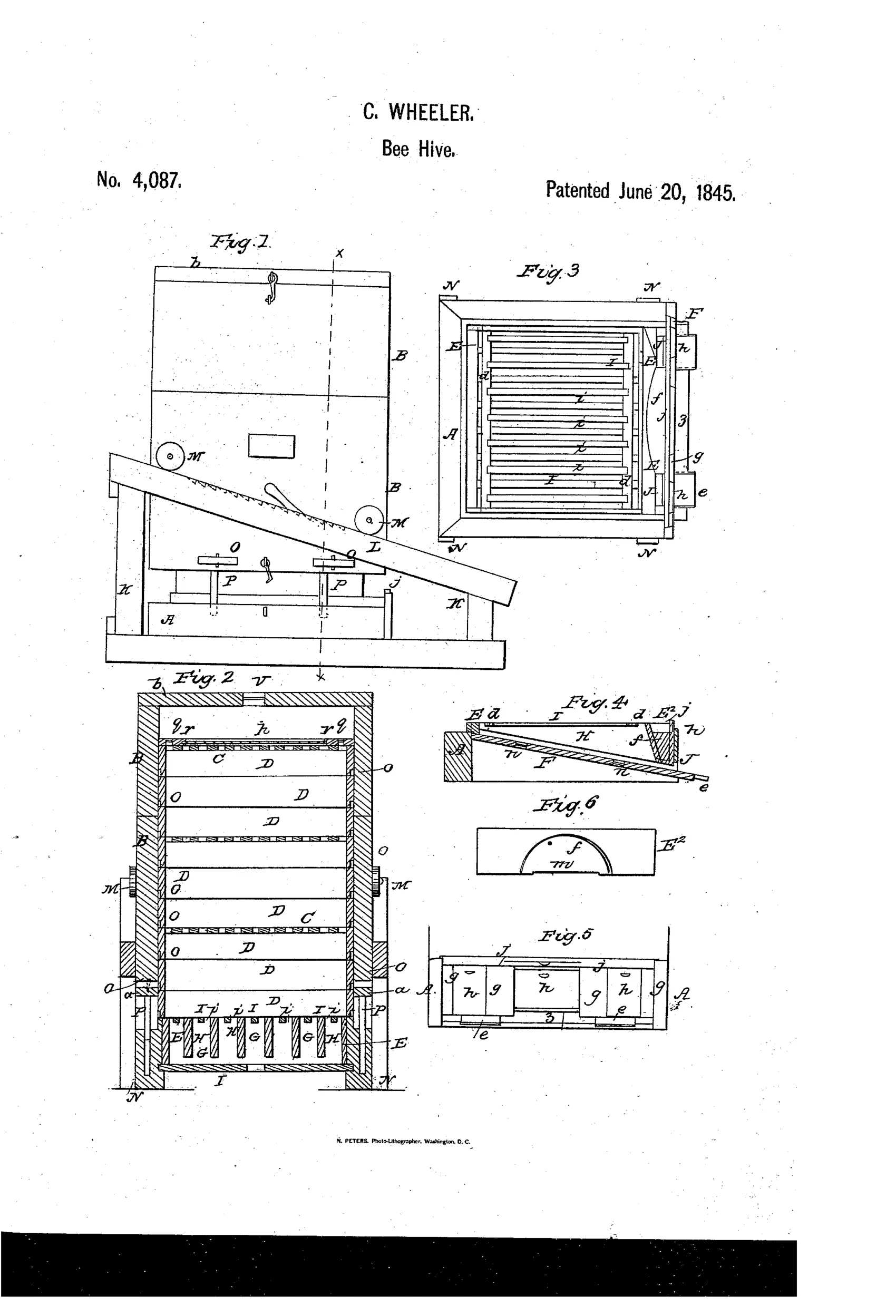
Expandable double-tiered beehive with drone trap
⬡ How it works
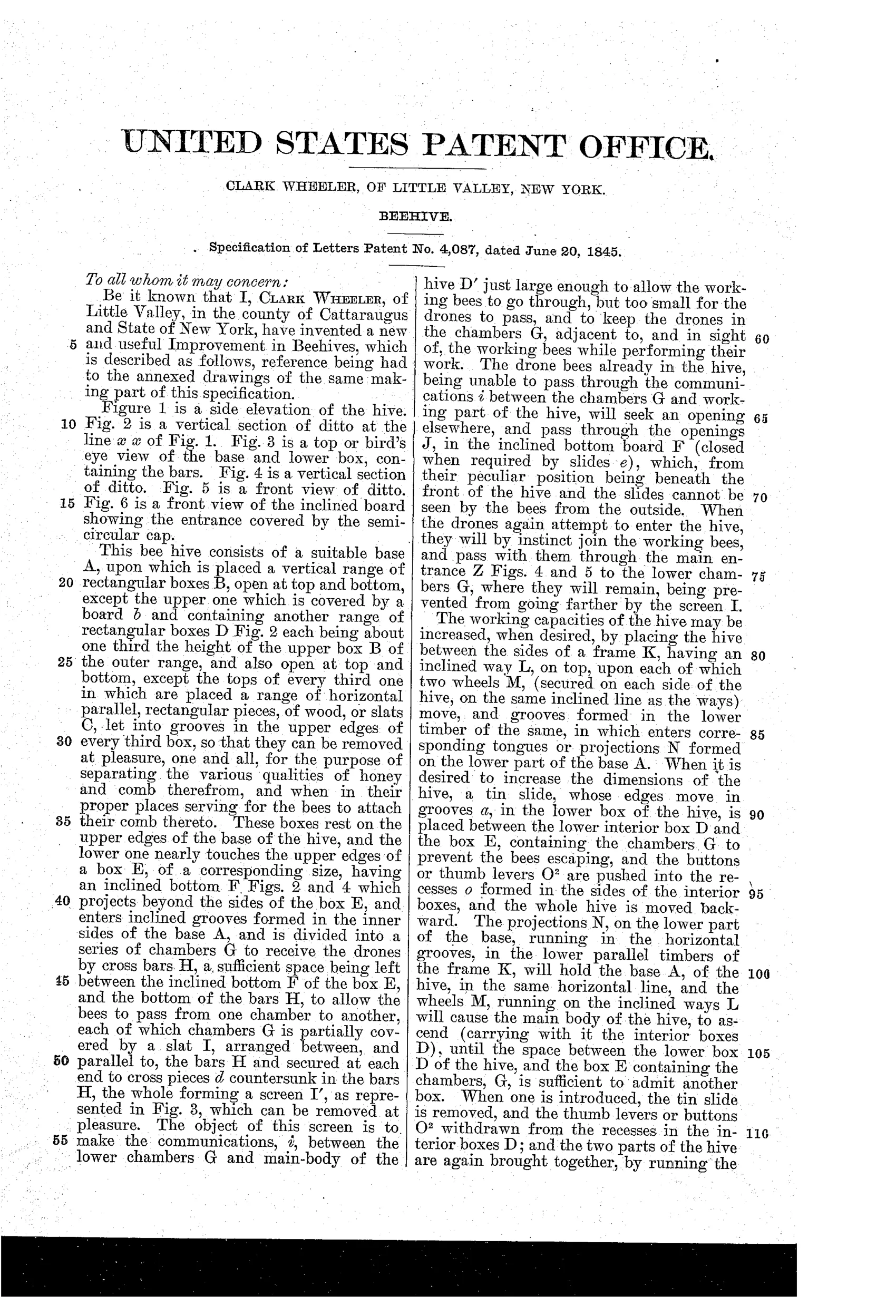
The hive consists of a base supporting an outer range of rectangular boxes and an inner tier of smaller slatted boxes, with a lower box E containing angled chambers G that trap drone bees behind a removable screen I while allowing worker bees to pass through small openings i. The inclined bottom F of box E has hidden openings J beneath the front of the hive so trapped drones escape unseen and rejoin the working bees through the main entrance Z, ending up confined in the lower chambers by the screen. To increase capacity, the whole upper hive body rides on wheels M along an inclined way L on frame K, so it can be raised by a wedge-like tongue and groove action (projections N) to admit an additional box D beneath the inner tier, with a tin slide temporarily closing the gap during insertion. Various slides, doors h, and vertical slide g allow adjustment of entrances, removal of the inclined bottom for cleaning, and removal of outer boxes B for access to the honey.
⬡ What was claimed
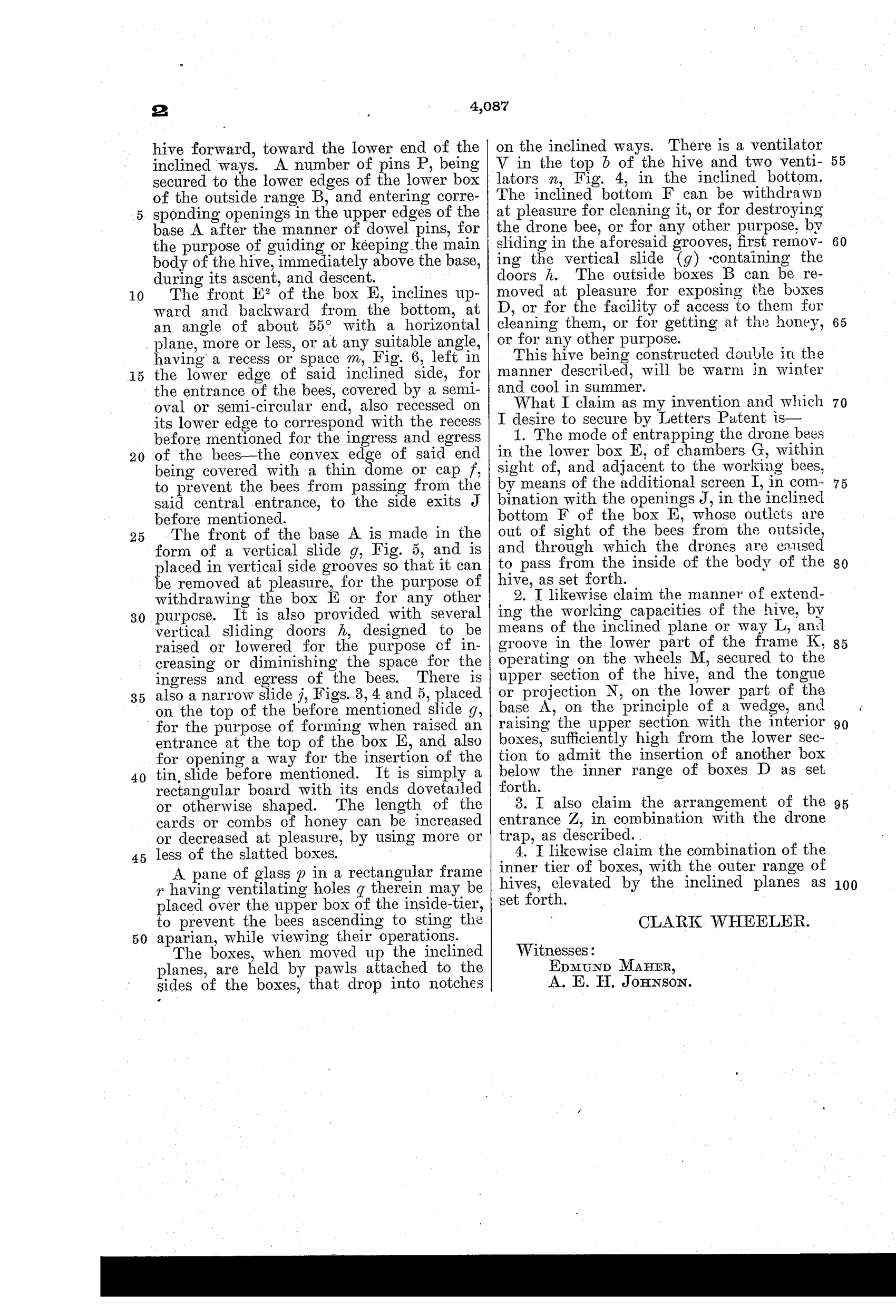
“The mode of entrapping the drone bees in the lower box E, of chambers G, within sight of, and adjacent to the working bees, by means of the additional screen I, in combination with the openings J, in the inclined bottom F of the box E, whose outlets are out of sight of the bees from the outside, and through which the drones are caused to pass from the inside of the body of the hive, as set forth.”
In plain English: A drone-trapping mechanism that catches drone bees in a lower chamber near the workers using a screen and hidden angled openings that let drones exit unnoticed but not easily return.
⬡ In the inventor’s words
“This hive being constructed double in the manner described, will be warm in winter and cool in summer.”— Clark Wheeler, from the specification
Paper patent — likely never produced
The wheeled ramp-and-wedge expansion adds cost and complexity far beyond what farm beekeepers of the 1840s would pay for, and no surviving example or trade record is known to me — though a marked specimen would overturn this.
⬡ More by Clark Wheeler
- Drone Trap for Bee Hives. (1854)
⬡ Commentary
Seven years before Langstroth, Clark Wheeler of Little Valley was attacking the two problems every pre-frame beekeeper obsessed over: how to enlarge a hive without enraging the colony, and what to do about drones. His answers are wonderfully mechanical. Look at Fig. 1 — those little circles marked M are actual wheels, riding on inclined ways L. To add capacity you roll the entire hive body up the ramp, slip a tin slide across the gap, insert a fresh box D underneath the inner tier, and lower everything back down. It's a nadiring jack, essentially — adding space at the bottom, where bees naturally build downward, rather than stacking supers on top.
The drone trap is the sneakier bit. Drones passing through the lower box E get funneled into angled chambers G behind a screen I, and the claim makes a point that the exit openings J are 'out of sight of the bees from the outside' — Wheeler is doing behavioral engineering, hiding the trap doors so the colony doesn't learn the trick. Whether 1845 drones cooperated is another matter; drone traps of this era mostly caught frustration.
All of it, of course, sits on the wrong side of 1852. With fixed combs inside, harvesting still meant pulling outer boxes B and hoping. The wheels-and-ramp expansion is a genuinely clever answer to a question movable frames would soon make obsolete. A dead end, but an inventive one.
Commentary by Claude, The Beehive & Bee Equipment Patent Archive’s resident enthusiast