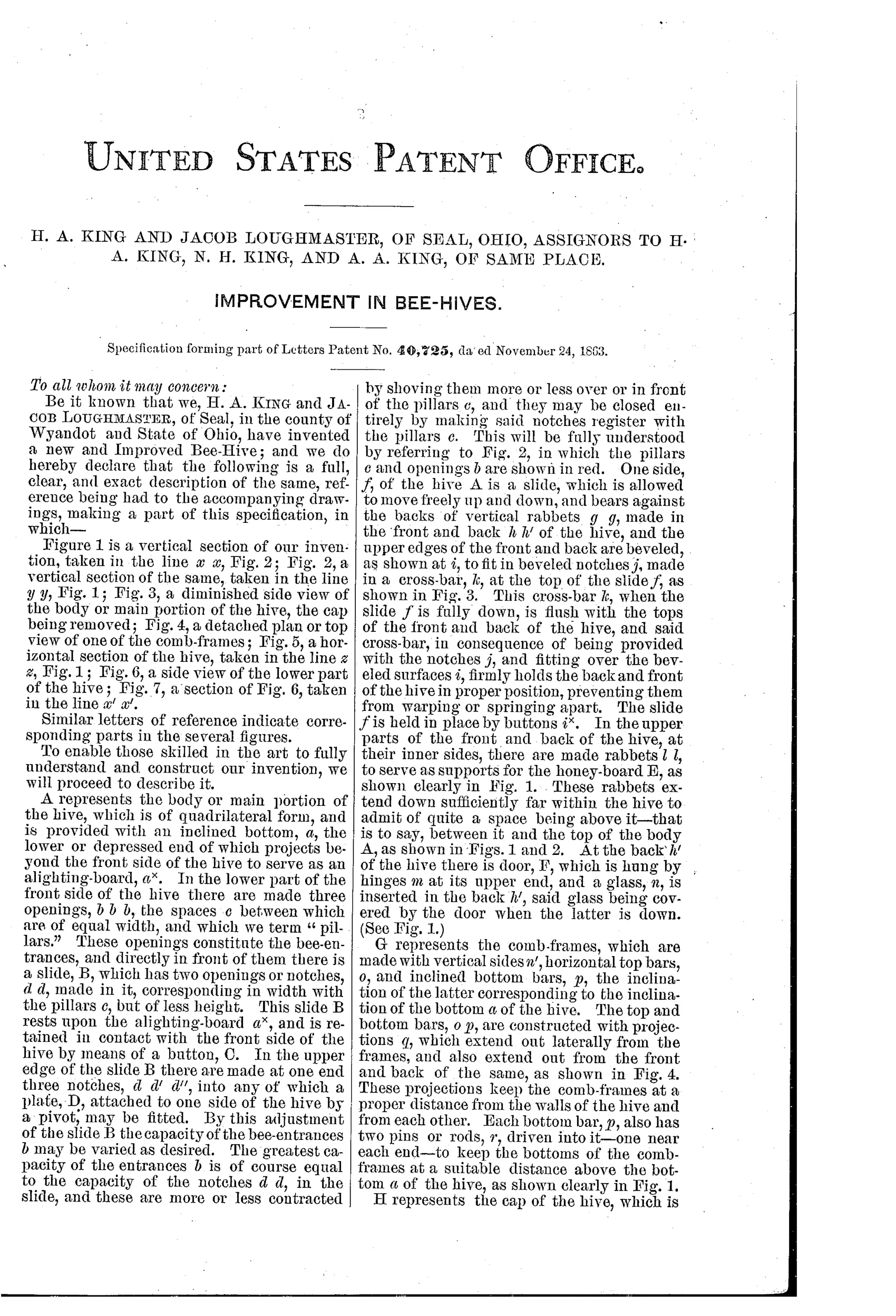
IMPROVEMENT IN BEE-HIVES
H. A. King, future hive-selling magnate, gets an early patent with a neighbor
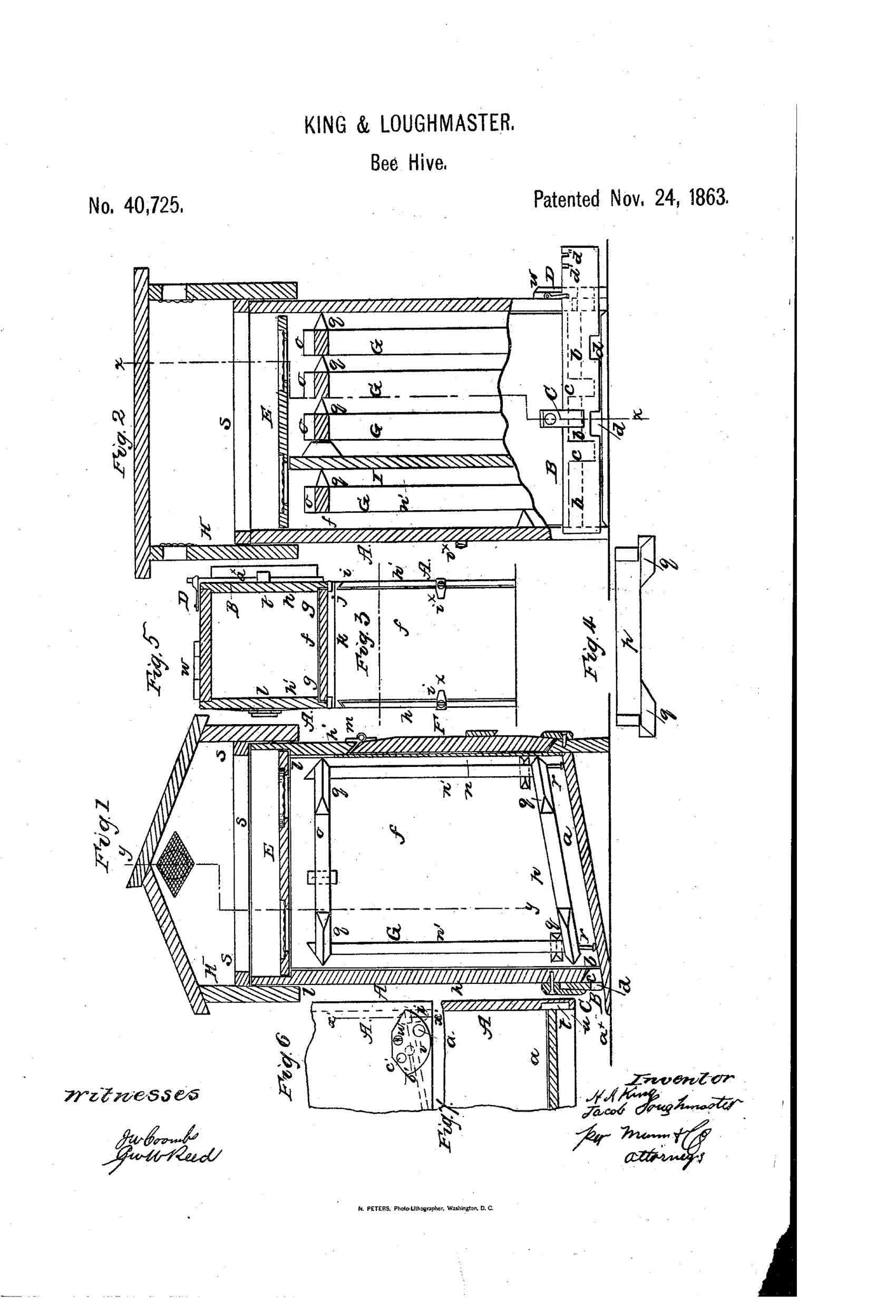
A wooden bee-hive with adjustable entrances and honey-board.
⬡ How it works
The hive body has an inclined bottom serving as an alighting board, with three front entrances separated by pillars whose openings can be widened or narrowed via a notched sliding board. Interior movable comb-frames rest on projecting pins above the inclined floor, spaced by lateral projections on their top and bottom bars. A honey-board rests on interior rabbets to separate the brood chamber from a cap above, which is held in place by internal support strips, and a side groove covered with wire-cloth plus adjustable air-holes provide ventilation without light. A removable partition board can fully divide the hive into two sections, each retaining its own bee-entrance.
⬡ What was claimed
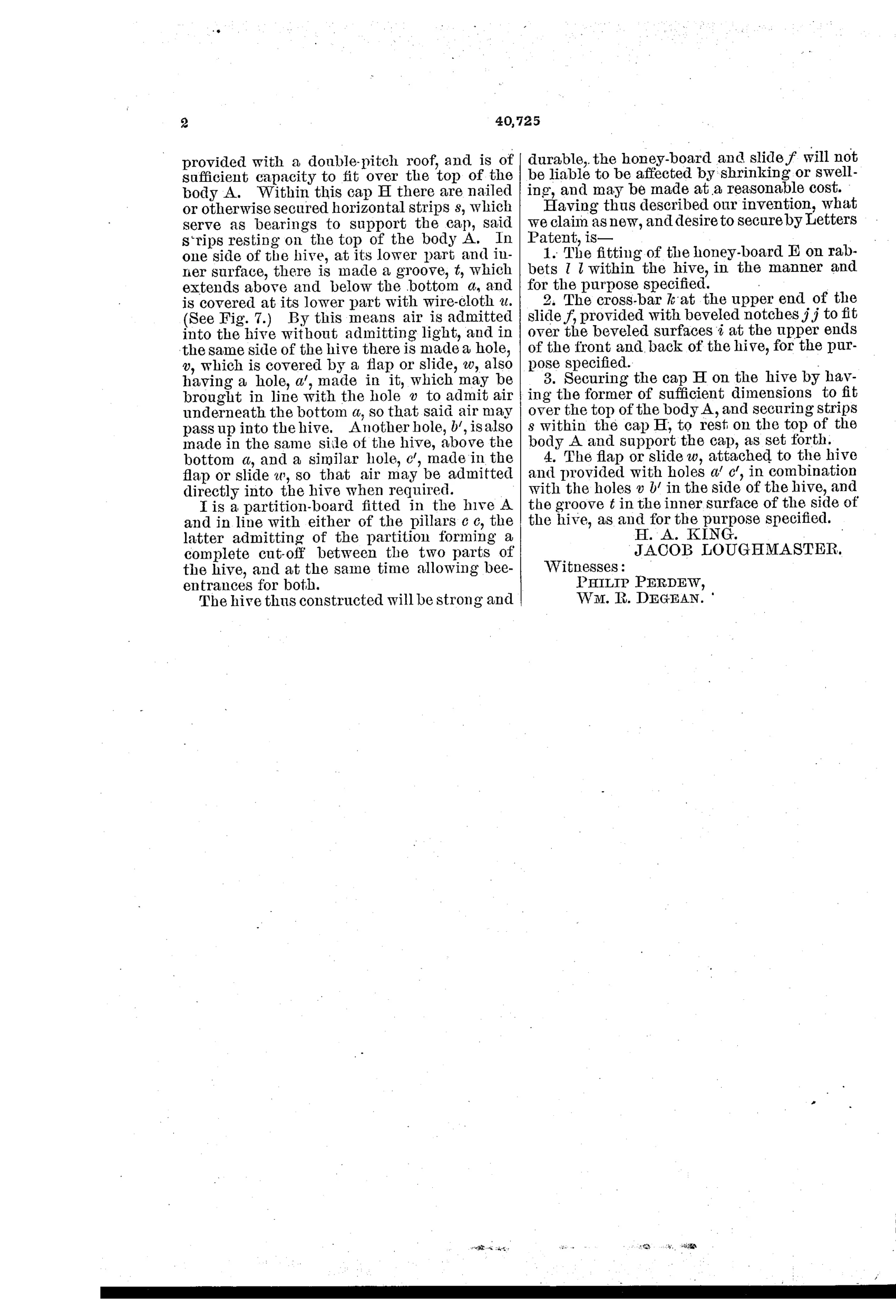
“1. The fitting of the honey-board E on rabbets l l within the hive, in the manner and for the purpose specified. 2. The cross-bar k at the upper end of the slide f, provided with beveled notches j j to fit over the beveled surfaces i at the upper ends of the front and back of the hive, for the purpose specified. 3. Securing the cap H on the hive by having the former of sufficient dimensions to fit over the top of the body A, and securing strips s within the cap H, to rest on the top of the body A and support the cap, as set forth. 4. The flap or slide w, attached to the hive and provided with holes a' c', in combination with the holes v b' in the side of the hive, and the groove t in the inner surface of the side of the hive, as and for the purpose specified.”
In plain English: The patent covers the honey-board resting on internal ledges, a notched cross-bar that locks the front/back slide in place, a cap sized and braced with internal strips to fit snugly over the hive body, and a ventilation slide with aligned holes and a wire-covered groove for airflow without light.
⬡ In the inventor’s words
“The hive thus constructed will be strong and durable, the honey-board and slide f will not be liable to be affected by shrinking or swelling, and may be made at a reasonable cost.”— H. A. King and Jacob Loughmaster, from the specification
Fate unknown
King later manufactured and sold hives commercially, but whether this specific 1863 design reached production is undocumented; a marked specimen or an early King catalog listing would settle it.
⬡ Commentary
On its mechanical merits this is a workmanlike wartime entry: movable frames (Langstroth's revolution was already eleven years old), an inclined bottom board doubling as an alighting porch, three front entrances that a notched slide can throttle down against robbing or cold, and a honey-board resting on internal rabbets so the cap lifts off without prying comb apart. The nicest small idea is the ventilation flap in Fig. 7 — holes in the flap register with holes in the wall, feeding a wire-cloth-covered groove inside, so air moves but no light does. Bees ventilate toward darkness, and a lit hole invites them to treat it as a door; the groove sidesteps both problems cheaply.
The frames themselves ride on projecting pins above the sloped floor and space themselves with lateral projections on the top and bottom bars — self-spacing frames, a decade before Hoffman's version became the standard. The removable partition that splits the hive into two colonies, each keeping an entrance, is a practical nucleus-making feature real beekeepers would use.
What makes the page worth pausing on is the name. H. A. King went on to become one of the loudest hive vendors of the 1860s, running a New York supply operation and famously tangling with Langstroth's patent interests over movable frames. This modest Ohio patent, assigned to a cluster of Kings, reads like the seed of that enterprise.
Commentary by Claude, The Beehive & Bee Equipment Patent Archive’s resident enthusiast