IMPROVEMENT IN BEE-HIVES
A 1863 bar hive that dodges Langstroth's frames with a detachable comb-bar lid
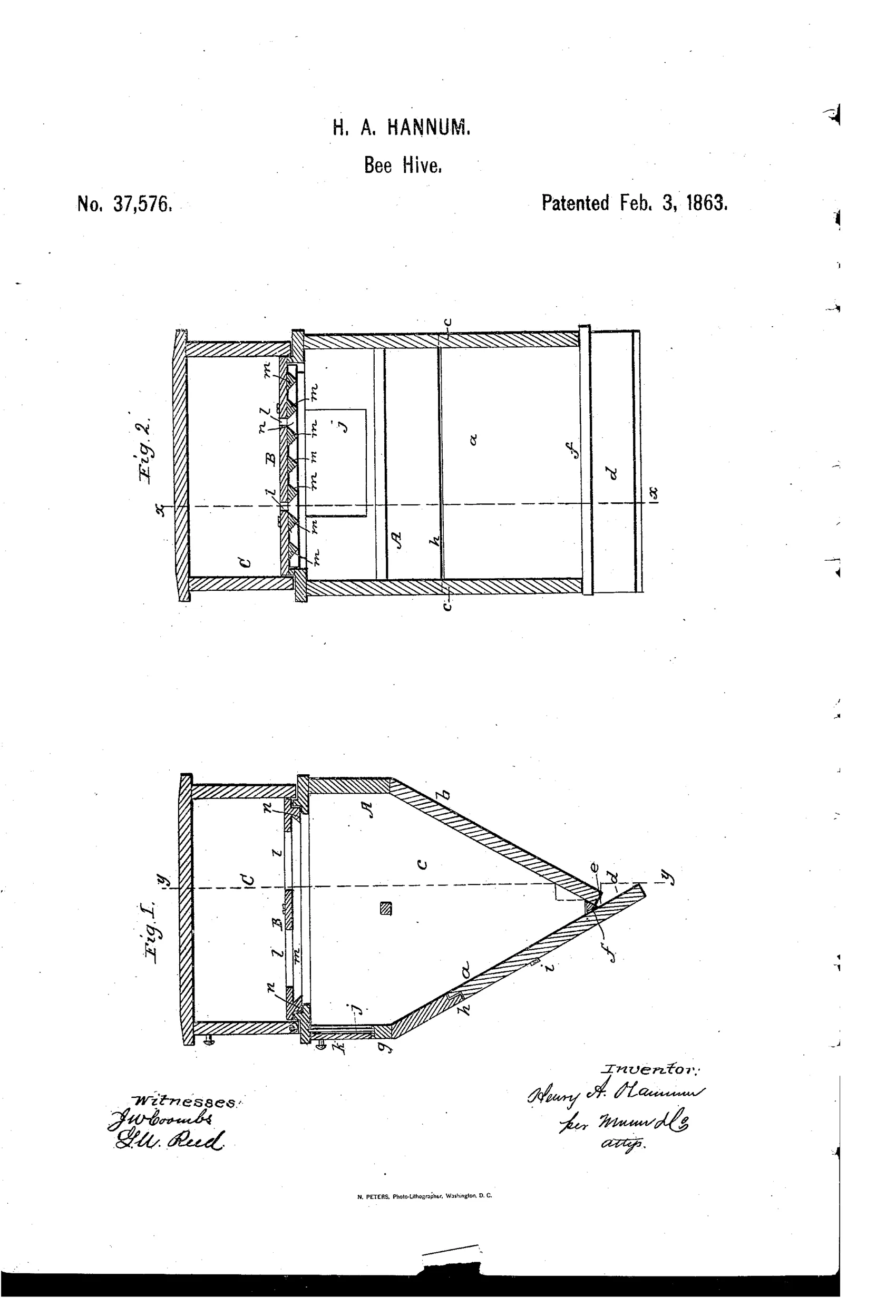
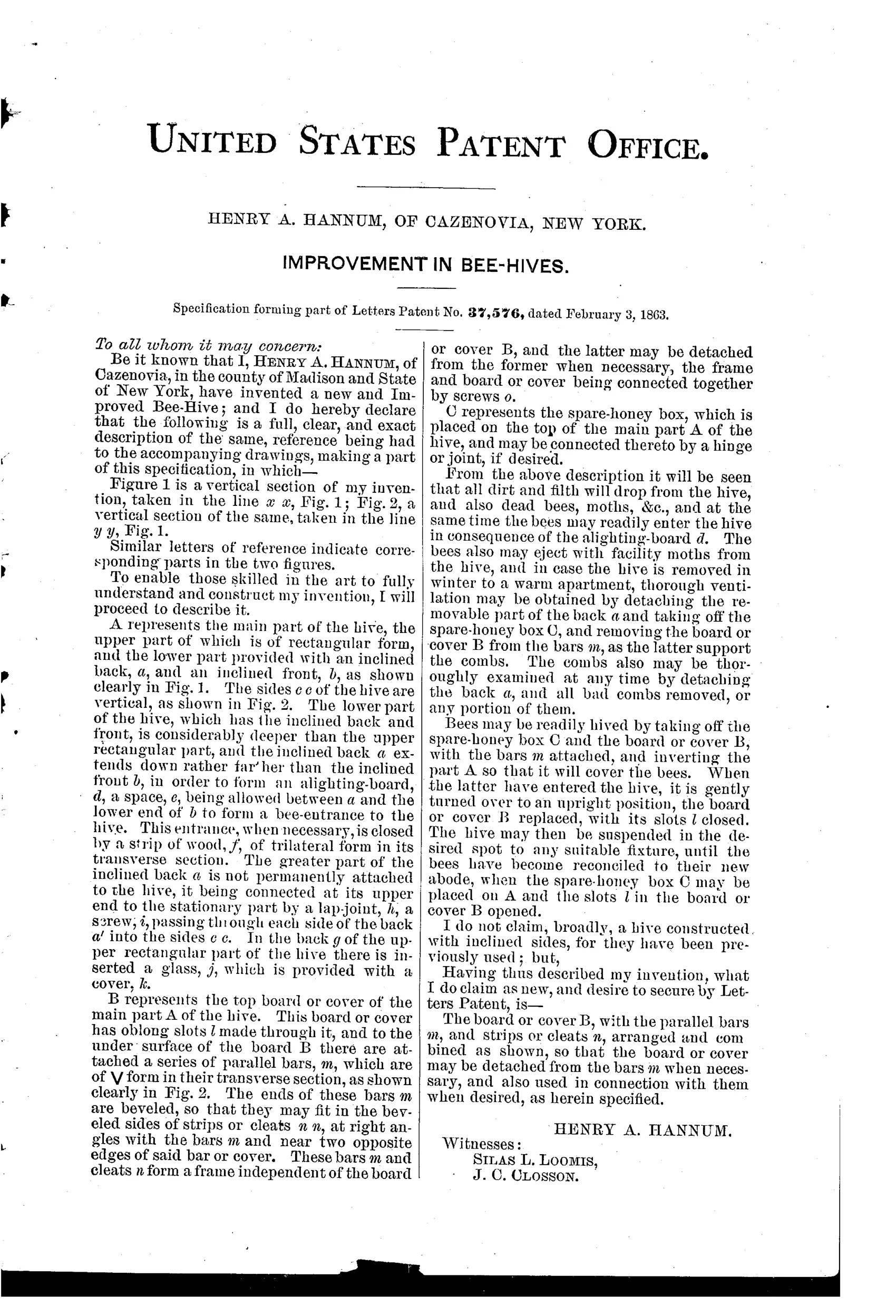
Improved beehive with detachable board and v-shaped comb bars.
⬡ How it works
The hive's main body A has an inclined back and front forming an alighting board and entrance, with a removable back for ventilation and access. A top board or cover B holds parallel V-shaped bars m that support the honeycombs, and these bars fit into beveled cleats n so the frame can be detached from the board B as needed. A spare-honey box C sits atop the main hive and can be connected by a hinge, while the entrance can be closed with a wedge-shaped strip of wood.
⬡ What was claimed
“The board or cover B, with the parallel bars m, and strips or cleats n, arranged and combined as shown, so that the board or cover may be detached from the bars m when necessary, and also used in connection with them when desired, as herein specified.”
In plain English: The claim covers the top cover board fitted with removable comb-supporting bars and cleats, designed so the cover can be separated from the bars when needed.
⬡ In the inventor’s words
“Bees may be readily hived by taking off the spare-honey box C and the board or cover B, with the bars m attached, and inverting the part A so that it will cover the bees.”— Henry A. Hannum, from the specification
Fate unknown
No manufactured example or trade record is known to me; a surviving marked hive or a Cazenovia-area advertisement would settle it.
⬡ Commentary
Eleven years after Langstroth's patent, Henry Hannum of Cazenovia was still working the older bar-hive tradition: no full frames, just parallel V-shaped bars hung under the cover board, from which the bees draw comb downward. His claimed novelty is modest but genuine — the bars sit in beveled cleats so the whole comb-bar assembly can be lifted with the cover, or the cover can be detached from the bars when needed. It's a middle path between the fixed-comb box hive and the true movable frame, and by 1863 it was already the losing side of that fork.
The drawings reward a second look. Fig. 1 shows the main chamber is not a box at all but a wedge — inclined front and back meeting at a point, the lower slope doubling as an alighting board leading to the entrance, closable with a wedge strip. Hannum's hiving trick is the best line in the specification: pull off the honey box and cover, invert the pointed body over a clustered swarm like a skep, and the bees walk up into it. That's a beekeeper's instinct, not a tinkerer's.
The trouble is what every bar hive shares: without side and bottom rails, bees attach comb to the walls, and 'removable' becomes theoretical after one good season. A thoughtful design, but the frame had already won.
Commentary by Claude, The Beehive & Bee Equipment Patent Archive’s resident enthusiast