Honey Comb Frame for Bee Hives.
Ten years after Langstroth, a frame that pivots out the front instead
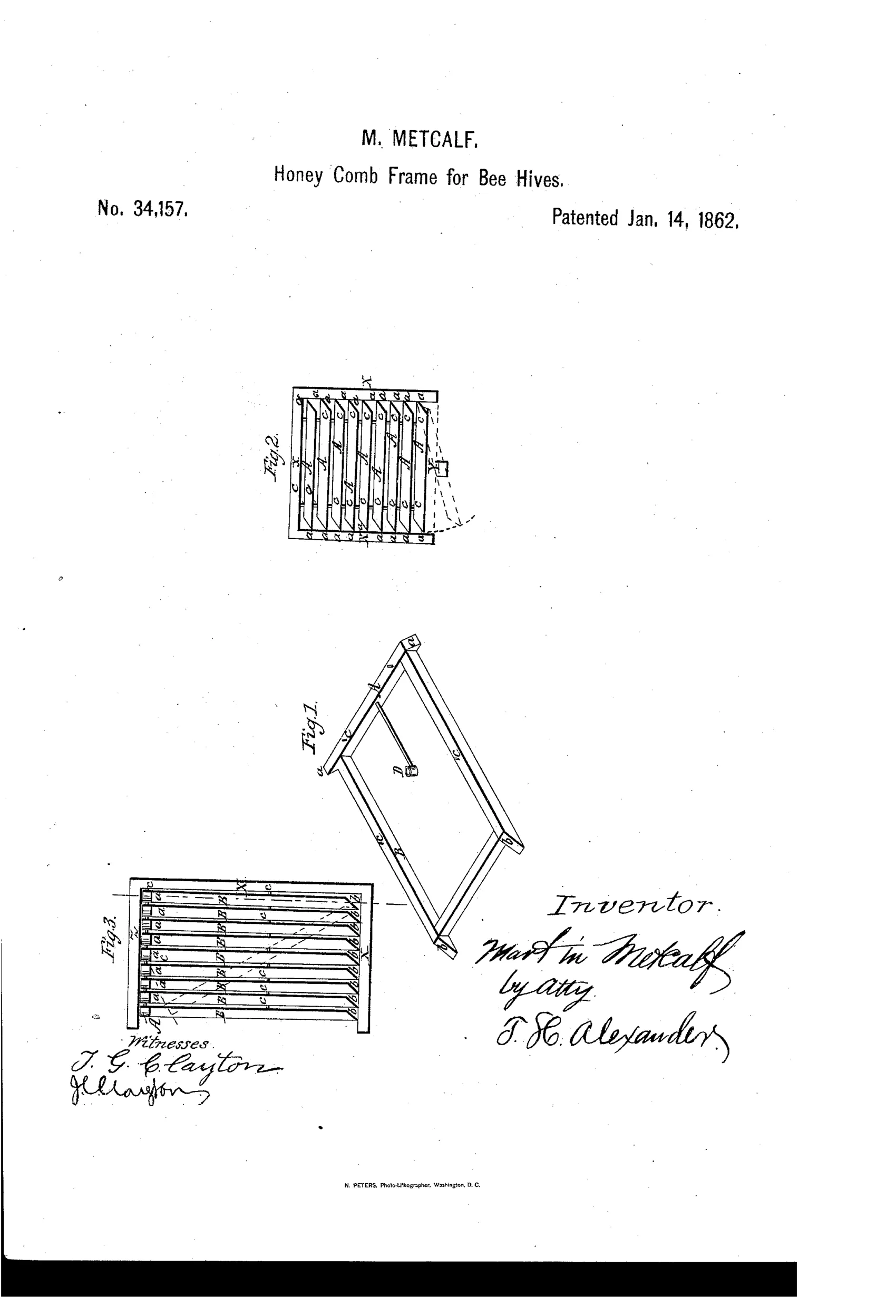
Adjustable beveled comb-frame for rectangular bee-hives
⬡ How it works
The frame has a top bar with beveled ends and side bars also beveled at their lower ends, so it rests on its feet like a pivot rather than lying flat. When inserted feet-first into the hive and rotated to vertical, small pins on the frame keep it equidistant from neighboring frames and hold it parallel against the hive back. Because the beveled feet sit outside the frame's center of gravity, the frame leans and locks against the adjacent frame rather than balancing freely. To remove a frame, the beekeeper pries off the movable front and cover, then swivels the frame at its beveled top-bar ends so it recedes from the hive wall instead of scraping and jarring the bees.
⬡ What was claimed
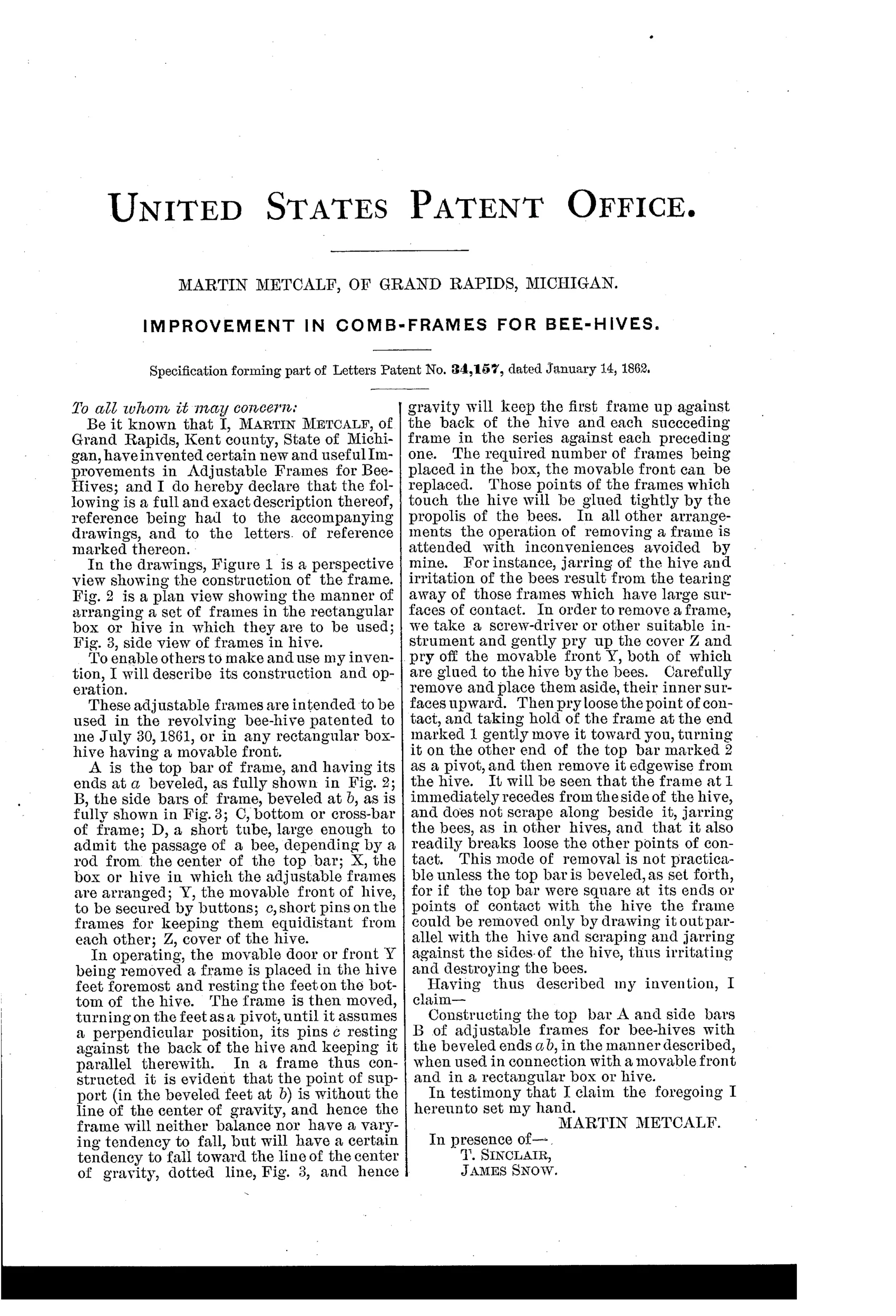
“Constructing the top bar A and side bars B of adjustable frames for bee-hives with the beveled ends a b, in the manner described, when used in connection with a movable front and in a rectangular box or hive.”
In plain English: The inventor claims a bee-hive frame whose top and side bars have beveled ends, designed to be used with a hive that has a removable front panel.
⬡ In the inventor’s words
“This mode of removal is not practicable unless the top bar is beveled, as set forth, for if the top bar were square at its ends or points of contact with the hive the frame could be removed only by drawing it out parallel with the hive and scraping and jarring against the sides of the hive, thus irritating and destroying the bees.”— Martin Metcalf, from the specification
Paper patent — likely never produced
Front-opening frame hives left no commercial lineage and no marked Metcalf hive is documented; the design almost certainly stayed on the drawing sheet or in a few homemade examples.
⬡ Commentary
By 1862 the movable frame was established fact, and the interesting fights were over how you got the frame out. Langstroth's answer — lift it straight up through the top — is the one we still use. Metcalf's answer was sideways: pry off a movable front panel, then swivel each frame on the beveled ends of its top bar so it swings away from the hive wall rather than dragging along it. His stated worry, in his own words, was 'scraping and jarring against the sides of the hive, thus irritating and destroying the bees,' and it was a real problem — bees do get rolled and crushed when frames are dragged.
The bevels are doing more work than they first appear to. The side bars are also beveled at their lower ends, so the frame stands on angled feet set outside its center of gravity; it deliberately leans and locks against its neighbor instead of balancing free. Small pins keep the spacing equal — an early stab at what would later be solved more elegantly by Hoffman self-spacing frames. Fig. 3 shows the whole stack tipped in unison, like dominoes caught mid-fall.
It's clever geometry serving a dead-end architecture. Front-opening hives lost, decisively, because you can't inspect the middle frame without disturbing every frame in front of it. Top access won on that arithmetic alone. Still, as an 1862 attempt to make frame removal gentle, this is honest engineering, not palace quackery.
Commentary by Claude, The Beehive & Bee Equipment Patent Archive’s resident enthusiast