Honey Comb Frame.
Nine years before Langstroth, an Ohio farmer hangs his comb boxes from the top
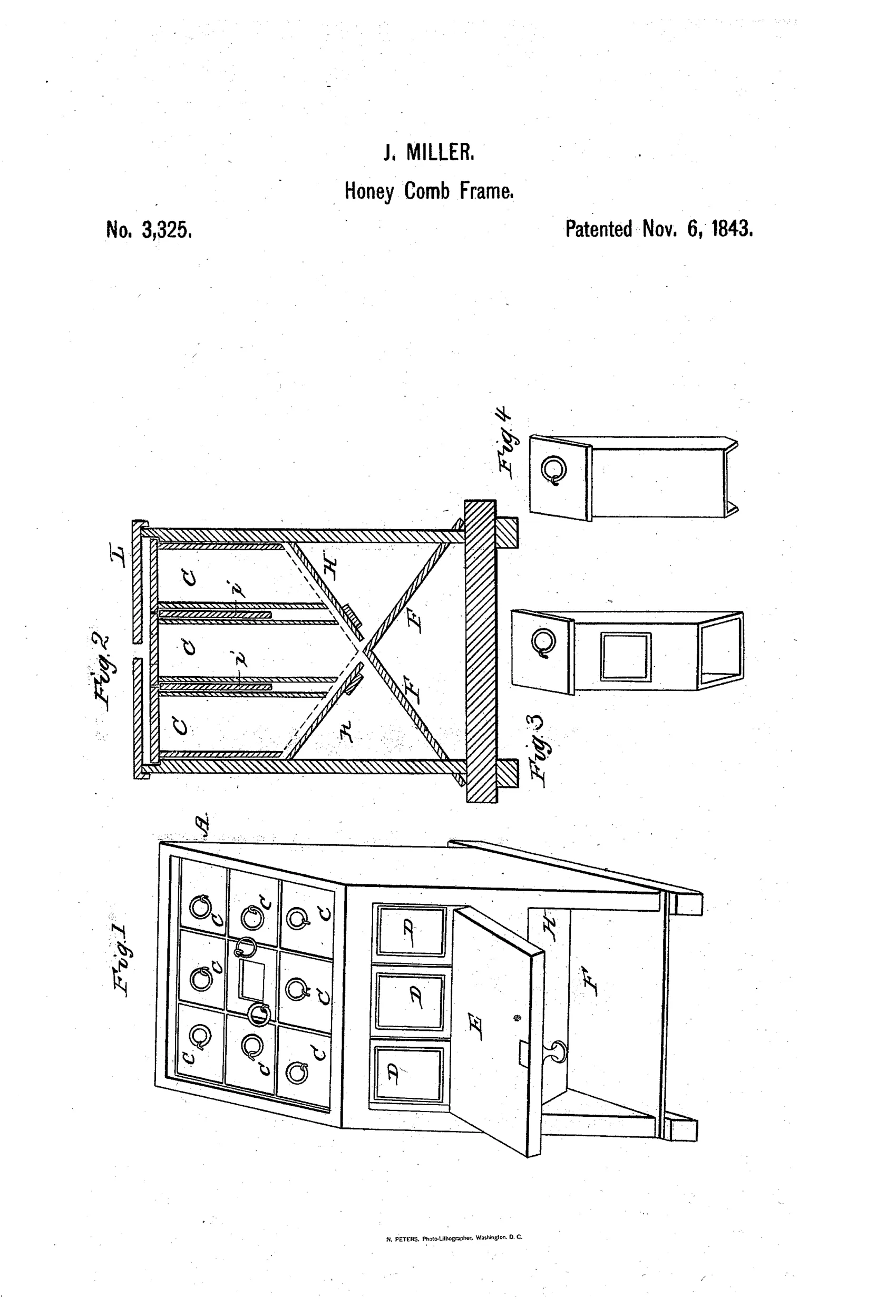
Beehive with removable, suspended honeycomb cell frames
⬡ How it works
The hive is a rectangular box (bee-palace) containing separate cells (c c c c c c) arranged in tiers, each cell hanging from its top edge and supported by division boards and side rails. The cells can be drawn straight up and out through the top of the hive once the cap or cover (L) is removed, sliding vertically in or out. Angled boards (F and H) form a chute that directs falling honey-worms downward and out of the hive, while separate lower boards (H H) are set about five-eighths of an inch below the cell bottoms so no part of the cells touches them, preventing worms from climbing back up. Glass panes (D D D) are set into the front and back rows of cells so the comb can be observed, and a door (E) provides access to the front compartment.
⬡ What was claimed
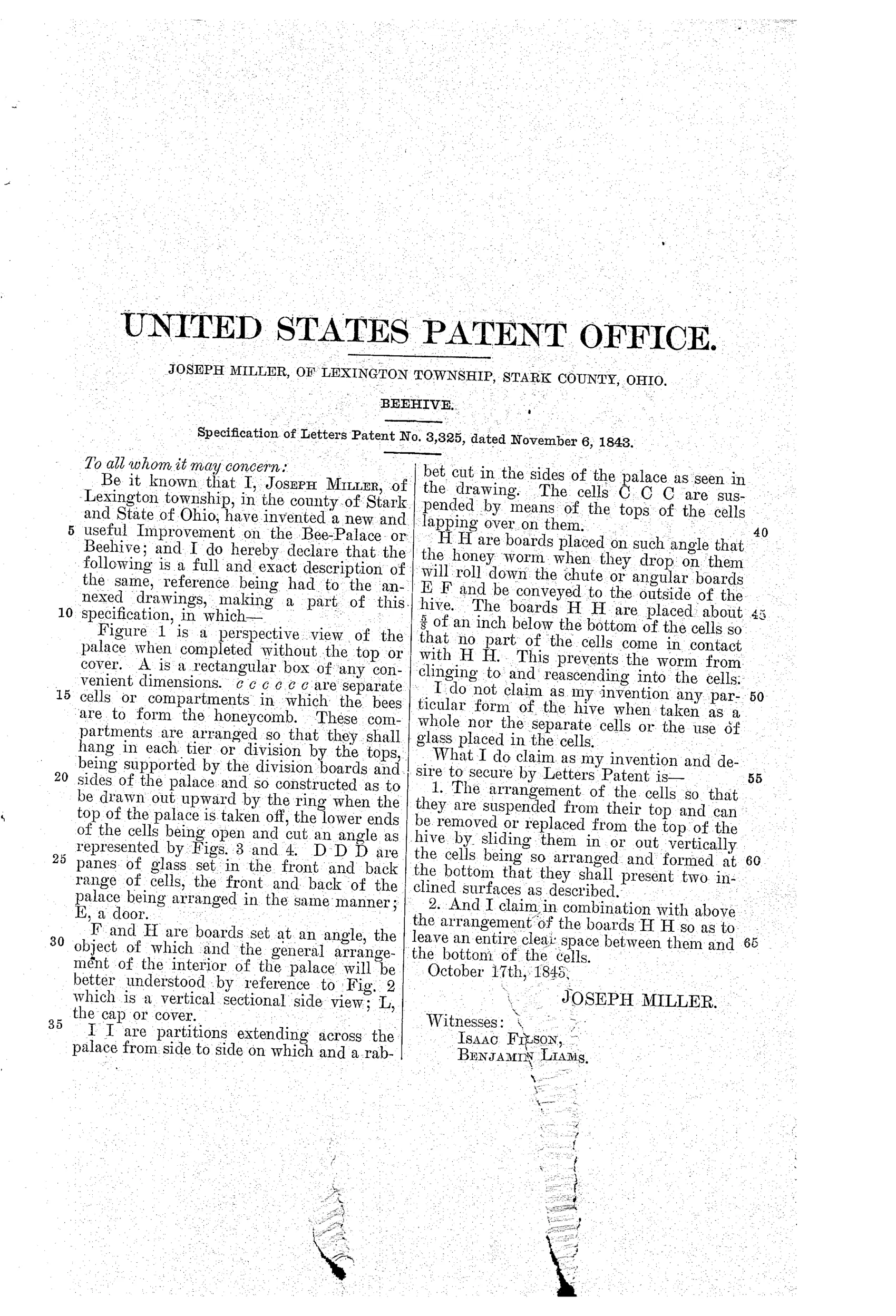
“1. The arrangement of the cells so that they are suspended from their top and can be removed or replaced from the top of the hive by sliding them in or out vertically the cells being so arranged and formed at the bottom that they shall present two inclined surfaces as described.”
In plain English: The inventor claims hanging the honeycomb cells from their tops so they can slide straight up out of the hive, with their bottoms shaped into two sloped surfaces.
⬡ In the inventor’s words
“H H are boards placed on such angle that the honey worm when they drop on them will roll down the chute or angular boards E F and be conveyed to the outside of the hive.”— Joseph Miller, from the specification
Fate unknown
No manufactured example or trade record is documented; a surviving marked hive or a period agricultural-journal notice would settle it.
⬡ Commentary
This is the kind of patent that makes 1840s beekeeping so tantalizing to read. Miller's core claim — cells suspended from their top edges, lifted straight up and out once the cover comes off — is the ghost of the movable frame, filed nine years before Langstroth's US 9,300. What Miller lacked was the one thing that made Langstroth's version work: the bee space. Nothing here provides a consistent 3/8-inch gap around the boxes, so in practice the bees would propolize and comb every seam, and 'sliding them out vertically' would mean prying out a solid glued mass. Fig. 4's ring pull on each cell box is optimistic hardware for that fight.
The drawing's real character is in Fig. 2, the sectional view. Those big X-crossed boards (F, H) are a wax-moth chute — larvae dropping from the comb are supposed to roll down the incline and out of the hive, and the lower boards sit five-eighths of an inch clear of the cell bottoms so worms can't climb back. It's the era's obsession in miniature: the moth as the great enemy, defeated by carpentry rather than colony strength.
Add the glass observation panes and the hinged front door and you have a proper bee-palace — earnest, over-built, and pointing in exactly the right direction without knowing it. A genuinely interesting near-miss.
Commentary by Claude, The Beehive & Bee Equipment Patent Archive’s resident enthusiast