BEEHIVE.
Trapezoidal frames and a moth-trap drawer, nine years after Langstroth changed everything
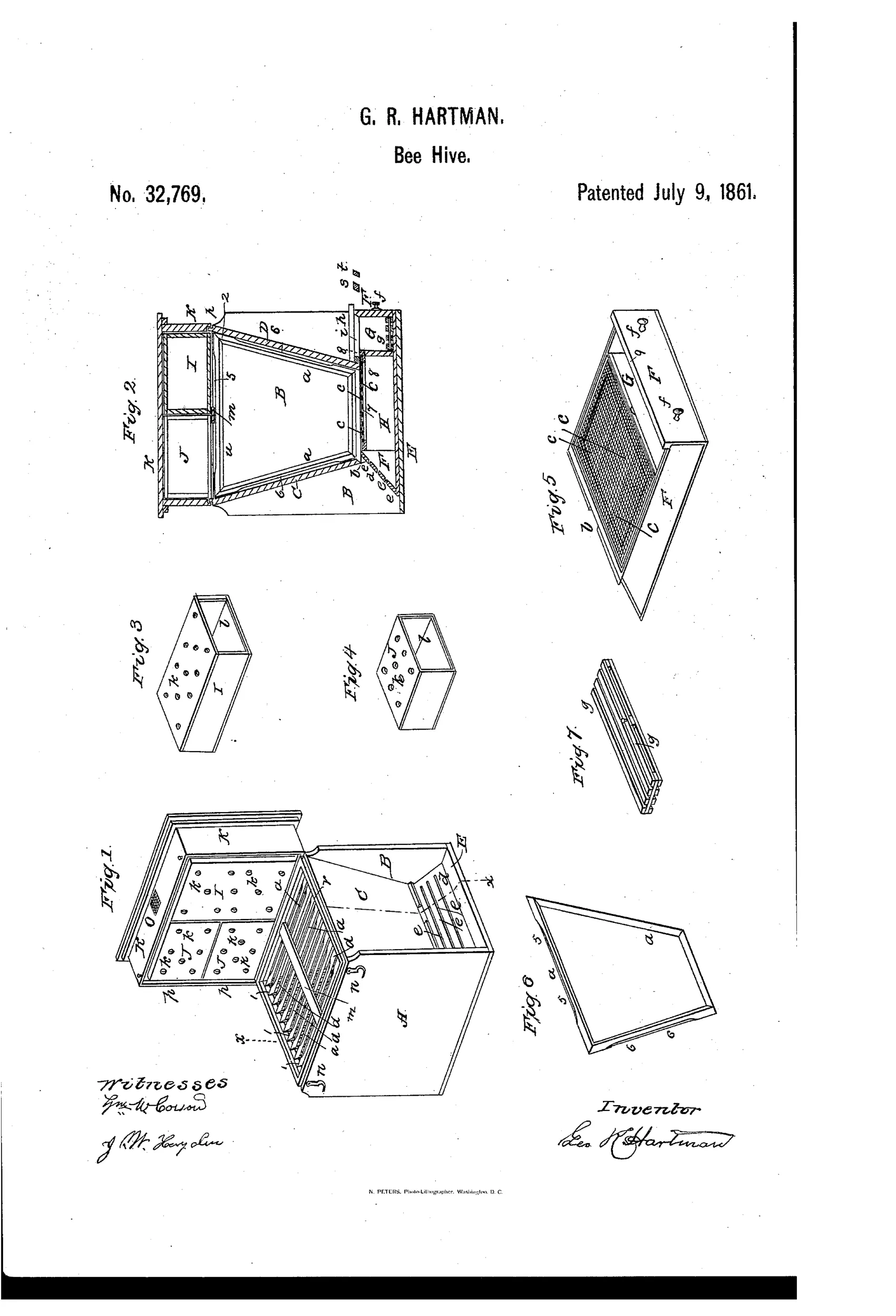
Improved beehive with trapezoidal comb frames and drawer
⬡ How it works
The hive box has front and rear sides that converge toward the bottom, creating a trapezoidal interior that holds parallel trapezoidal comb frames spaced about a quarter inch apart to bring bees closer together in the center. A sliding drawer beneath the frames serves as both a feed box and a miller/moth trap, covered with a removable wire gauze frame that lets debris fall through while blocking moth entry. The drawer's beveled front has narrow decoy slots for millers and an adjustable entrance regulated by interchangeable strips of different widths placed under a lid, allowing the keeper to enlarge, narrow, or fully close the bee entrance. Surplus honey boxes with glass sides rest atop the frames and are enclosed by a removable top case fastened with hooks and fitted with a ventilator.
⬡ What was claimed
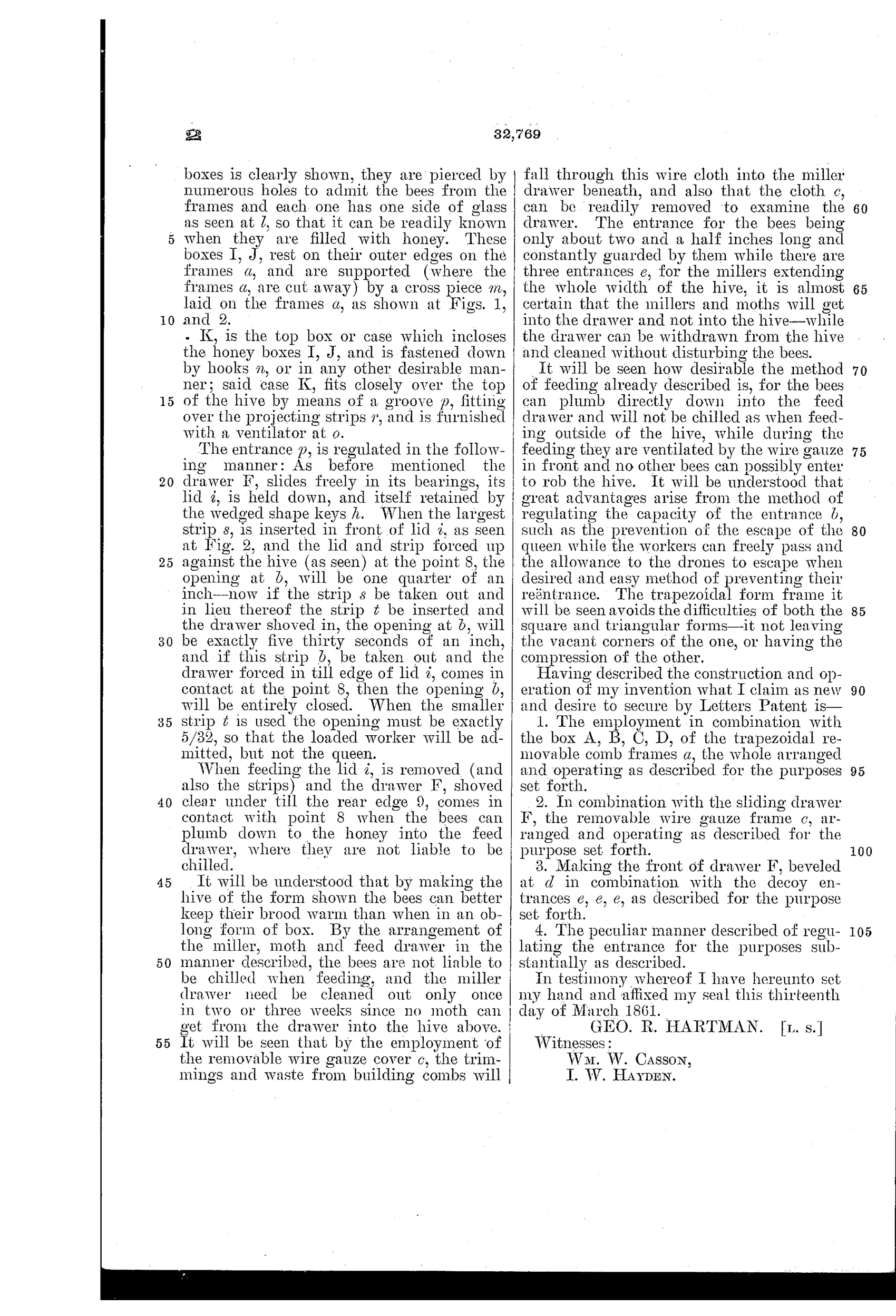
“1. The employment in combination with the box A, B, C, D, of the trapezoidal removable comb frames a, the whole arranged and operating as described for the purposes set forth.”
In plain English: The claim covers a beehive box combined with removable trapezoidal comb frames arranged as described.
⬡ In the inventor’s words
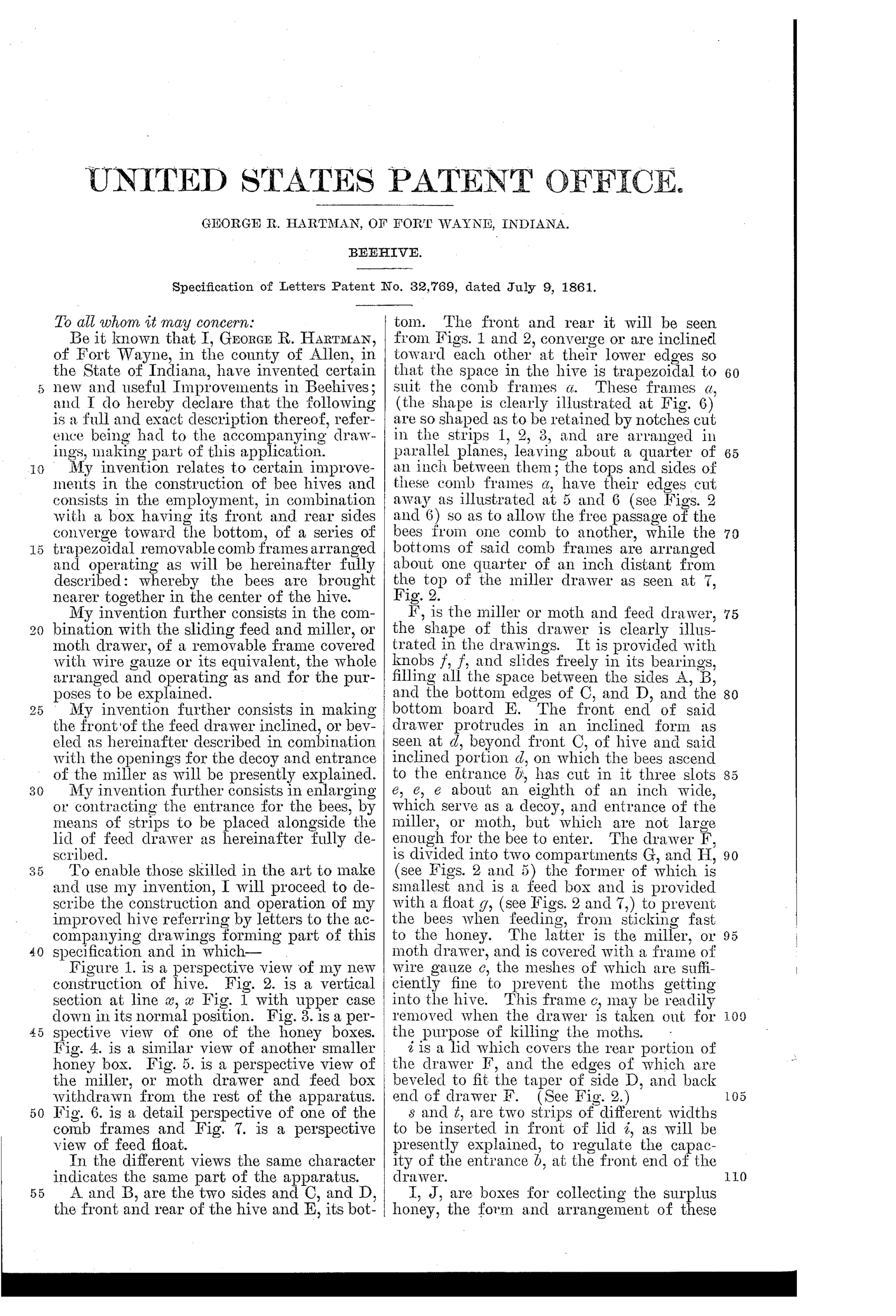
“It will be seen that by the employment of the removable wire gauze cover c, the trimmings and waste from building combs will fall through this wire cloth into the miller drawer beneath, and also that the cloth c, can be readily removed to examine the drawer.”— George R. Hartman, from the specification
Fate unknown
No documented manufacture or surviving example is known to me; a marked hive or a period agricultural-press advertisement would settle it.
⬡ Commentary
Hartman filed this from Fort Wayne in March 1861, a month before Fort Sumter, and it shows the movable-frame idea already loose in the countryside — but not quite understood. His frames are trapezoids, hung in a hive whose front and back converge toward the bottom, on the theory that pinching the space brings the cluster tighter at the center. It's a reasonable-sounding warmth argument, but the practical cost is real: trapezoidal frames don't interchange positions the way Langstroth's rectangles do, and the quarter-inch spacing he specifies is under bee space — bees will glue those frames together with propolis, defeating the whole point of removability.
The part that holds up better is the drawer. Fig. 5 shows it withdrawn: a sliding tray under the frames that doubles as feeder and wax-moth trap, with a removable wire-gauze cover so comb trimmings fall through while moths are blocked, decoy slots cut in the beveled front to lure millers in, and an entrance regulated by swapping strips of different widths under a lid. That's three functions in one serviceable box, and the adjustable entrance in particular is a genuinely modern instinct.
As a whole it's a transitional artifact: frames adopted, bee space not yet internalized. The moth-trap obsession dates it to the pre-Langstroth mindset even as the frames point forward. A dead end, but an honest and mechanically thoughtful one.
Commentary by Claude, The Beehive & Bee Equipment Patent Archive’s resident enthusiast