Beehive.
A woman in Wheeling patents the double-walled hive, weeks into the Civil War
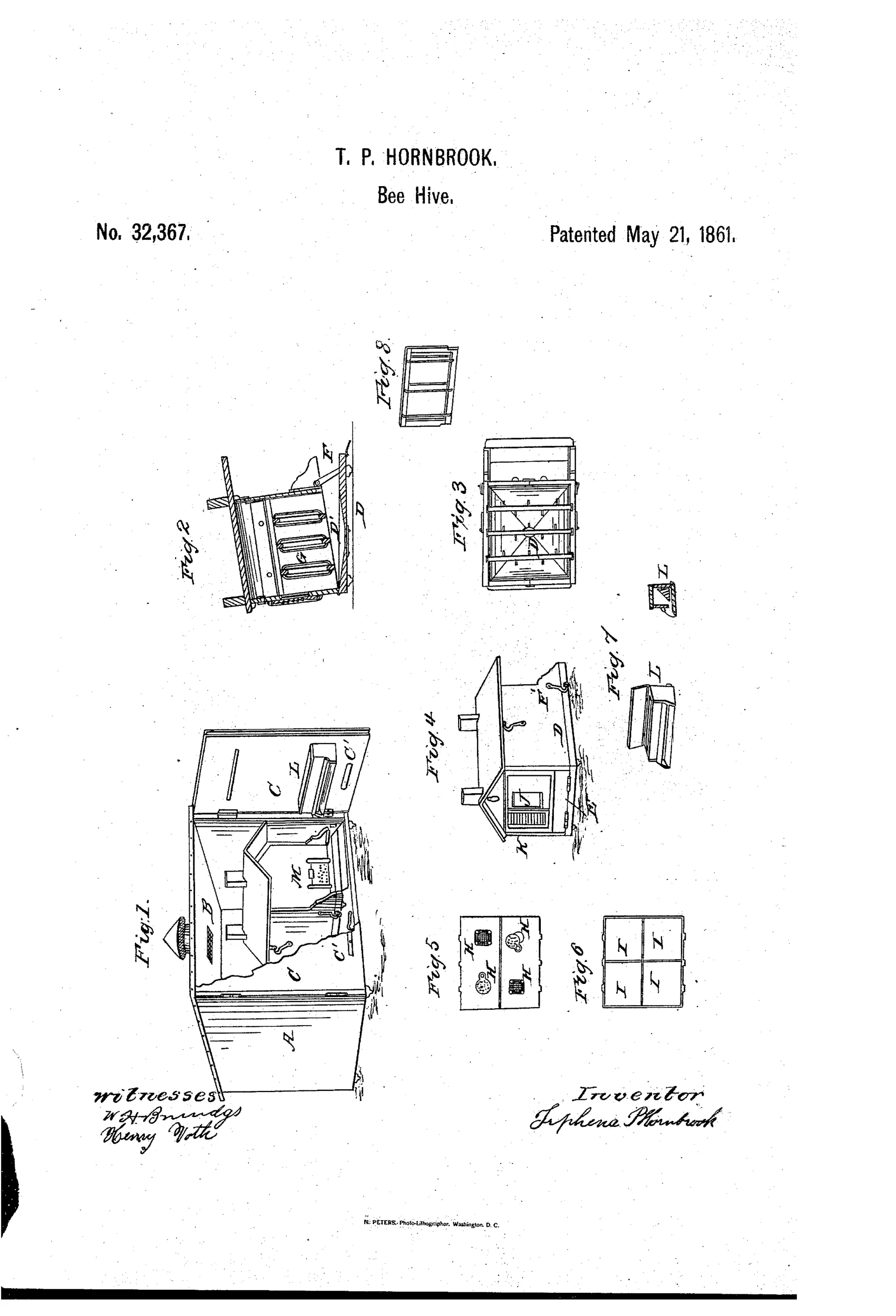
Beehive enclosed in an outer protective case
⬡ How it works
The hive body containing movable comb frames sits inside a larger outer case that provides an air-insulating dirt/air space and ventilation at top and bottom. A hinged, scooped bottom board tilts down for cleaning and is held by a support and hooks. A detachable feeding trough is attached to the outer case's door so it contacts the hive front when closed, allowing feeding without opening the case, and a perforated slide controls the entrance while a glass window with a slide lets the keeper inspect the interior.
⬡ What was claimed
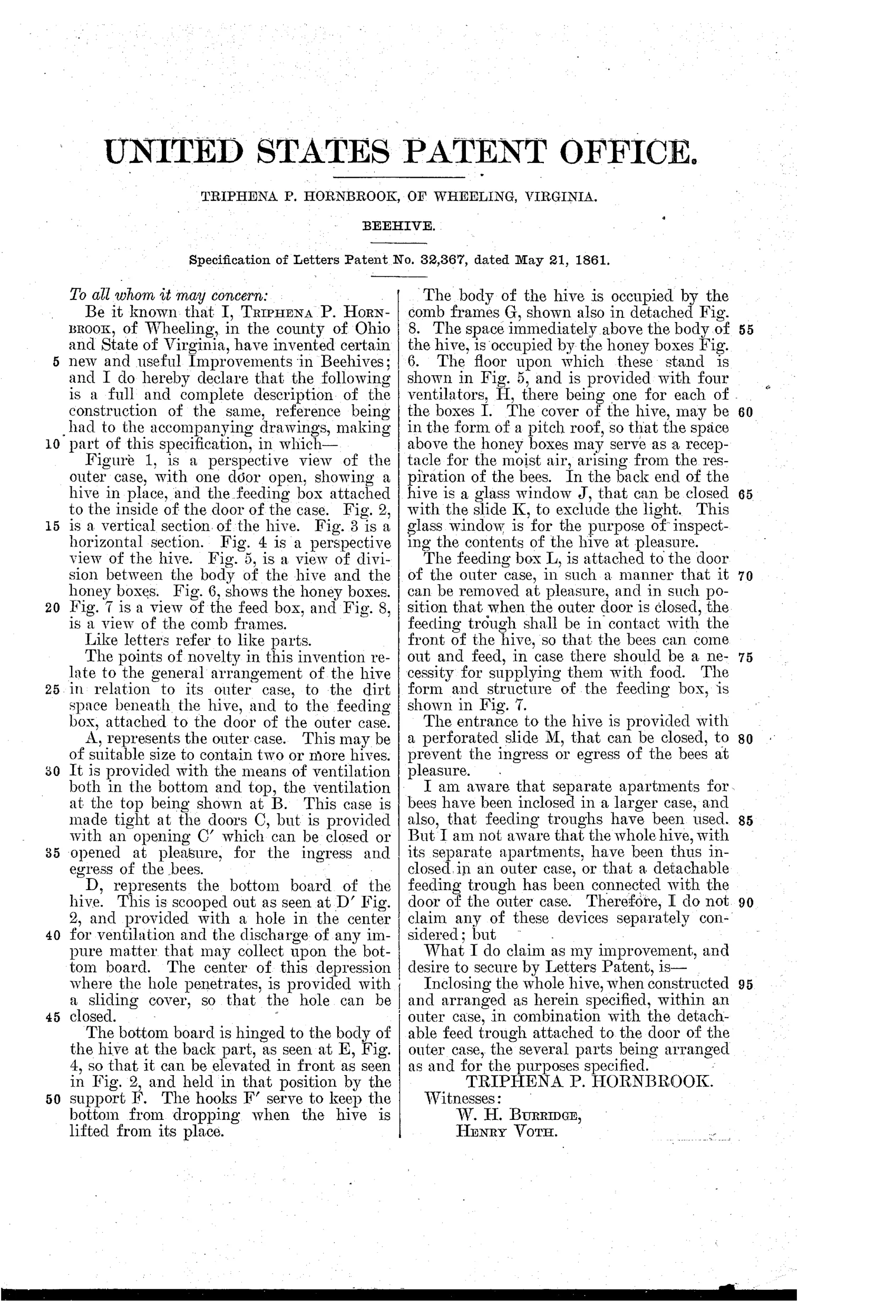
“Inclosing the whole hive, when constructed and arranged as herein specified, within an outer case, in combination with the detachable feed trough attached to the door of the outer case, the several parts being arranged as and for the purposes specified.”
In plain English: The invention claims placing the entire beehive inside an outer protective case together with a removable feeding trough mounted on the case's door.
⬡ In the inventor’s words
“I am aware that separate apartments for bees have been inclosed in a larger case, and also, that feeding troughs have been used. But I am not aware that the whole hive, with its separate apartments, have been thus inclosed in an outer case, or that a detachable feeding trough has been connected with the door of the outer case.”— Triphena P. Hornbrook, from the specification
Fate unknown
No commercial production or surviving example is documented; a marked hive or a period advertisement from the Wheeling area would settle it.
⬡ Commentary
Triphena P. Hornbrook is one of the earliest women to hold a beehive patent, and she filed it from Wheeling, Virginia in May 1861 — a month after Fort Sumter, in a city that would shortly declare for the Union and become West Virginia. That alone earns this one a look. But the design itself is better than a curiosity.
The core idea is a hive-within-a-case: the frame hive sits inside an outer shell with an insulating air space and ventilation top and bottom. That is a genuinely sound instinct, and it anticipates the double-walled and telescoping-cover hives that became standard for wintering bees in cold climates decades later. Hornbrook's own claim language is careful and modest — she concedes that enclosed apartments and feed troughs both existed, and stakes her ground only on the combination, which is how an honest 1861 claim reads.
The nicest mechanical touch is the feed trough mounted on the outer case's door: swing the door shut and the trough mates against the hive front, so you can feed in bad weather without ever exposing the colony. Fig. 1 shows the whole arrangement with the door thrown open, and Fig. 8 confirms she is using movable comb frames — this is a post-Langstroth design, not a box-hive folly. The scooped, tilting bottom board for cleaning is another practical detail. Overpriced to build compared to a bare Langstroth, which is likely why the industry went the other way, but nothing here is quackery.
Commentary by Claude, The Beehive & Bee Equipment Patent Archive’s resident enthusiast