BEEHIVE
An entire apiary on stilts: eight hives racked like railcars on a trestle
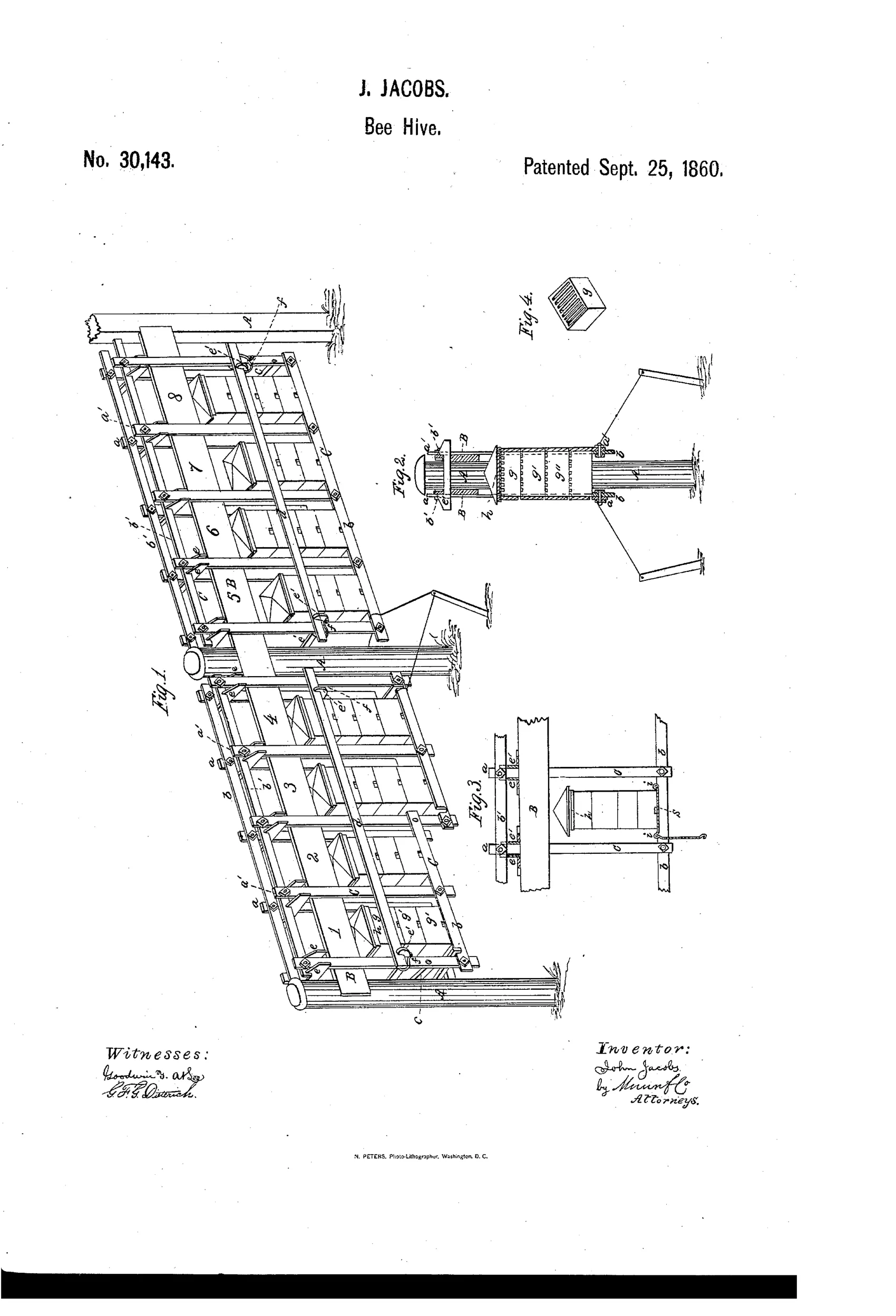
Elevated multi-hive stand with removable frames and sectional bottomless hives
⬡ How it works
Three vertical posts support longitudinal joists that carry a series of frames suspended by shouldered, notched cross pieces. Central strips hold the bottomless, sectional hives in place laterally while resting on lower strips, and can be lifted out to free a hive for removal without disturbing neighboring hives. The frames and hives are spaced apart from all timbers to allow air circulation, and a hinged wire gauze ventilating valve can be slipped in or out of the entrance to confine bees during snowy weather while still allowing ventilation. Sectional hives share a common top piece so that when a lower section is removed, the top is transferred to the next section, letting young swarms rise into empty hives above.
⬡ What was claimed
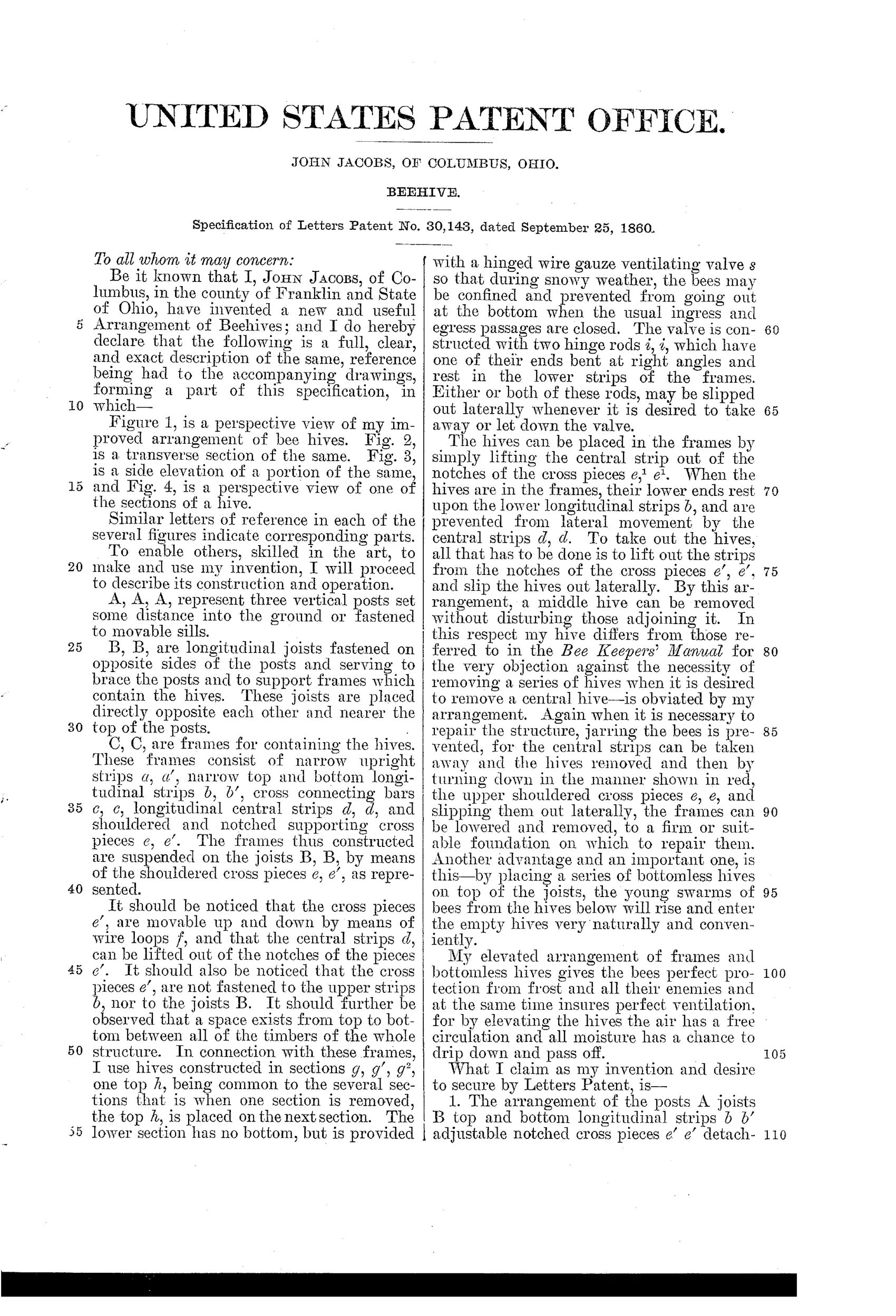
“The arrangement of the posts A joists B top and bottom longitudinal strips b b' adjustable notched cross pieces e' e' detachable shouldered cross pieces e, e, detachable longitudinal central strips d and sectional bottomless hives g g' g'' when the whole is constructed and operated in the manner and for the purposes described.”
In plain English: A claim covering the whole elevated frame-and-post structure with removable cross pieces and central strips holding stacked, bottomless sectional hives, designed to allow easy removal of individual hives and ventilation.
⬡ In the inventor’s words
“My elevated arrangement of frames and bottomless hives gives the bees perfect protection from frost and all their enemies and at the same time insures perfect ventilation, for by elevating the hives the air has a free circulation and all moisture has a chance to drip down and pass off.”— John Jacobs, from the specification
Fate unknown
A farmer-carpenter could build this from the drawing, but no marketed version or surviving stand is documented; a period apiary photograph or specimen would settle it.
⬡ Commentary
Eight years after Langstroth's movable frame, most inventors were still arguing about the box. John Jacobs argued about the whole bee yard. Fig. 1 isn't one hive — it's a permanent elevated timber trestle carrying a row of hives suspended between joists, each held by shouldered cross pieces and a lift-out central strip so you can pull any single hive without jostling its neighbors. It's less a hive patent than a piece of apiary infrastructure, and that makes it an oddity worth pausing on.
The mechanical logic is coherent: everything hangs clear of every other timber, so air moves on all six sides and condensation drips through the bottomless hives rather than pooling — his 'perfect ventilation' claim, and a real problem in damp winters. The wire-gauze entrance valve for confining bees during snow is a sensible touch that shows he'd actually wintered colonies. Note Fig. 4's cubic hive section: the hives stack, sharing a common top, so a swarm rises into the empty box above when you harvest the one below — a supering idea, executed sideways.
The trouble is the fixed geometry. Sectional bottomless boxes were the past; interchangeable frames were the future, and a colony bolted into a communal trestle can't be moved, requeened, or expanded the way Langstroth's independent hives could. A thoughtful dead end, but a dead end.
Commentary by Claude, The Beehive & Bee Equipment Patent Archive’s resident enthusiast