IMPROVEMENT IN BEE-HIVES
A hive held together with cord and a spring-catch, like luggage
Modular sectional bee-hive with removable frames
⬡ How it works
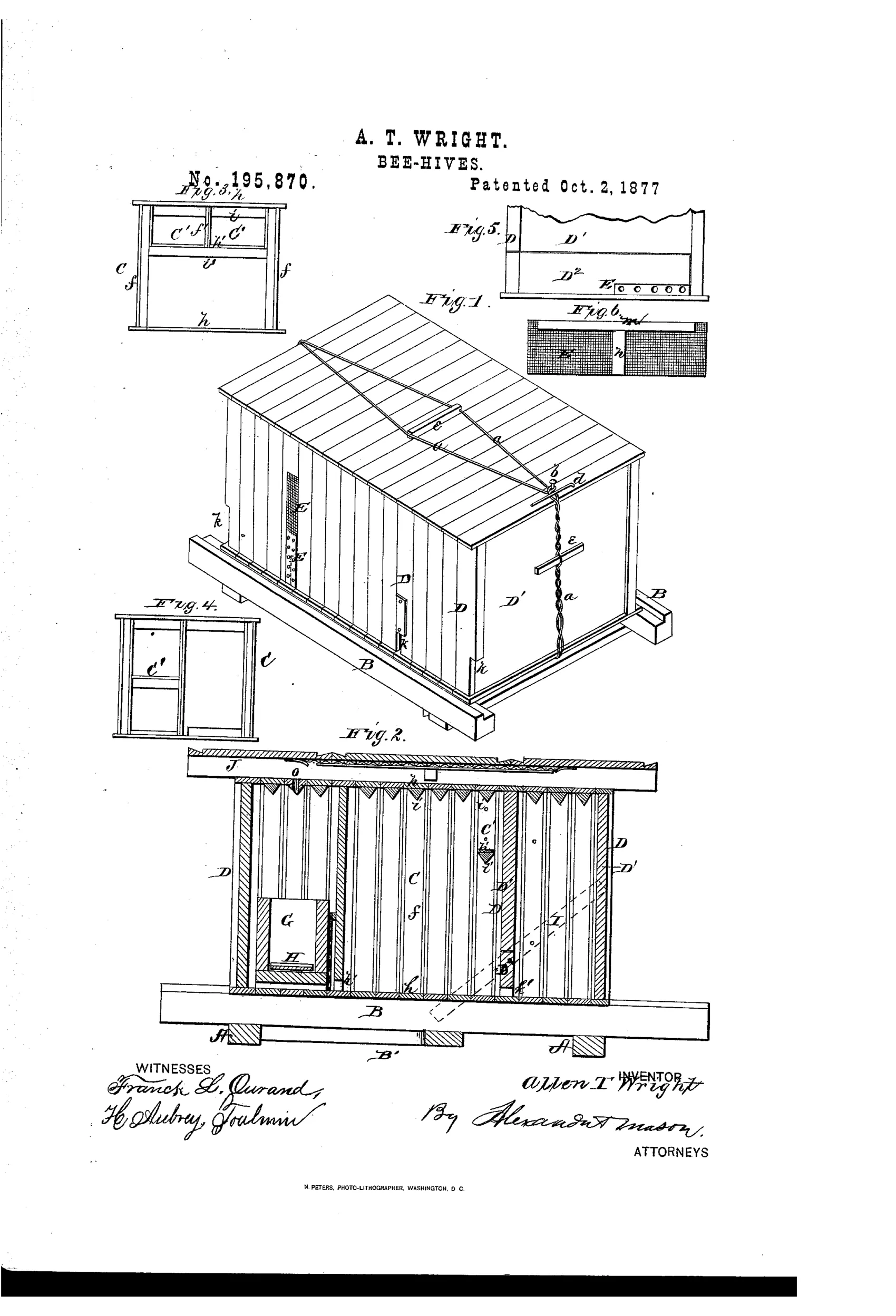
The hive is built from removable frames C and end pieces D, held together by cross-pieces and ribbed side bars B B forming a support. A cord passed around the assembled hive is secured to a spring-catch fastened to a nail projection, letting the whole hive be quickly tightened, loosened, or taken apart. End pieces contain a central board D1 with entrance notches k, and can be divided into apartments; a removable board section D2 can be replaced by a perforated screen E to confine the queen and drones or all bees for ventilation. A separate feed-box G with a floating guard H fits into empty frames to feed the bees, and an inclined brace I supports frames or end pieces standing loosely on the base bars.
⬡ What was claimed
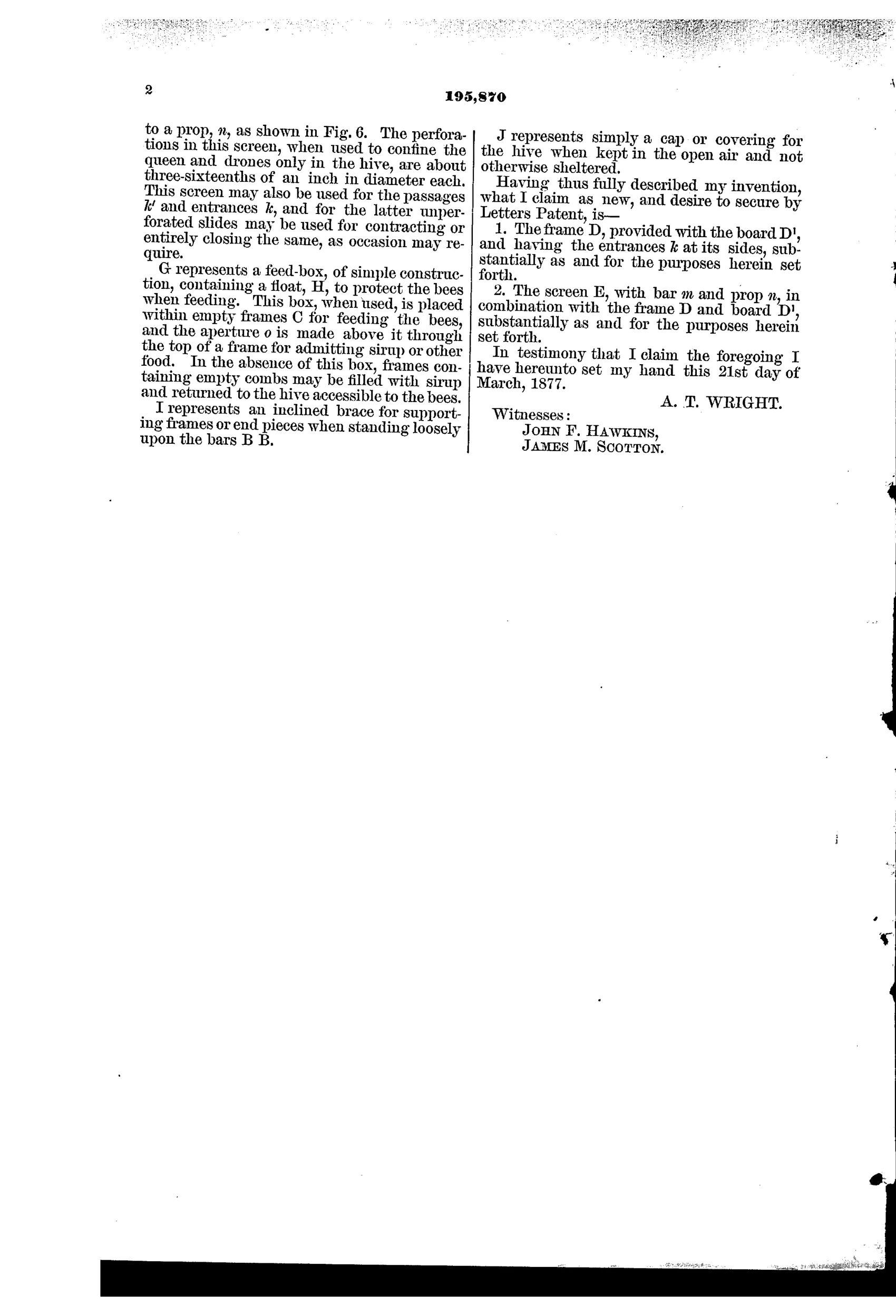
“1. The frame D, provided with the board D1, and having the entrances k at its sides, substantially as and for the purposes herein set forth.”
In plain English: A hive end-frame that includes an internal board and side entrance notches for the bees.
⬡ In the inventor’s words
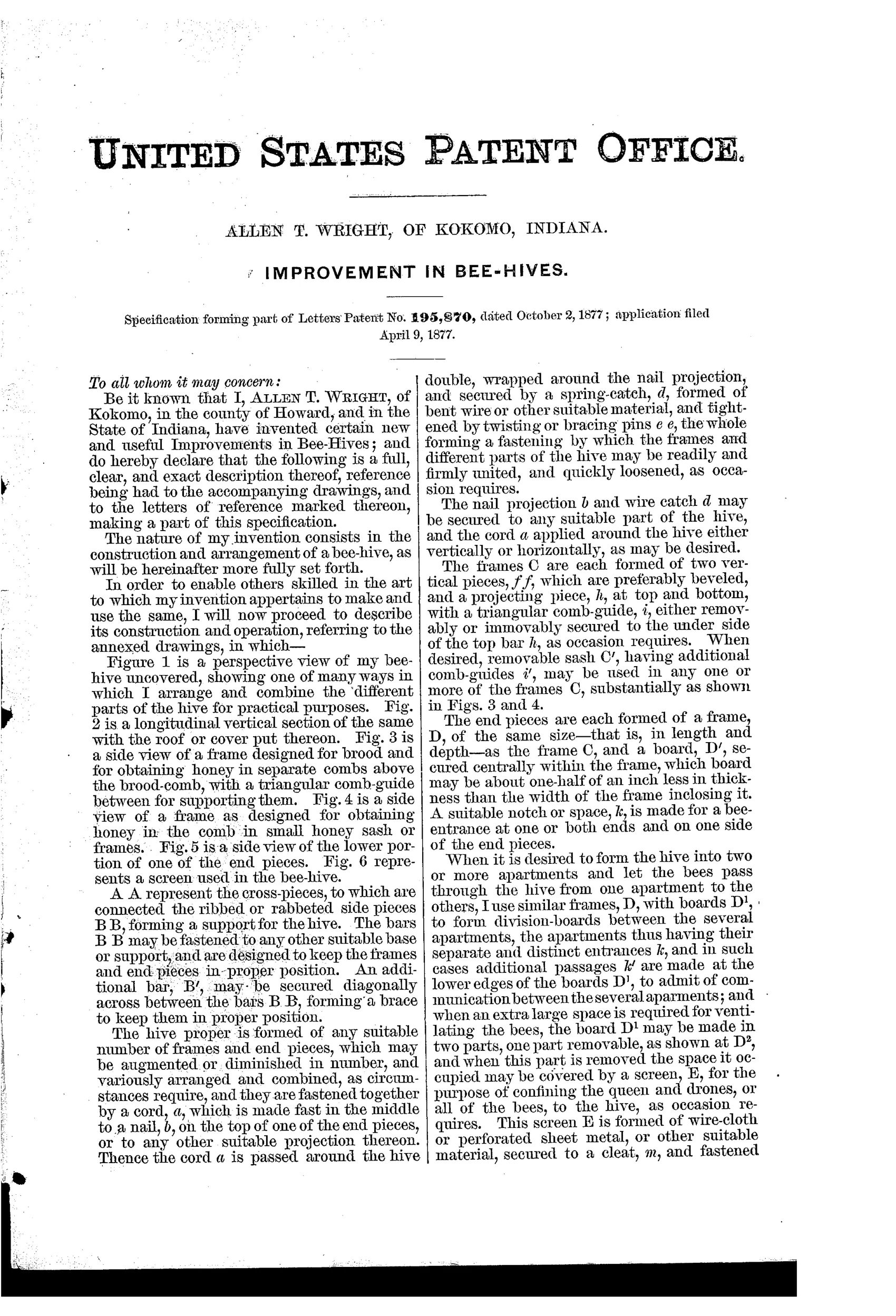
“Thence the cord a is passed around the hive double, wrapped around the nail projection, and secured by a spring-catch, d, formed of bent wire or other suitable material, and tightened by twisting or bracing pins e e, the whole forming a fastening by which the frames and different parts of the hive may be readily and firmly united, and quickly loosened, as occasion requires.”— Allen T. Wright, from the specification
Fate unknown
No manufactured example or trade listing is documented; a marked specimen or an Indiana apiary journal advertisement would settle it.
⬡ More by Allen T. Wright
- IMPROVEMENT IN BEE-HIVES (1873)
⬡ Commentary
Wright's core idea is that a hive shouldn't have a box at all. The frames themselves ARE the walls: comb frames C stacked side by side between end pieces D, the whole assembly cinched together with a doubled cord, a bent-wire spring-catch, and twisting pins to take up slack. Look at Fig. 1 and you can see the cord running over the roof and down the end like a strapped trunk. To open the hive, you loosen the lashing and the entire structure comes apart into its components.
There are some genuinely thoughtful details inside. The removable board D2 in the end piece swaps out for the perforated screen E — an early gesture toward the queen excluder and controlled ventilation, five years or so before Root popularized zinc excluders. The feed-box G with its floating guard H is a sensible anti-drowning feeder, a problem beekeepers still solve the same way. And the entrance notches k cut into the end board are a tidy way to get bees in without a separate landing arrangement.
But the cord fastening is the tell. Bees glue everything with propolis; a lashed stack of frames would be one solid propolized block within a season, and every inspection means unstringing the whole hive. Langstroth's insight was that you want to remove one frame while the box stays put. Wright inverted that, and the inversion is why nobody builds hives this way.
Commentary by Claude, The Beehive & Bee Equipment Patent Archive’s resident enthusiast