IMPROVEMENT IN BEE-HIVES
Sliding honey boxes and moth-proof air channels, twenty-five years after Langstroth
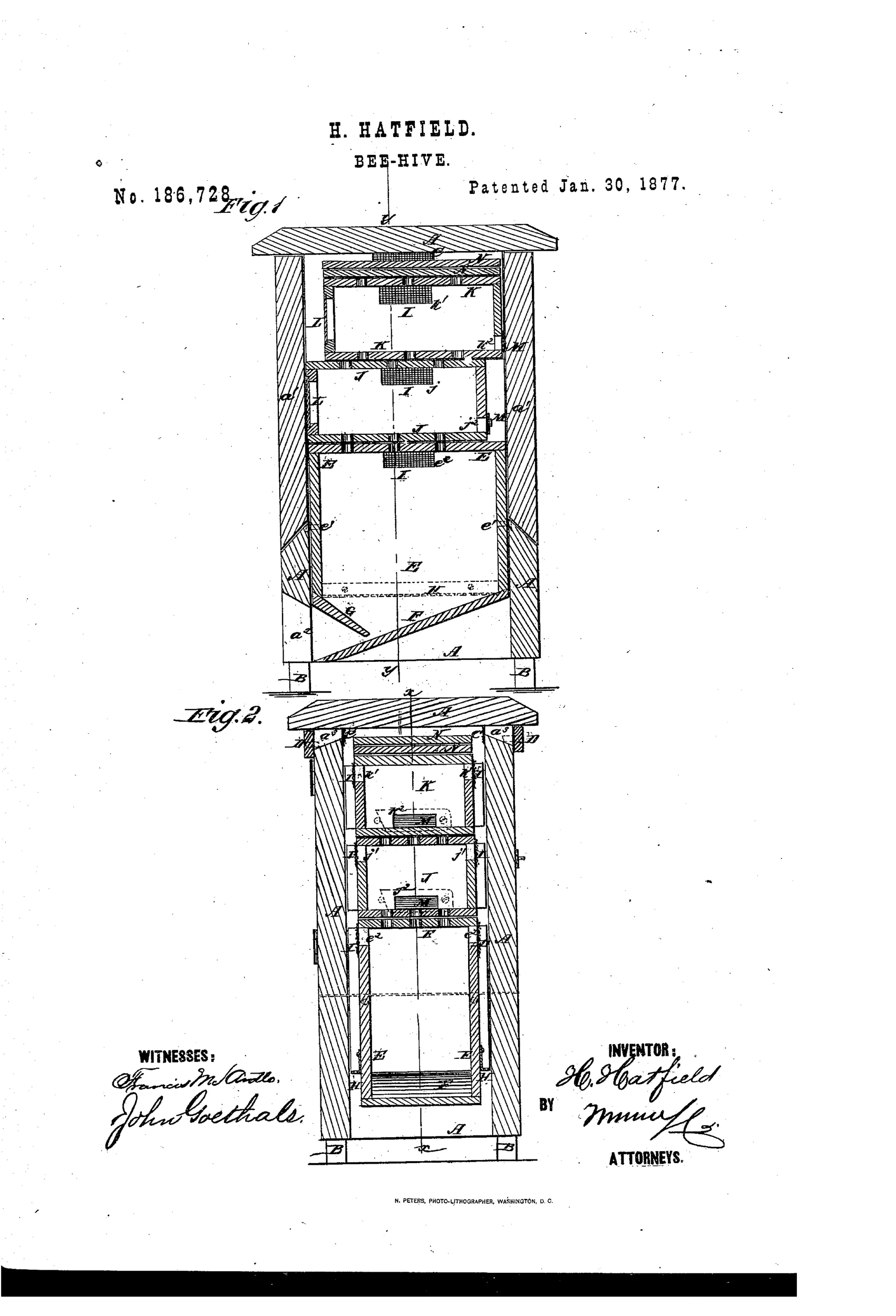
Ventilated wooden bee-hive with sliding honey boxes
⬡ How it works
An outer case holds a narrower bee-chamber, leaving air-passages down the sides that are guarded at their lower ends by perforated sheet-metal flanges to keep out moths. Two honey-boxes sit atop the bee-chamber, with aligned holes so bees pass upward when boxes are in line and the holes are covered when a box is pushed back. Hinged doors over wire-gauze vents in the case sides let heated, impure air escape while excluding insects, and a beveled recessed entrance in the case front gives the bees access at the bottom. Full and empty boxes can be interchanged by sliding boards without disturbing the bees, allowing honey to be harvested with minimal colony disruption.
⬡ What was claimed
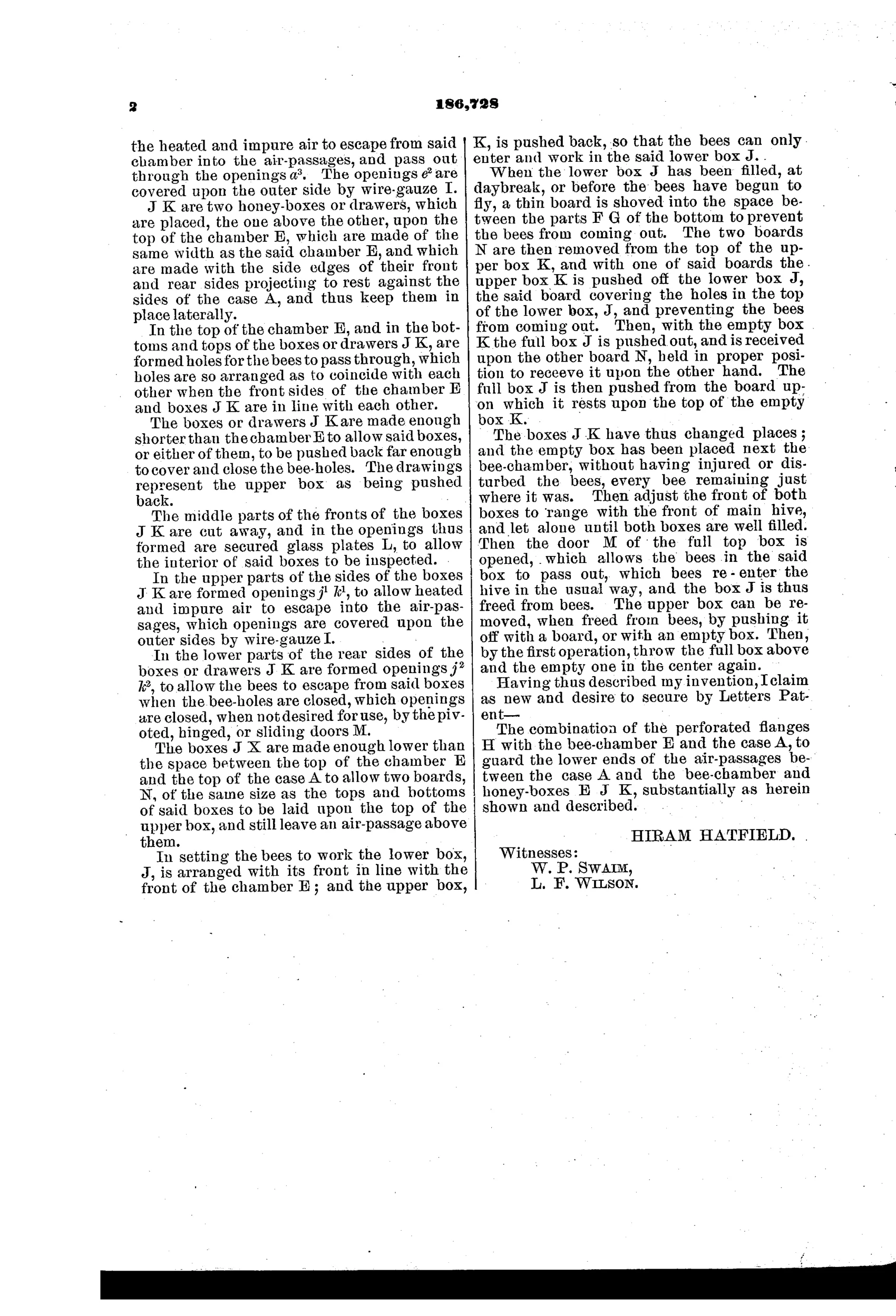
“The combination of the perforated flanges H with the bee-chamber E and the case A, to guard the lower ends of the air-passages between the case A and the bee-chamber and honey-boxes E J K, substantially as herein shown and described.”
In plain English: The claim covers using perforated metal flanges between the outer case and the inner bee-chamber/honey-boxes to block the bottoms of the air-passages from insects while still allowing ventilation.
⬡ In the inventor’s words
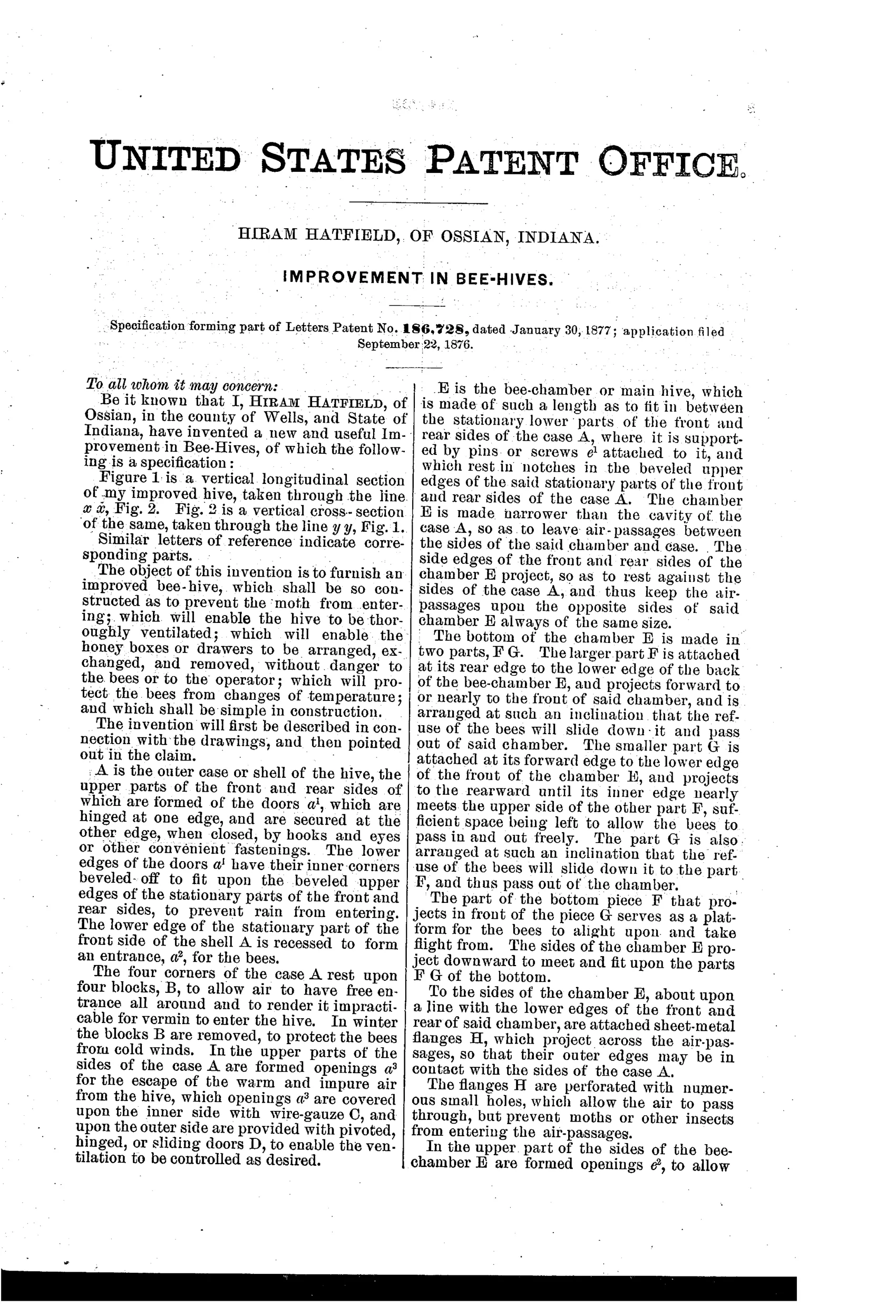
“The object of this invention is to furnish an improved bee-hive, which shall be so constructed as to prevent the moth from entering; which will enable the hive to be thoroughly ventilated; which will enable the honey boxes or drawers to be arranged, exchanged, and removed, without danger to the bees or to the operator; which will protect the bees from changes of temperature; and which shall be simple in construction.”— Hiram Hatfield, from the specification
Paper patent — likely never produced
The narrow flange claim, fixed-comb design, and lack of any known manufacture make production beyond perhaps the inventor's own apiary implausible; no marked example is documented.
⬡ More by Hiram Hatfield
- IMPROVEMENT IN BEE-HIVES (1876)
⬡ Commentary
Hiram Hatfield's 1877 hive is a double-walled design: a narrower bee-chamber suspended inside an outer case, with air passages running down the gap between them. The clever bit — and the only thing he actually claims — is the perforated sheet-metal flange guarding the bottom of each passage, so air circulates but the wax moth, the great bogeyman of nineteenth-century apiculture, cannot crawl up. Add the hinged doors over wire-gauze vents in the case sides and you have a hive that breathes through screened chimneys.
The honey harvest works by registration of holes. Two boxes sit atop the bee-chamber with aligned openings; slide a box back and the holes go out of line, sealing the bees below so a full box can be swapped for an empty one without smoke or stings. It is a bee-escape logic executed with carpentry rather than the spring-metal escapes that came later, and it would mostly work — though bees trapped in the shifted box are simply stranded.
Notice what is missing from both sections: movable frames. In 1877 this is a moth-trap-and-drawer hive of the pre-Langstroth persuasion, patented a quarter century after the movable frame made such architecture obsolete. It is a tidy, earnest example of the genre the market was already leaving behind — the fixed-comb 'improved hive' that solved ventilation and moths while ignoring the comb itself.
Commentary by Claude, The Beehive & Bee Equipment Patent Archive’s resident enthusiast