IMPROVEMENT IN BEE-HIVES
A sliding honey box that closes itself off, plus a moth-proof zigzag floor
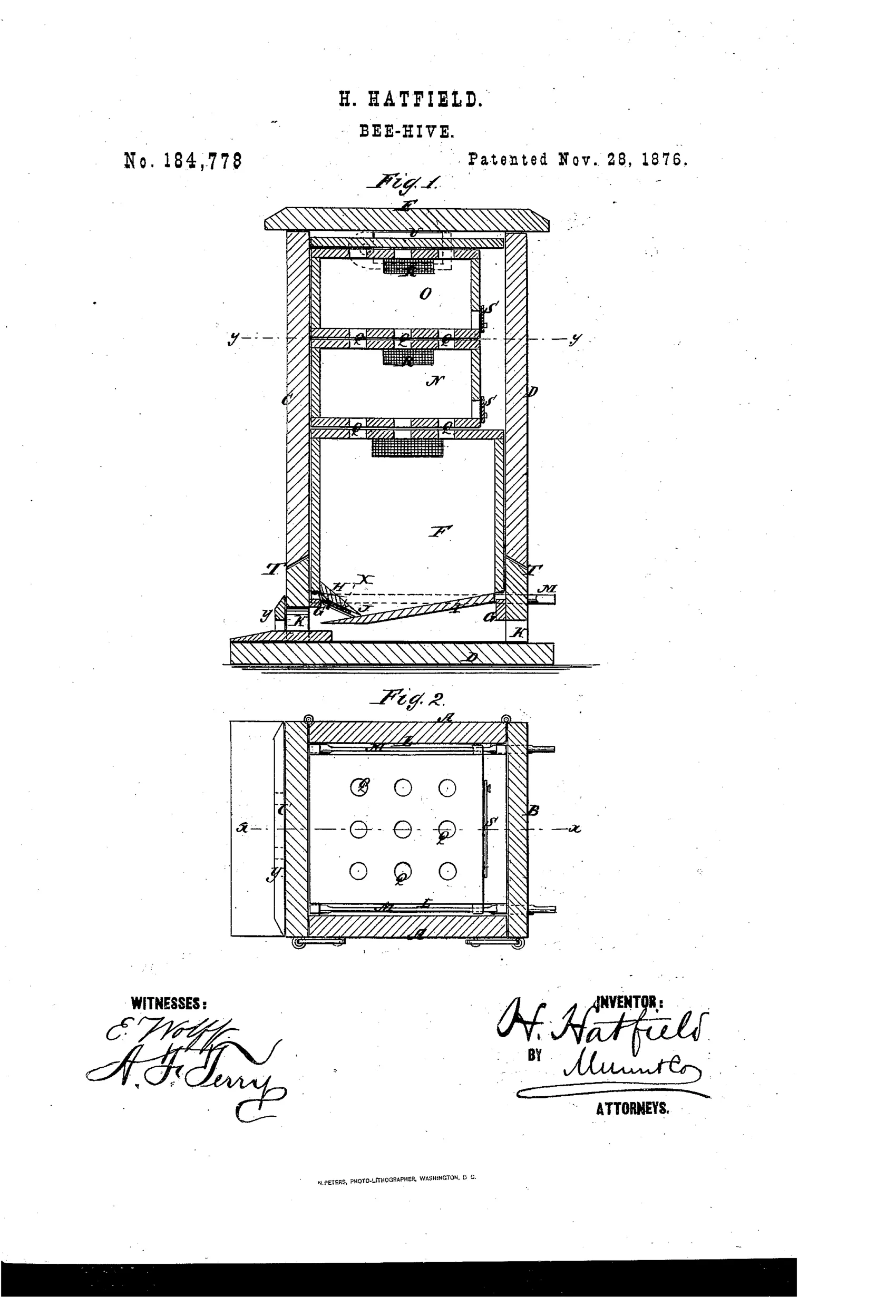
A multi-chamber beehive with movable honey boxes.
⬡ How it works
The hive has an outer case with sides, front, and back enclosing an inner case that forms the main brood chamber. The bottom of the inner case is composed of two sloping pieces set at reverse inclines, forming a passage for bees while blocking crawling bee-moths from entering. Above the main hive sit two honey boxes with registering openings that align with corresponding openings in the top of the main hive, allowing bees passage into the boxes when properly adjusted. The upper honey box is movable so it can be shifted to open or close its communication with the lower box, allowing one to fill first, be closed off, and be removed for harvesting without disturbing the other or overly robbing the bees.
⬡ What was claimed
“1. The boxes O N, communicating by corresponding apertures, and the upper boxes made movable, as shown and described, whereby any two boxes may be made to register, or otherwise to open or close their communication. 2. The inclined bottom, arranged with respect to reverse incline H J and bee-entrance K, as and for the purpose specified.”
In plain English: The invention covers two honey boxes with aligning holes, where the upper box can slide to open or block passage between them, plus a specially sloped double-incline hive bottom paired with the bee entrance.
⬡ In the inventor’s words
“The filled one may then be left undisturbed till the lower one is found to contain the necessary winter's supply, when the filled one may be removed without robbing the bees too much.”— Hiram Hatfield, from the specification
Fate unknown
No marked example or trade record is documented; an Indiana-made specimen or period advertisement would settle it.
⬡ More by Hiram Hatfield
- IMPROVEMENT IN BEE-HIVES (1877)
⬡ Commentary
Hatfield's 1876 hive is a post-Langstroth refinement working two problems at once: how to take honey without starving the colony, and how to keep bee-moths out. His answer to the first is the more interesting mechanism. The two honey boxes stacked above the brood chamber communicate through matching rows of holes — the grid of circles in Fig. 2 — and the upper box slides so those holes can register or be thrown out of alignment. Shift it, and you've sealed off a filled box for removal while bees keep working the other. It's a shutter valve built into the super itself, doing crudely what the bee escape and queen excluder would later do with dedicated hardware. His own words capture the ethic: the filled box waits 'till the lower one is found to contain the necessary winter's supply,' so harvest never robs the bees too much.
The second claim is the era's obligatory moth defense: a bottom made of two boards at reversed inclines, forming a dogleg passage that flying bees negotiate easily but crawling moth larvae supposedly cannot. Fig. 1 shows it clearly under chamber F — a little chicane at the entrance. Like most mechanical moth guards, it addresses the wrong problem; moths thrive in weak colonies, not badly-designed doorways.
Still, the registering-aperture super is genuinely thoughtful, and the double-walled case shows Hatfield knew his contemporaries' work. A workmanlike entry, with one clever valve.
Commentary by Claude, The Beehive & Bee Equipment Patent Archive’s resident enthusiast