IMPROVEMENT IN BEE-HIVES
Diamond frames turned 45 degrees, in a hive built like a Texas chapel
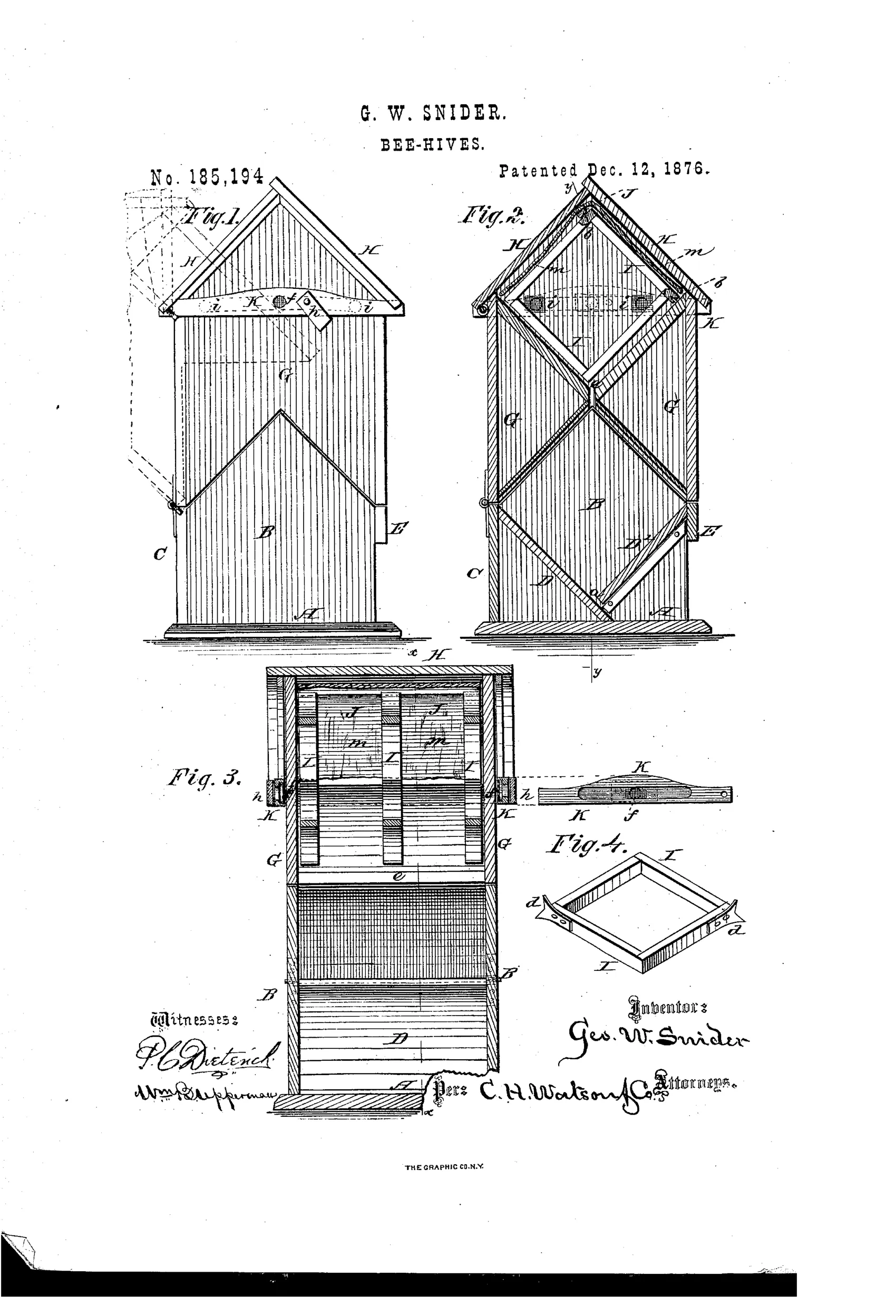
A two-chamber wooden bee-hive with movable frames
⬡ How it works
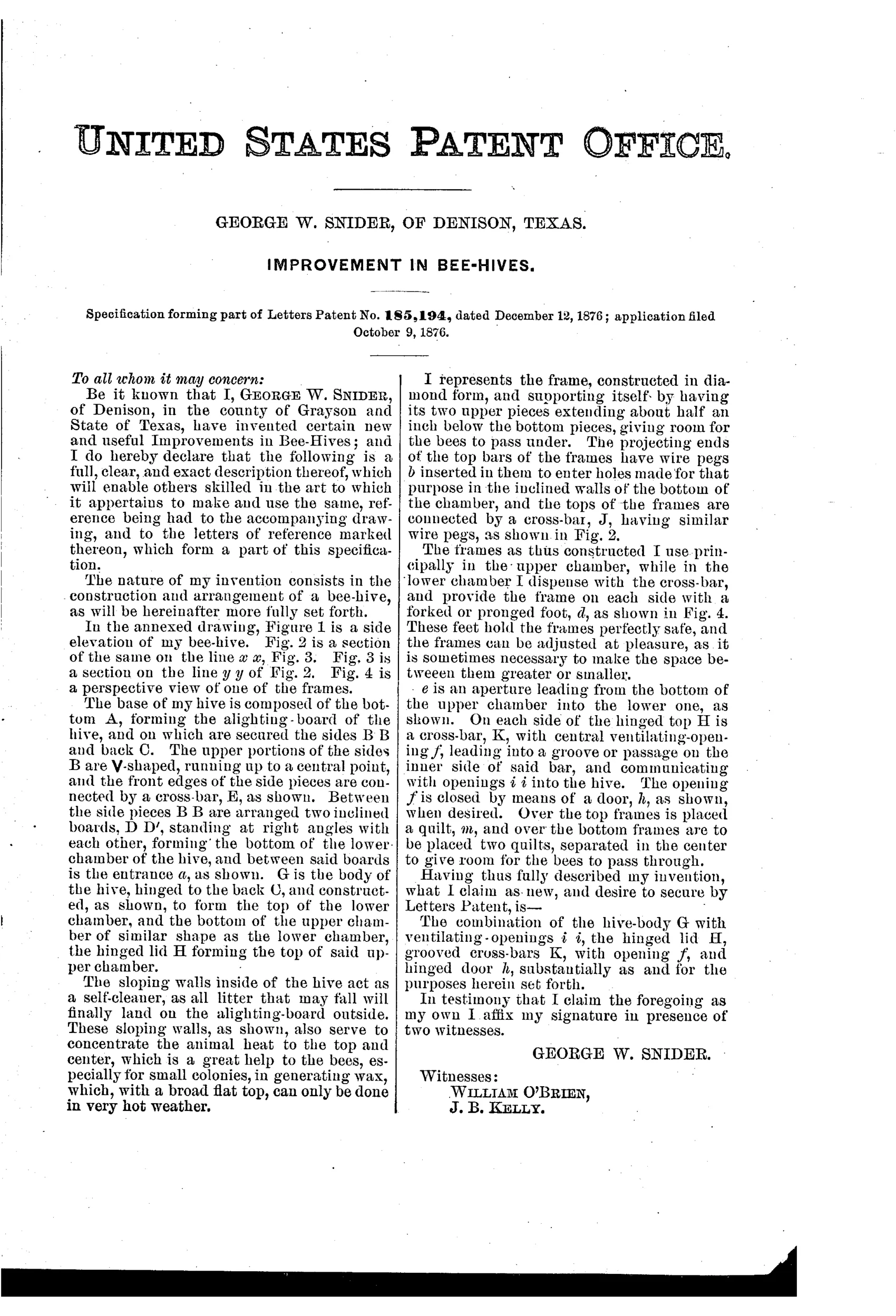
The hive body G is hinged to a back board C and forms the top of a lower chamber and bottom of an upper chamber, both with sloping V-shaped inner walls that channel debris out onto an alighting board and concentrate heat toward the top. Diamond-shaped movable frames I, fitted with wire pegs b and connected by a cross-bar J, hang in the upper chamber, while similar frames with forked feet d rest in the lower chamber. An aperture e lets bees pass between chambers, and a hinged lid H with grooved cross-bars K containing a ventilating opening f and hinged door h controls airflow into the hive interior via openings i i.
⬡ What was claimed
“The combination of the hive-body G with ventilating-openings i i, the hinged lid H, grooved cross-bars K, with opening f, and hinged door h, substantially as and for the purposes herein set forth.”
In plain English: The claim covers the hive body combined with its ventilation openings, hinged lid, grooved cross-bars with an opening, and a hinged door, all working together as described.
⬡ In the inventor’s words
“These sloping walls, as shown, also serve to concentrate the animal heat to the top and center, which is a great help to the bees, especially for small colonies, in generating wax, which, with a broad flat top, can only be done in very hot weather.”— George W. Snider, from the specification
Fate unknown
No record of manufacture is known to me, and diamond frames left no commercial descendant; a surviving marked hive or a period supply-catalog listing would settle it.
⬡ Commentary
By 1876 the Langstroth rectangle had a quarter-century head start, and here comes George Snider of Denison, Texas, rotating the whole idea 45 degrees. His frames are diamonds — squares standing on a corner — hung by wire pegs in the upper chamber and standing on forked feet in the lower one. Look at Fig. 2 and you can see why he did it: the diamonds nest into the sloping V-shaped inner walls of each chamber, so the hive body and the comb share the same geometry. Debris slides down the slopes and out onto the alighting board, and Snider argues the sloping walls concentrate 'animal heat to the top and center' to help small colonies draw wax. That thermal instinct is not crazy — heat retention genuinely matters to weak colonies.
But the diamond is a dead end, and the reason is coming fast down the road: the centrifugal extractor and machine-made foundation both assume rectangles. A diamond frame is awkward to uncap, awkward to spin, and wastes the box's corners. Even the handling is fussy — pegs above, forked feet below, a cross-bar tying frames together.
What the drawing rewards is the ventilation train in the peaked lid: grooved cross-bars, an opening with its own hinged door, feeding air through ports in the gable. Snider claimed that combination, not the diamonds — perhaps sensing where his real novelty lay. A thoughtful, doomed shape.
Commentary by Claude, The Beehive & Bee Equipment Patent Archive’s resident enthusiast