IMPROVEMENT IN BEE-HIVES
A moth trap under the floor and a cover that fits two ways
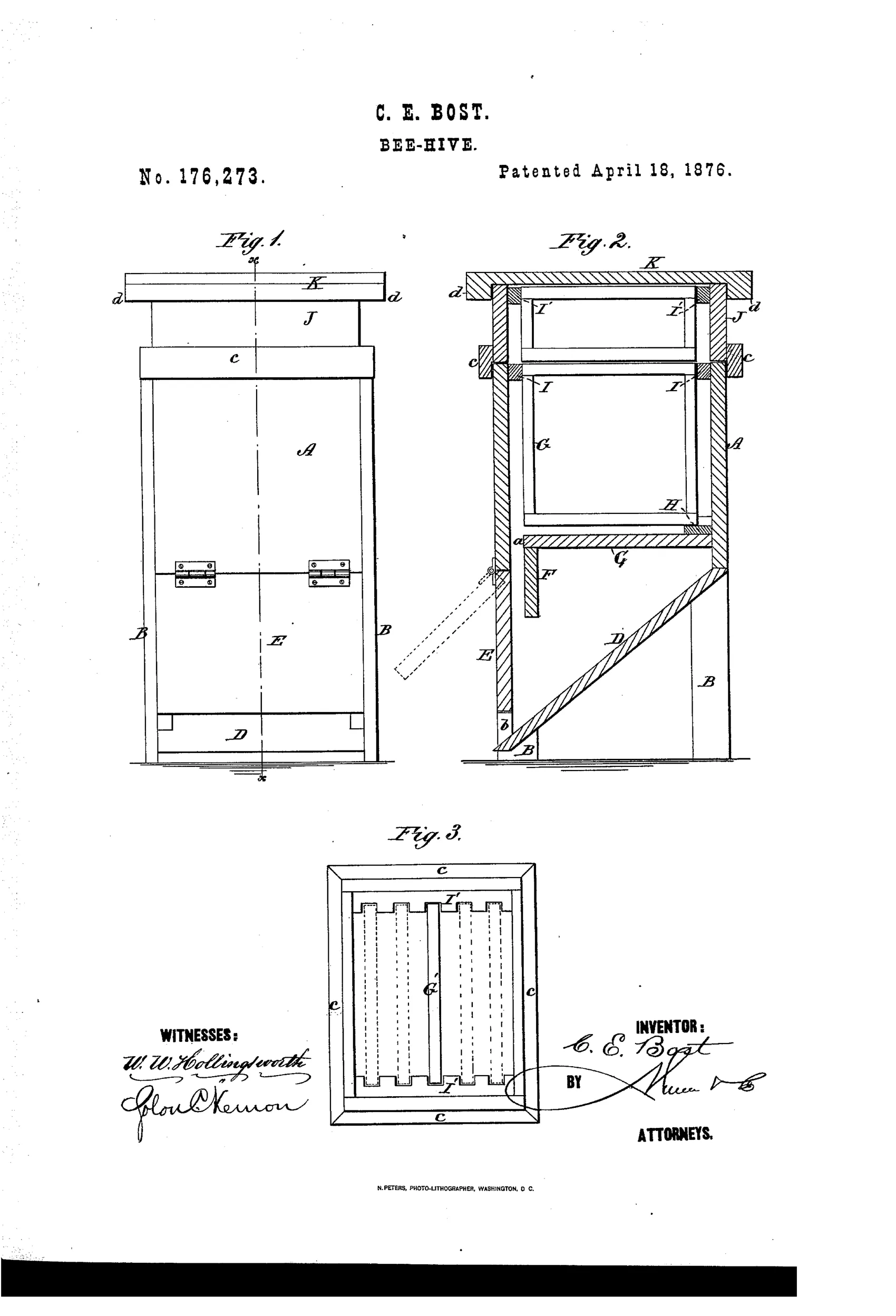
Improved wooden bee-hive with moth trap
⬡ How it works
The hive body A rests on legs B that extend over the corner seams, with a horizontal bottom C leaving a gap 'a' for bee entry. A hinged door E and inclined lighting board D form a triangular chamber that traps moths and millers below the hive while a pendent board F screens the entrance from other insects. A detachable supplemental section J, matching the hive's transverse dimensions, uses guideways I' to hold a shallower set of honey frames G', and connects via a lap joint formed by boards c and a cover K with rim d that fits either the hive body or the supplemental section. Interior frames G are held in place by a notched bar H and guides I with about a half-inch clearance for ventilation and cleanliness.
⬡ What was claimed
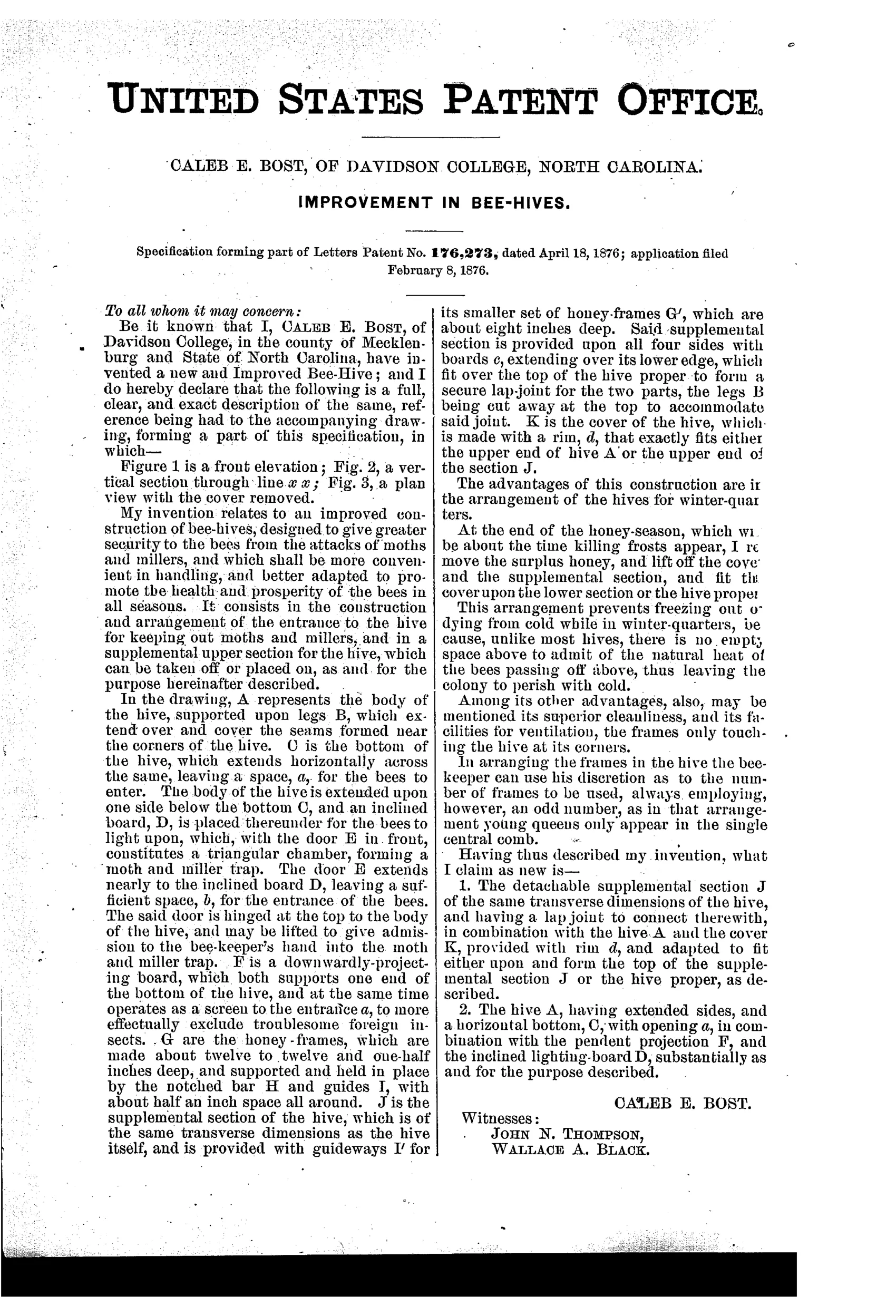
“The detachable supplemental section J of the same transverse dimensions of the hive, and having a lap joint to connect therewith, in combination with the hive A and the cover K, provided with rim d, and adapted to fit either upon and form the top of the supplemental section J or the hive proper, as described.”
In plain English: A removable upper honey box that matches the hive's size and locks on with a lap joint, paired with a cover that can fit either the upper box or the main hive body directly.
⬡ In the inventor’s words
“This arrangement prevents freezing or dying from cold while in winter-quarters, because, unlike most hives, there is no empty space above to admit of the natural heat of the bees passing off above, thus leaving the colony to perish with cold.”— Caleb E. Bost, from the specification
Fate unknown
No manufacturer, assignment, or surviving marked hive is documented; a period supply catalog or specimen would settle it.
⬡ Patented the same day
- IMPROVEMENT IN FILLING PACKAGES WITH COMB-HONEY — Charles O. Perrine
⬡ Commentary
Bost's hive is a nice snapshot of what post-Langstroth beekeeping looked like in the hands of a thoughtful amateur: movable frames adopted, bee-space fussiness half-understood, and the era's twin obsessions — wax moths and winter losses — driving the odd bits. The signature feature here is under the hive, not in it. The legs and inclined lighting board form a triangular dead space below the entrance, closed by a hinged door E, meant to trap moths and millers before they reach the comb. Fig. 2 shows it clearly: bees enter through the narrow gap 'a' above the board while the pests supposedly blunder into the pocket below. Whether moths actually cooperate with that arrangement is another matter; the trap-hive genre rarely worked, since moths ride in on the bees' own traffic.
The genuinely practical piece is the claim itself: a shallow supplemental section J with its own smaller frames and a lap-jointed cover K that fits either the super or the bare hive body. That's a honey super with an interchangeable telescoping cover — exactly the direction the industry was heading, worked out independently in North Carolina.
His winter argument — no empty headspace above the cluster, so heat can't escape — is sound instinct, even if we'd now frame it as condensation management. A workmanlike entry with one clever joint and one earnest folly.
Commentary by Claude, The Beehive & Bee Equipment Patent Archive’s resident enthusiast