IMPROVEMENT IN BEE-HIVES
A V-shaped brood chamber that funnels moths into a glass-walled trap below
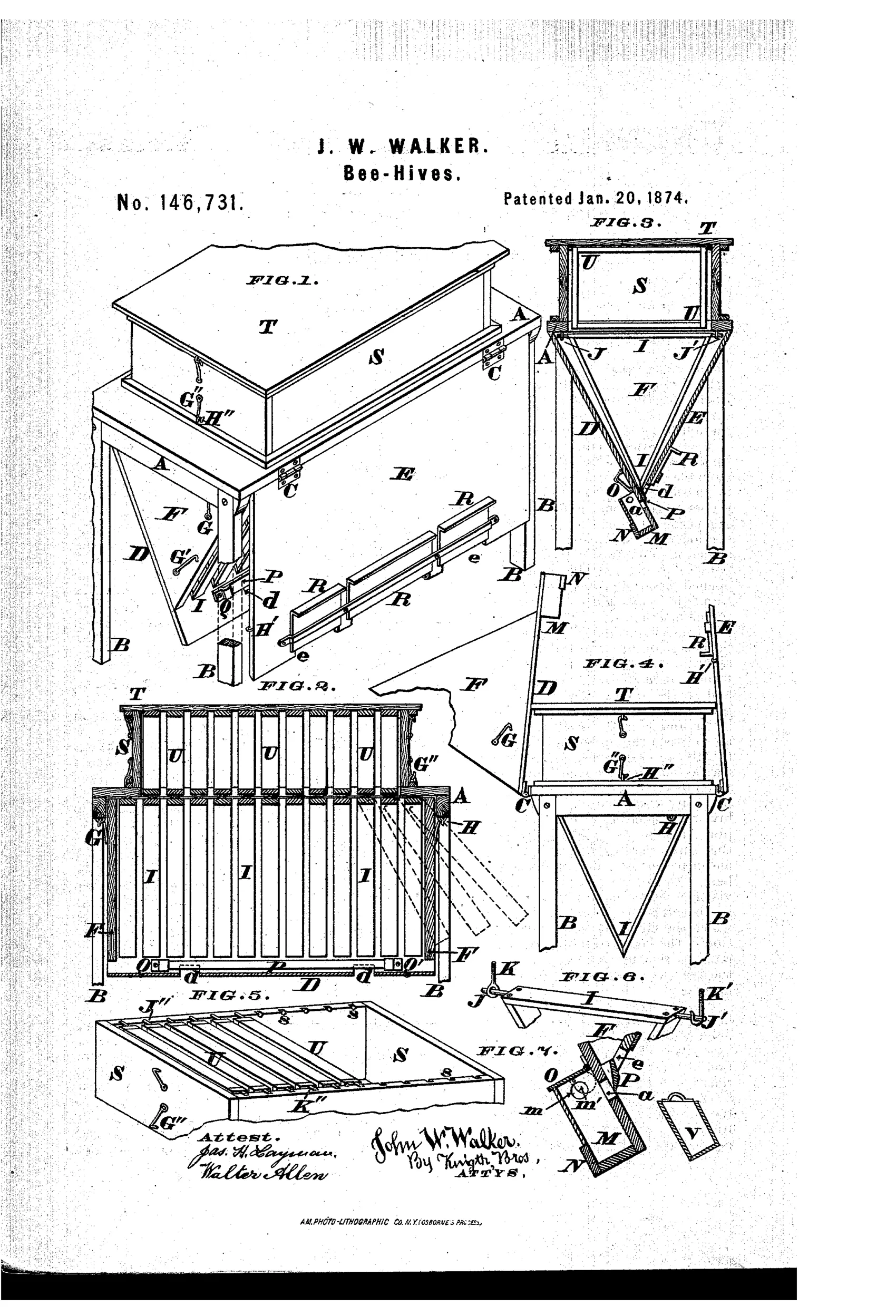
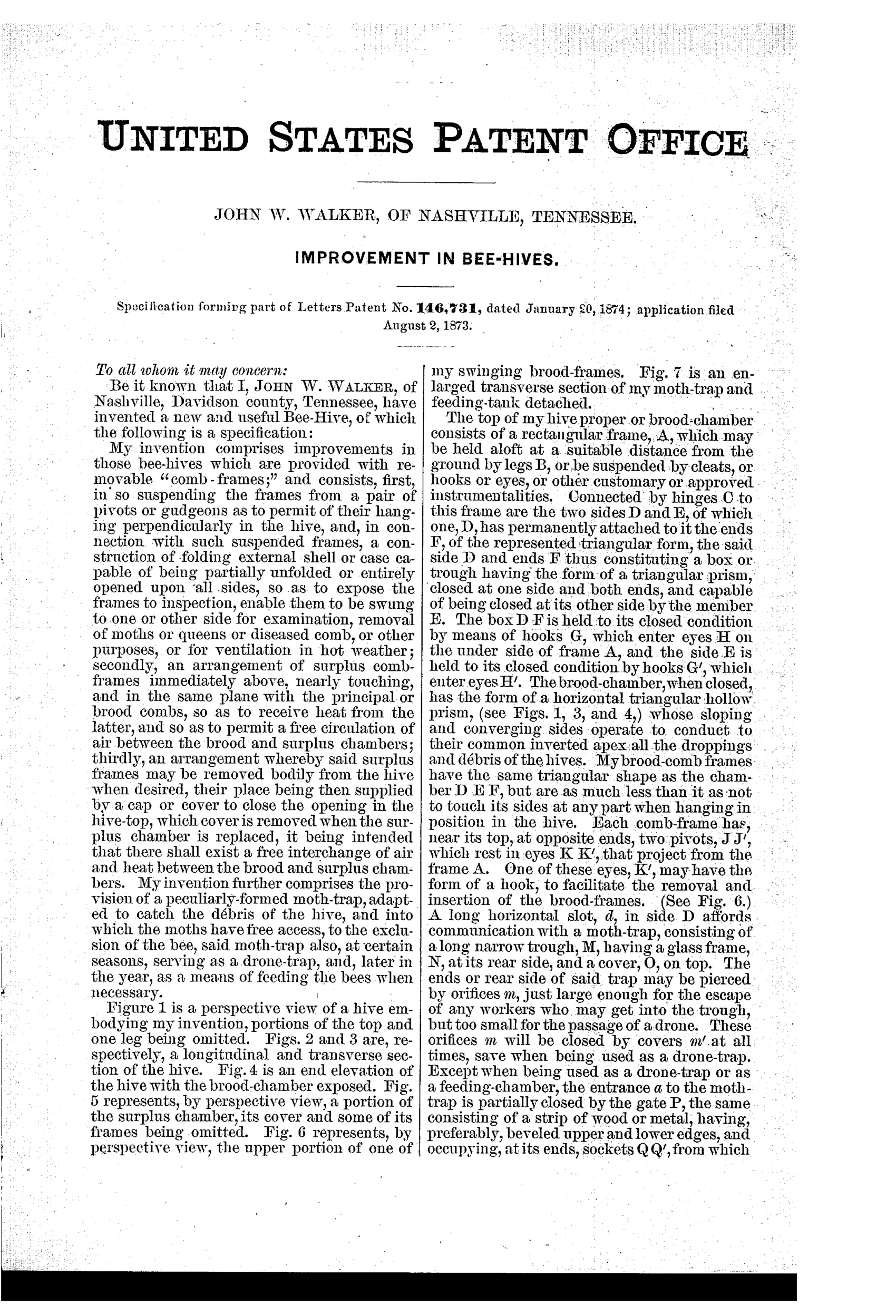
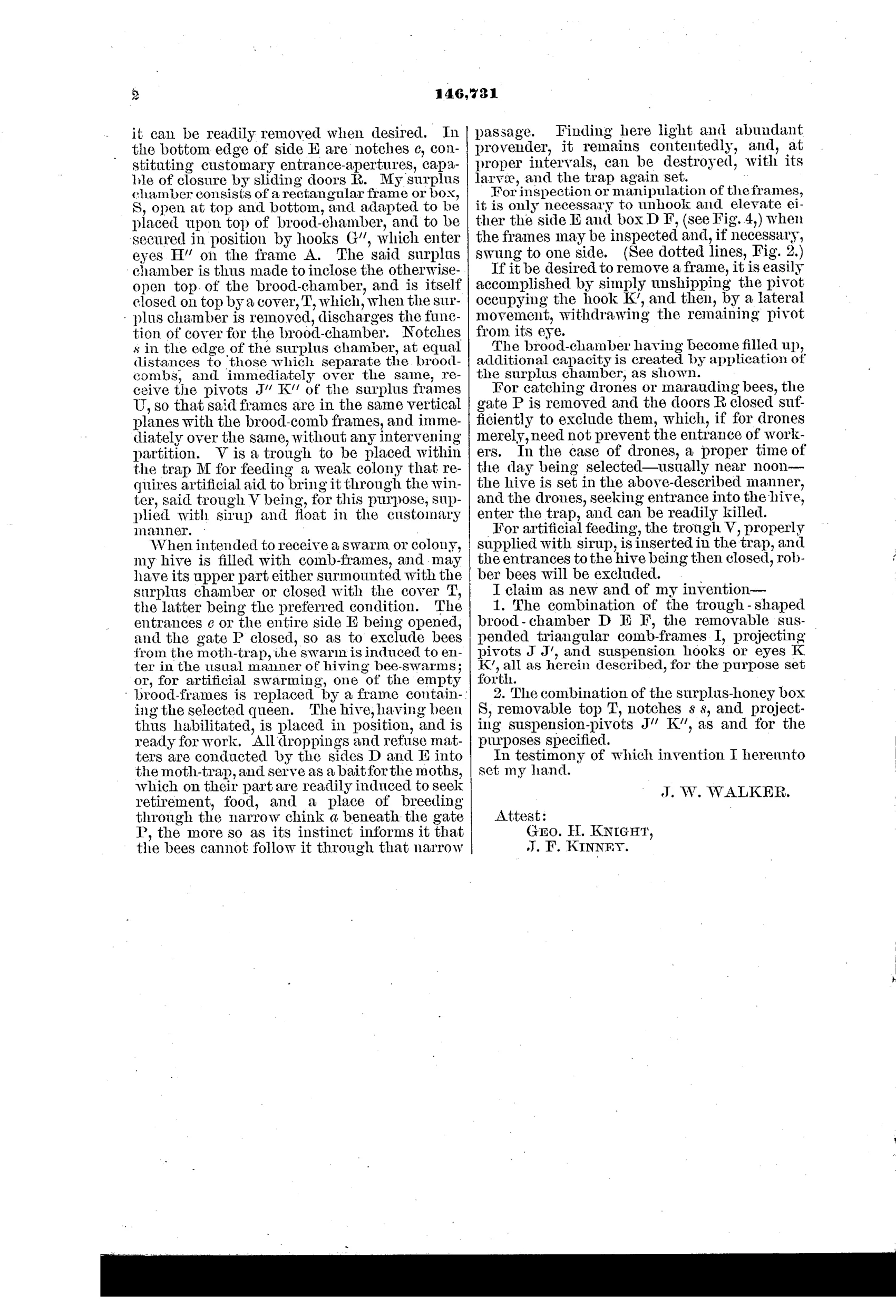
Triangular-chamber bee-hive with swinging comb-frames
⬡ How it works
The brood-chamber is formed as a triangular prism with sloping converging sides D and E that funnel debris and moths down to a common apex trap. Triangular comb-frames I hang from pivots J J' resting in eyes K K' on frame A, allowing them to swing freely to one side for inspection instead of sliding. A moth-trap M with a glass side N and cover O sits beneath the hive at the apex slot d, catching debris and moths (and later serving as a drone-trap or feeding trough via insertable trough V). A removable surplus-honey box S with its own pivoted frames U sits atop the brood-chamber, sharing the same vertical planes as the brood frames so heat and air circulate freely between the two chambers, and is closable by a separate cover T.
⬡ What was claimed
“1. The combination of the trough-shaped brood-chamber D E F, the removable suspended triangular comb-frames I, projecting pivots J J', and suspension hooks or eyes K K', all as herein described, for the purpose set forth.”
In plain English: The invention claims the triangular trough-shaped brood-chamber together with the removable triangular comb-frames that hang from projecting pivots seated in hook-like eyes.
⬡ In the inventor’s words
“Finding here light and abundant provender, it remains contentedly, and, at proper intervals, can be destroyed, with its larvae, and the trap again set.”— John W. Walker, from the specification
Paper patent — likely never produced
The nonstandard triangular frames and prism carpentry made it commercially impractical against the standardizing Langstroth pattern, and no manufactured example or trade listing is known to me — though a surviving specimen would overturn this.
⬡ Commentary
Walker's hive turns the whole brood chamber into a funnel. The sides slope inward to a slot at the bottom apex, so every scrap of debris — and, he hopes, every wax-moth larva — slides down into a little trap M with a glass window for inspection. The trap doubles as a feeder when you drop in the trough V. It's the moth obsession of the 1870s taken to its logical geometric conclusion: if moths hide in flat bottom-board corners, eliminate the flat bottom entirely.
The frames are the part worth lingering on. They're triangular to match the chamber, and instead of sliding out like Langstroth's, they hang on pivots J J' seated in eyes K K' (Fig. 6) so each frame can swing sideways for inspection like a page in a book. That's genuinely thoughtful — no prying, no crushing bees against the next comb. But it also means every comb is a nonstandard triangle, useless in an extractor, incompatible with any other equipment, and structurally weakest exactly where brood comb is heaviest, at the wide top.
Walker did get one thing modern beekeepers would recognize: his surplus box S sits with its frames in the same vertical planes as the brood frames, deliberately preserving heat and air flow between chambers. That's sound instinct. But by 1874 the industry was already standardizing around rectangular Langstroth frames, and a hive requiring bespoke triangular combs was rowing against the current. A charming, well-reasoned dead end.
Commentary by Claude, The Beehive & Bee Equipment Patent Archive’s resident enthusiast