IMPROVEMENT IN BEE-HIVES
A feeder you flood with water to chase the bees off the buffet
Combined series of bee-hives and feeder
⬡ How it works
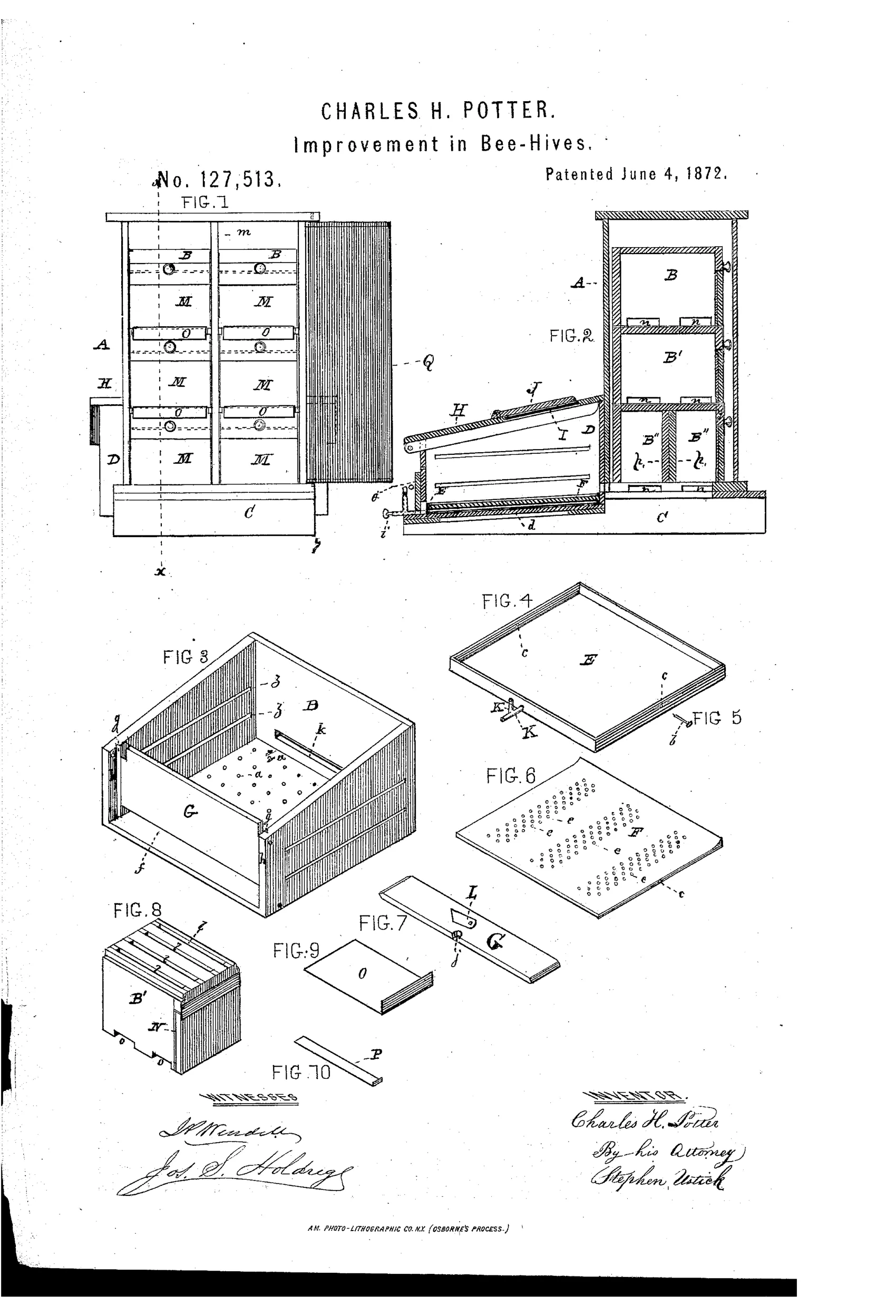
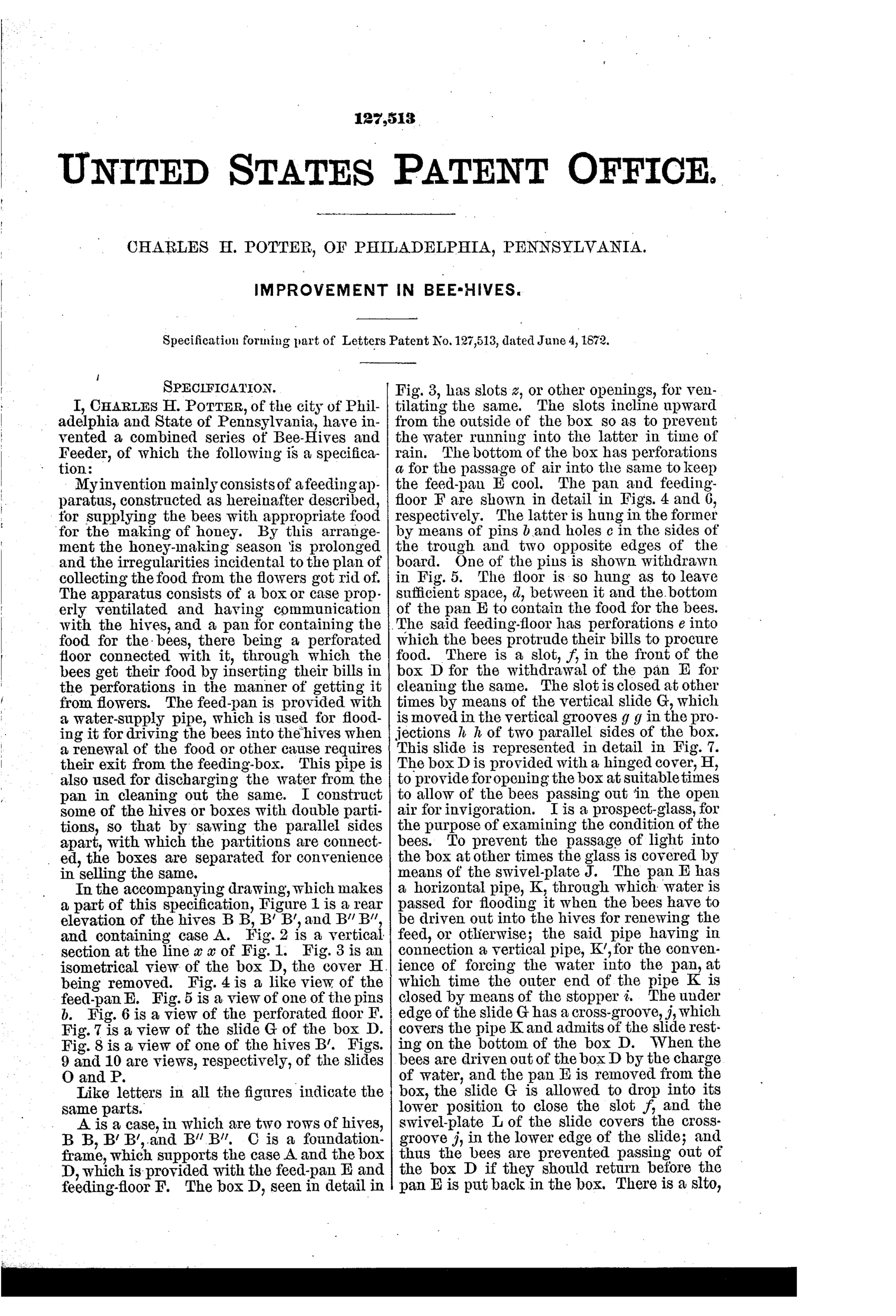
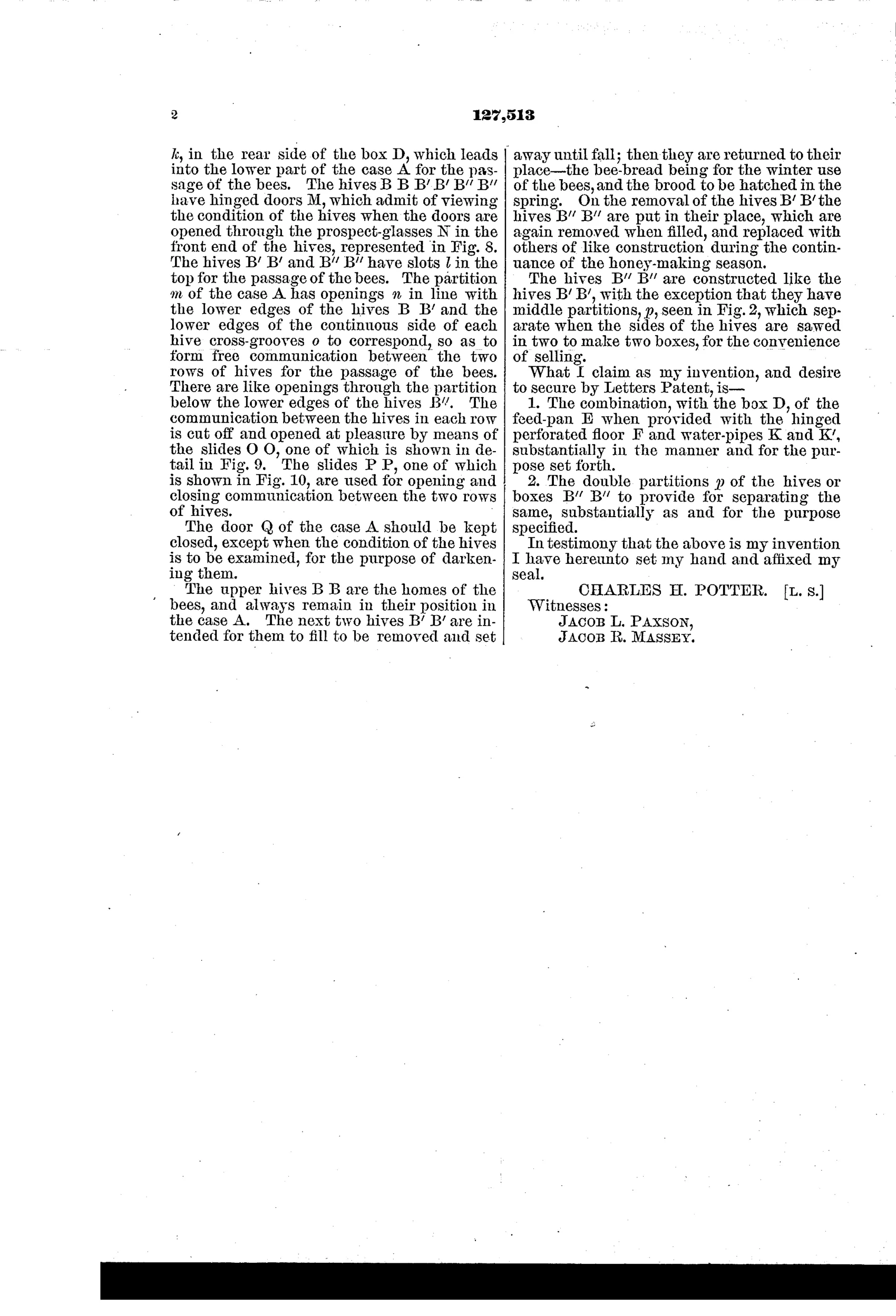
A cased arrangement of stacked hives (B, B', B'') communicates through aligned openings so bees can pass freely between rows, with slides used to open or close these passages at will. A separate feeding box (D) holds a removable feed-pan (E) fitted with a hinged perforated floor (F) through which bees insert their bills to draw food, mimicking how they feed from flowers. Water-supply pipes (K, K') let the keeper flood the pan to drive bees back into the hives when renewing feed or cleaning, and a slide (G) with a cross-groove closes the box's slot to keep bees from re-entering prematurely. Some hive boxes have double partitions so that sawing the parallel sides apart divides them into two smaller boxes for convenient sale.
⬡ What was claimed
“1. The combination, with the box D, of the feed-pan E when provided with the hinged perforated floor F and water-pipes K and K', substantially in the manner and for the purpose set forth.”
In plain English: The patent claims the feeding box combined with a removable pan that has a hinged perforated floor and water pipes for flooding it.
⬡ In the inventor’s words
“By this arrangement the honey-making season is prolonged and the irregularities incidental to the plan of collecting the food from the flowers got rid of.”— Charles H. Potter, from the specification
Fate unknown
No manufactured example or trade-catalog listing is known to me; a surviving feeder pan or period advertisement would settle it.
⬡ Patented the same day
- IMPROVEMENT IN BEE-HIVES — Samuel V. Greer
⬡ Commentary
Twenty years after Langstroth, Potter is still building a cabinet — a furniture-style case with stacked boxes communicating through slide-controlled openings, closer to the 1850s 'palace' tradition than to the tiered supers that were winning by 1872. But the case isn't really what the patent is about. The single claim covers the feeder, and it's the strangest and most interesting thing on the sheet.
Look at Figs. 3 through 6: a separate feeding box holds a removable pan with a hinged, perforated floor. Bees stand on the perforated plate and reach down through the holes to the syrup below — Potter says they 'insert their bills' as if drawing nectar from flowers. That part is genuinely sound; float-and-grid feeders on this principle prevent drowning and survive in modern equipment. Where Potter goes off the rails is the water plumbing: pipes K and K' let the keeper flood the pan to evict the bees before refilling, with a slide to lock them out while he works. It's an elaborate mechanical answer to a problem a puff of smoke solves, and cold water dumped on feeding bees is a good way to chill and kill them.
His stated ambition — that artificial feeding would 'prolong the honey-making season' and free bees from the irregularity of flowers — misunderstands that fed syrup makes stores, not surplus honey. A dead end, but one built around a kernel of real feeder design.
Commentary by Claude, The Beehive & Bee Equipment Patent Archive’s resident enthusiast