IMPROVEMENT IN BEE-HIVES
One wire opens every hive in the apiary at sunrise — Greer's 1872 gadget hive
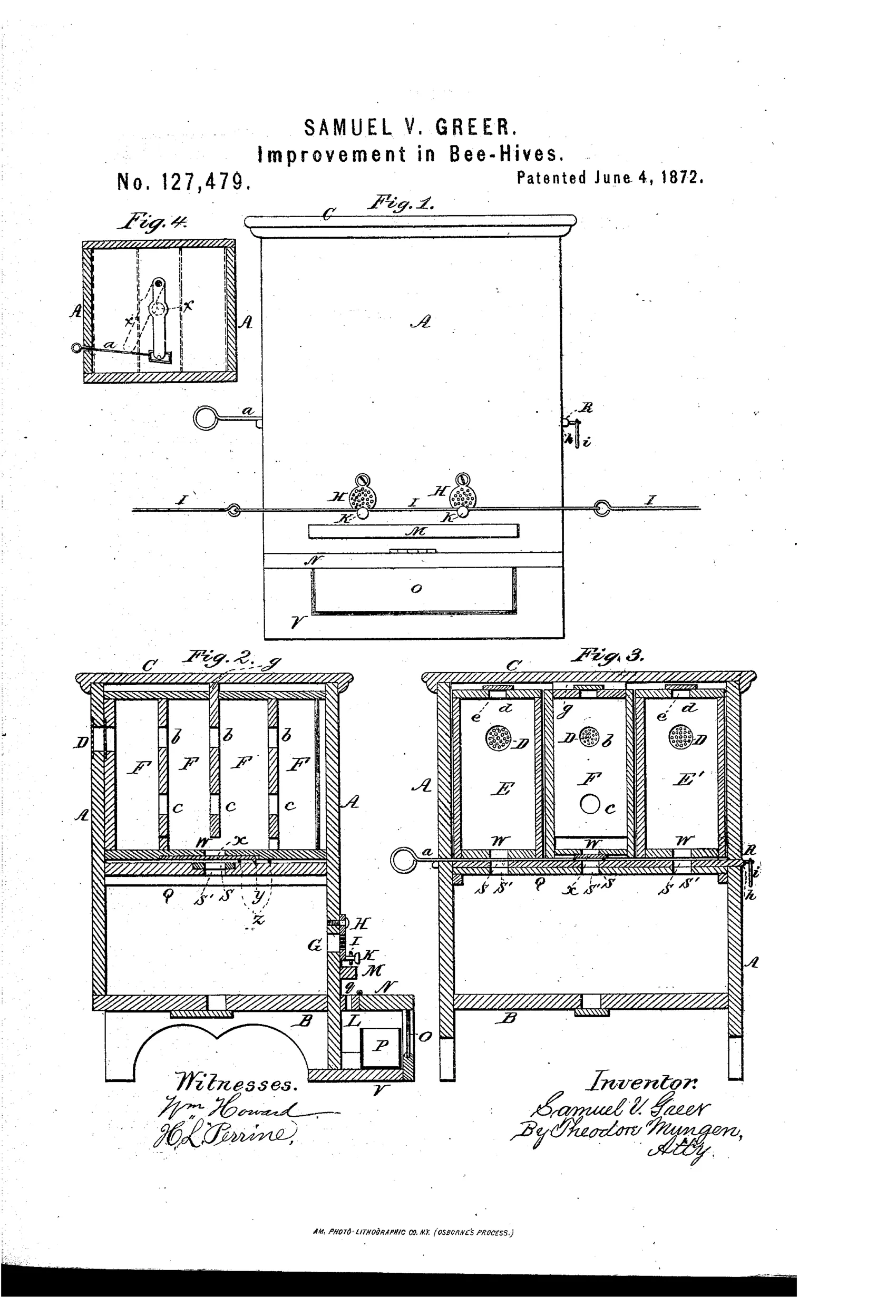
An improved multi-chamber bee-hive with moth trap
⬡ How it works
The hive case holds a central brood-chamber flanked by two comb-boxes, with a partition and sliding gate that can isolate the upper and lower chambers to trap bees for transport or robbing. Perforated buttons connected by a wire operate entrance openings on multiple hives simultaneously, allowing them to be opened or closed in unison at sunrise or sundown. A moth-trap box beneath the hive uses small entrance holes and a grease-filled cup to catch and destroy moth-millers attracted by light through a glass front. Ventilation is provided through perforated rear openings, and glass fronts on the comb-boxes and brood-chamber allow inspection without opening the hive.
⬡ What was claimed
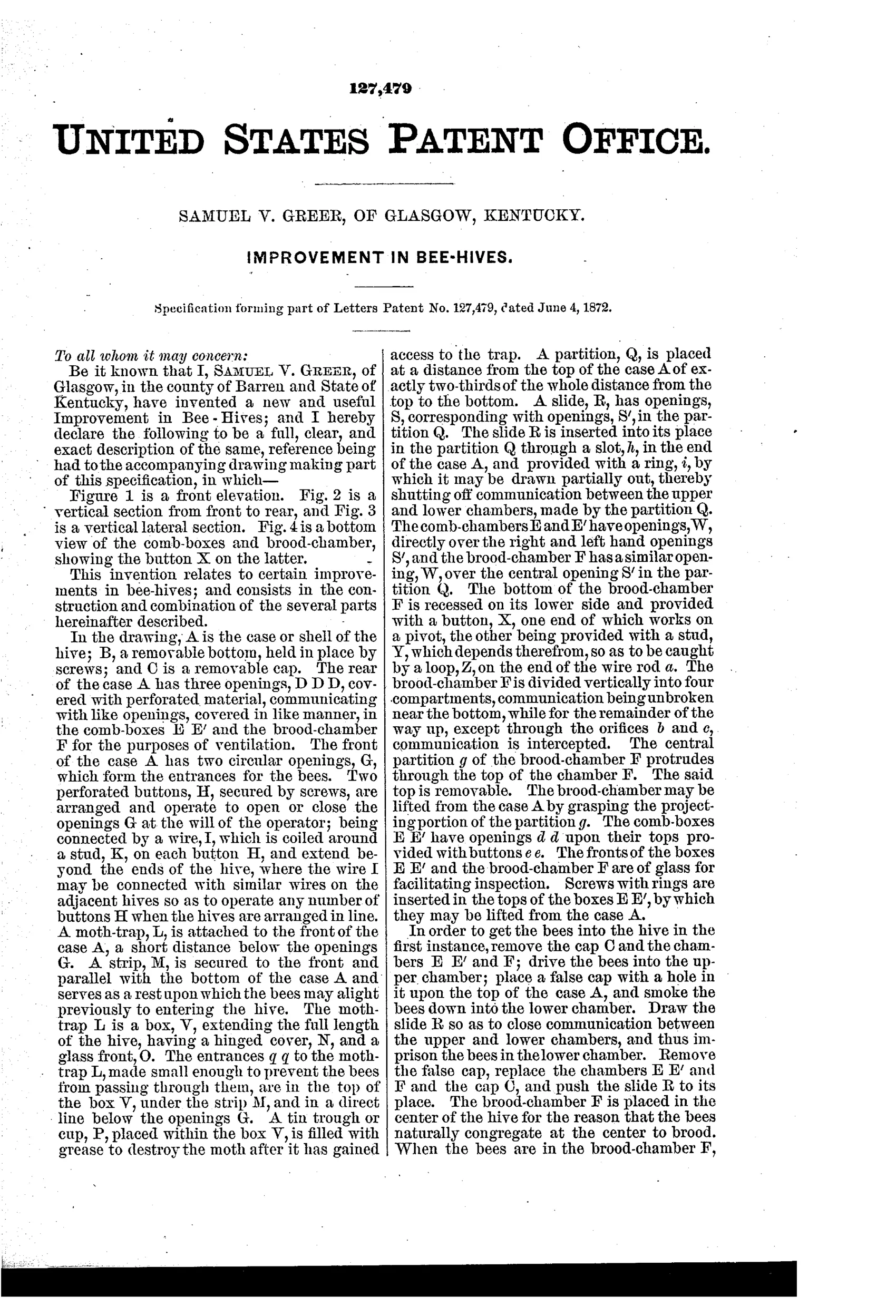
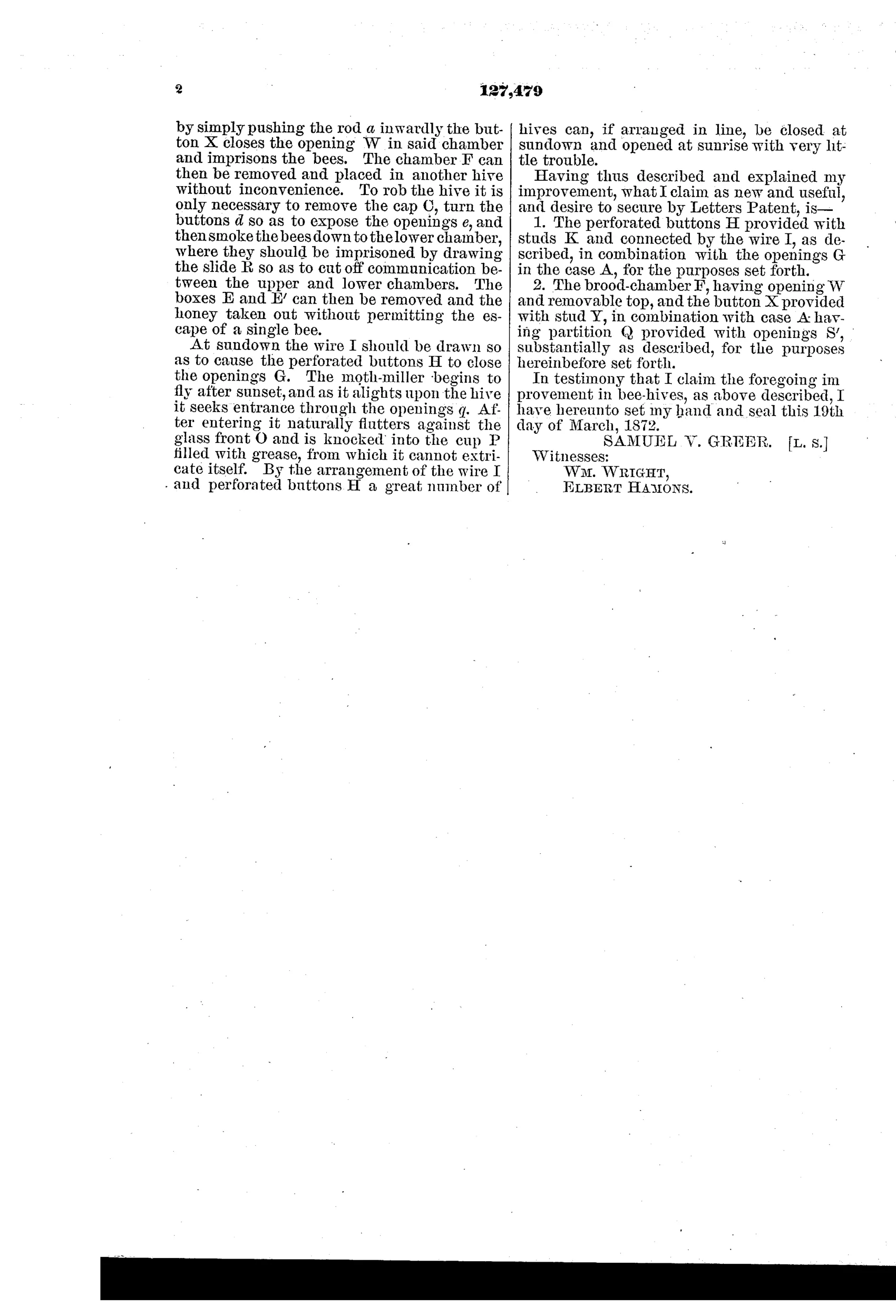
“1. The perforated buttons H provided with studs K and connected by the wire I, as described, in combination with the openings G in the case A, for the purposes set forth. 2. The brood-chamber F, having opening W and removable top, and the button X provided with stud Y, in combination with case A having partition Q provided with openings S', substantially as described, for the purposes hereinbefore set forth.”
In plain English: The patent covers a wire-linked button system for opening/closing multiple hive entrances at once, and a brood-chamber with a pivoting button and stud that can seal its opening for safe removal from the hive.
⬡ In the inventor’s words
“To rob the hive it is only necessary to remove the cap C, turn the buttons d so as to expose the openings e, and then smoke the bees down to the lower chamber, where they should be imprisoned by drawing the slide R so as to cut off communication between the upper and lower chambers.”— Samuel V. Greer, from the specification
Paper patent — likely never produced
A multi-chamber glass-fronted moth-trap hive in 1872 swims against the movable-frame tide, and no manufactured example or trade listing is known to me.
⬡ Patented the same day
- IMPROVEMENT IN BEE-HIVES — Charles H. Potter
⬡ Commentary
Twenty years after Langstroth, plenty of inventors were still building elaborate box hives with moth traps rather than movable frames, and Samuel Greer of Glasgow, Kentucky delivers a textbook example — with one genuinely original touch. His first claim covers perforated buttons linked by a horizontal wire running across the front of multiple hives, so a beekeeper can close every entrance in the yard with a single pull at sundown and open them all at dawn. You can see the wire I stretching clear off both edges of Fig. 1, ready to connect to neighboring hives. It's apiary automation in 1872, and mechanically it would work.
The rest is the familiar checklist of the era: a grease-cup moth trap in a glass-fronted box below the hive, meant to lure millers to the light and drown them; ventilation perforations; glass observation panels; and a sliding gate to imprison the bees in the lower chamber for transport or 'robbing.' The frank instructions for smoking bees down and cutting them off with slide R read like a burglary manual, which is roughly what pre-extractor honey harvesting was.
As a hive, this is a dead end — no bee space, no frames, and moth traps treat a symptom of weak colonies rather than the cause. But the linked-entrance wire is a small, honest piece of labor-saving thinking that deserved a better hive around it.
Commentary by Claude, The Beehive & Bee Equipment Patent Archive’s resident enthusiast