IMPROVEMENT IN BEE-HIVES.
Nested paper boxes for winter insulation, plus a gravity-operated cone valve for drafts
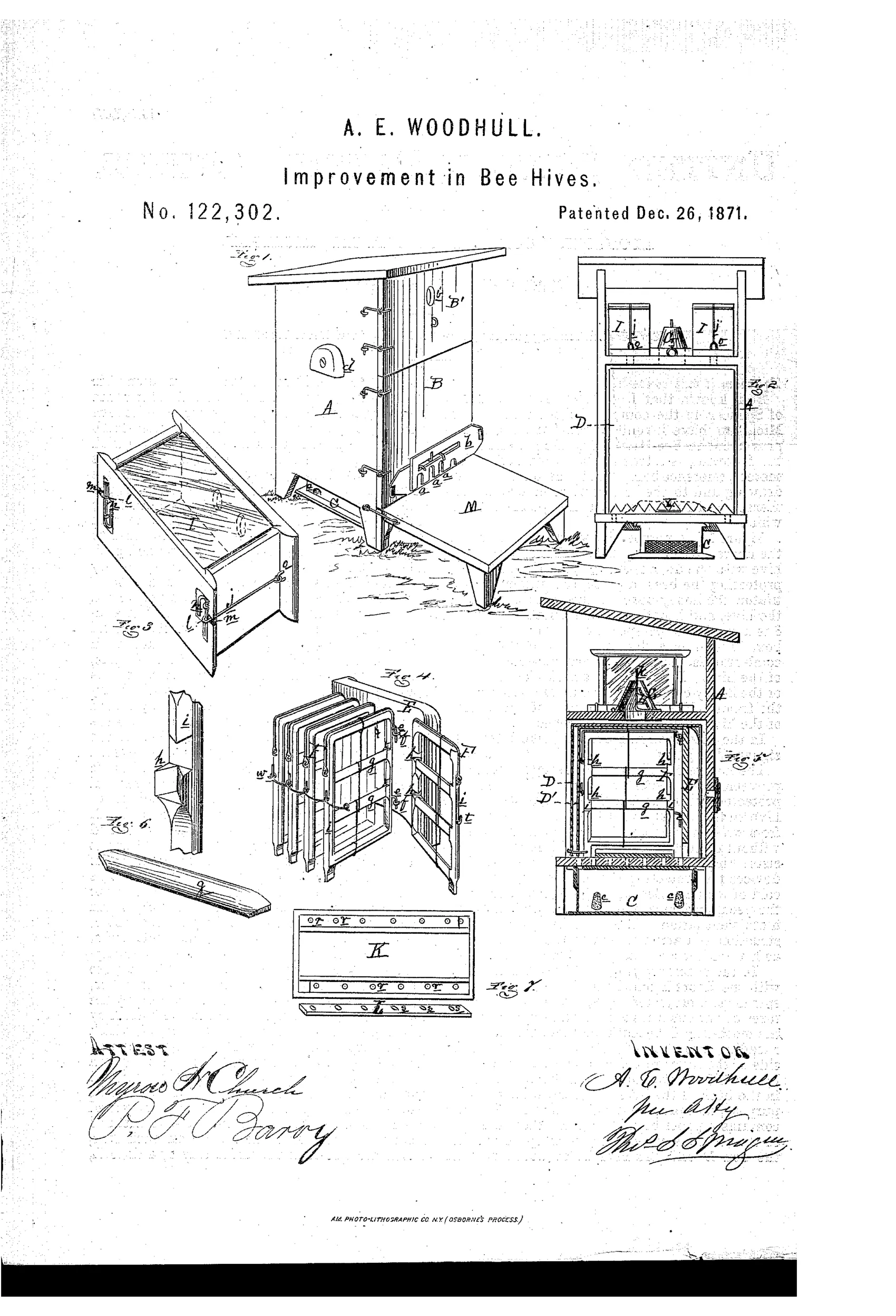
Winterized bee-hive with automatic ventilation and detachable honey boxes
⬡ How it works
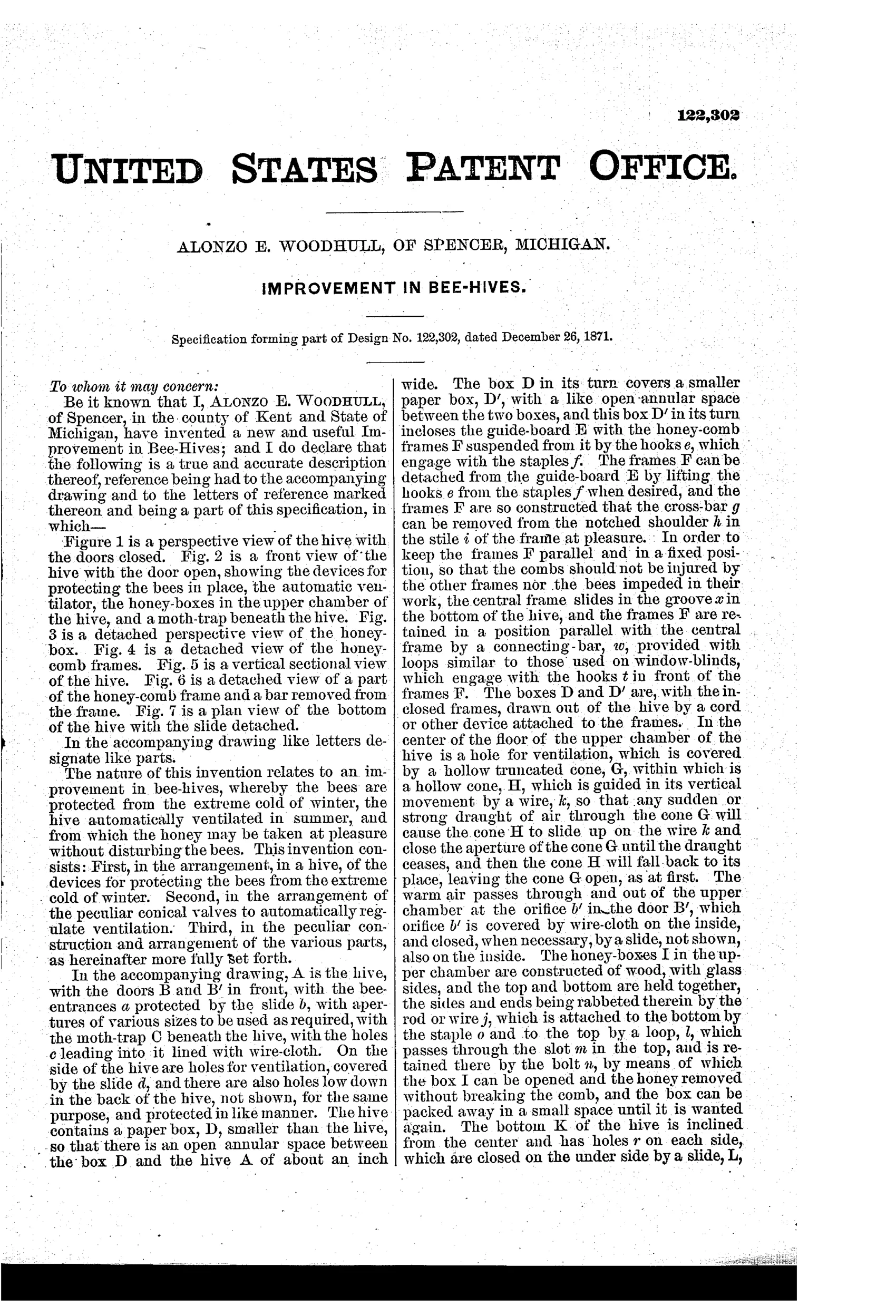
The hive body A nests a smaller paper box D with an air gap around it, which in turn encloses a smaller paper box D', forming two fixed insulating air-chambers over the bees to protect them from winter cold. A hollow truncated cone G sits over a ventilation hole in the floor of the upper chamber, with a smaller hollow cone H riding on a guide-wire k inside it; a sudden draft pushes cone H up to close the opening, and it falls back open when the draft ceases, automatically regulating airflow. The honeycomb frames F hang from a guide-board E by hooks e engaging staples f, are kept parallel by a connecting bar w with window-blind-style loops engaging hooks t, and slide in a floor groove x; the whole guide-board and frame assembly can be drawn out of the hive with the boxes D and D' by a cord. Glass-sided wooden honey-boxes I in the upper chamber can be opened via a bolt n to remove honey without breaking the comb, and packed flat when not in use.
⬡ What was claimed
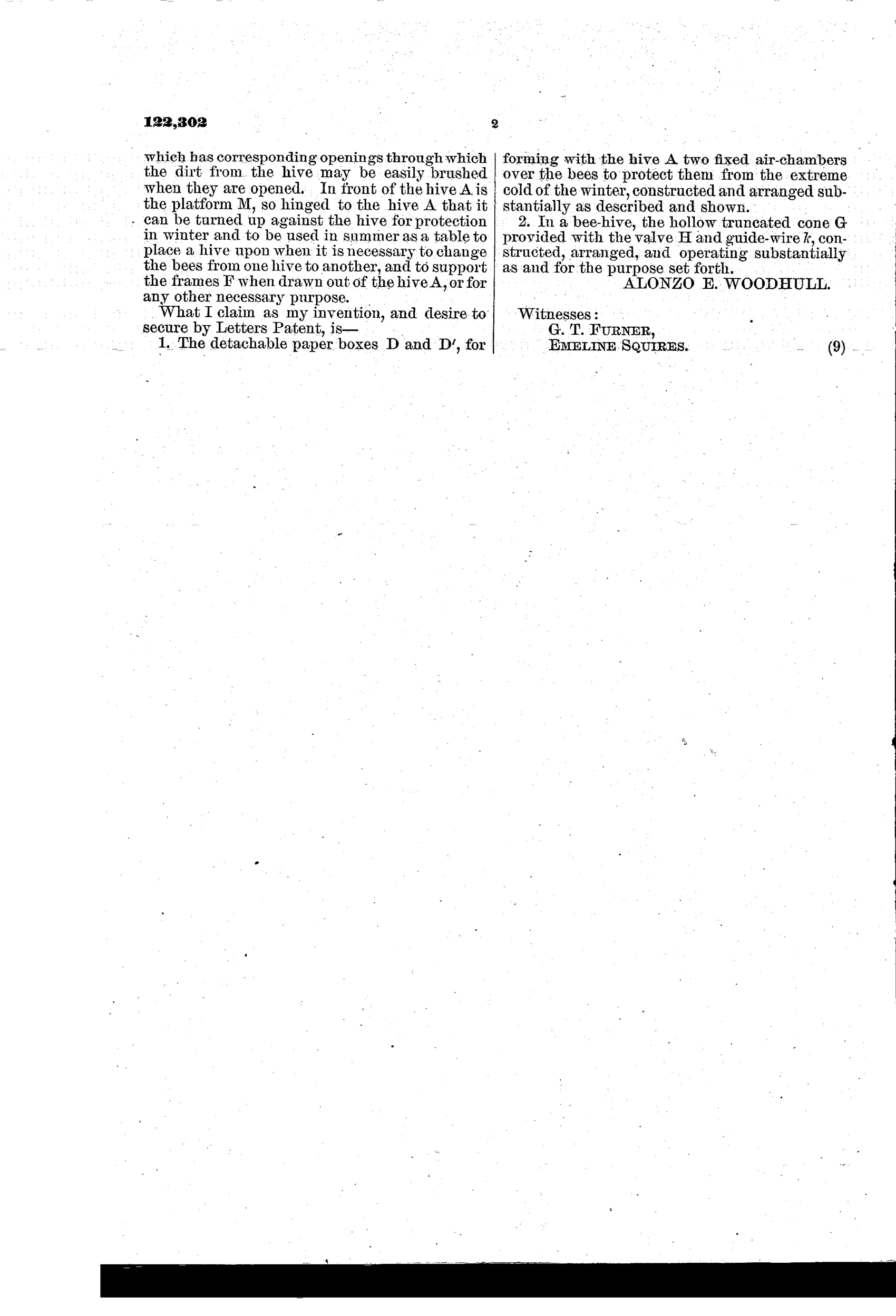
“The detachable paper boxes D and D', for forming with the hive A two fixed air-chambers over the bees to protect them from the extreme cold of the winter, constructed and arranged substantially as described and shown.”
In plain English: A claim covering the two removable paper boxes nested inside the hive body that create insulating air pockets to keep the bees warm in winter.
⬡ In the inventor’s words
“This invention consists: First, in the arrangement, in a hive, of the devices for protecting the bees from the extreme cold of winter.”— Alonzo E. Woodhull, from the specification
Paper patent — likely never produced
The paper insulating boxes, wire-guided cone valve, and cord-drawn frame assembly are fragile and fussy for field use, and no manufactured example or trade listing is known to me.
⬡ Commentary
Woodhull's 1871 hive is a kitchen-sink entry from Michigan, where winter kill was the beekeeper's real enemy, and the interesting parts are the two he actually claimed: insulation and automatic ventilation. The insulation is a pair of nested paper boxes inside the hive body, creating two dead-air chambers over the cluster — a genuinely sound thermal idea, and notable for being cheap and removable rather than built into thick double walls like most winterized hives of the era. The ventilator is odder: a small hollow cone riding a guide-wire inside a larger fixed cone, so a sudden updraft lifts the inner cone to seal the opening, and it drops open again when the gust passes. It's a check valve for wind, essentially, and whether propolis and dead bees would let it keep working past October is a fair question.
Fig. 4 rewards a close look. The frames hang by hooks on staples and are held parallel by a connecting bar with window-blind loops, so the whole comb assembly can be drawn out of the hive by a cord along with the paper boxes. This is the era's recurring dream — extract everything at once without disturbance — and it fights the Langstroth logic of handling frames one at a time. Add the glass-sided honey boxes that pack flat and the obligatory moth trap, and you have an earnest, over-engineered hive whose best idea (cheap dead-air insulation) got buried under its cleverest ones.
Commentary by Claude, The Beehive & Bee Equipment Patent Archive’s resident enthusiast