IMPROVEMENT IN BEE-HIVES.
Three Shorts and a Kile nest the honey super inside the brood frames
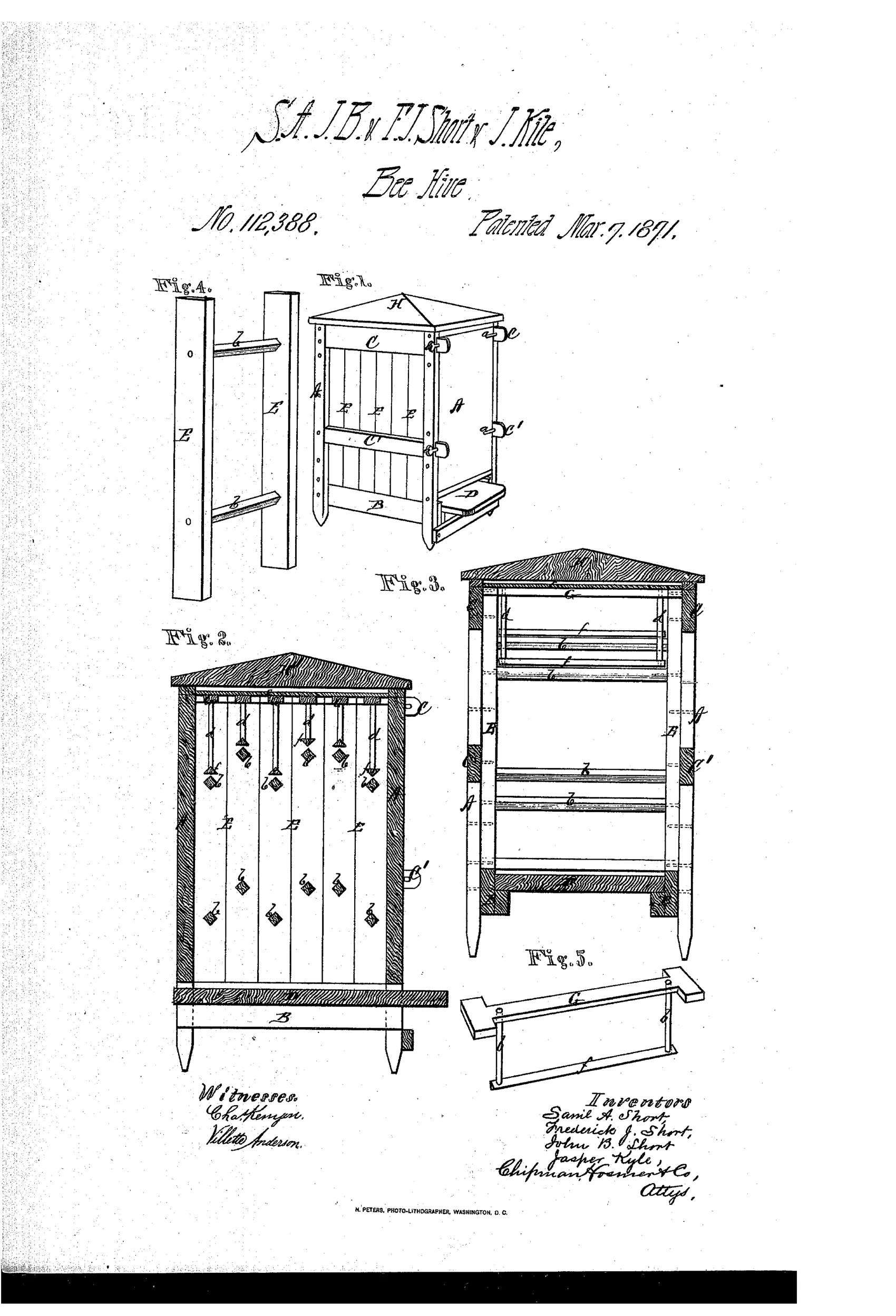
A wooden bee-hive with movable comb and honey frames.
⬡ How it works
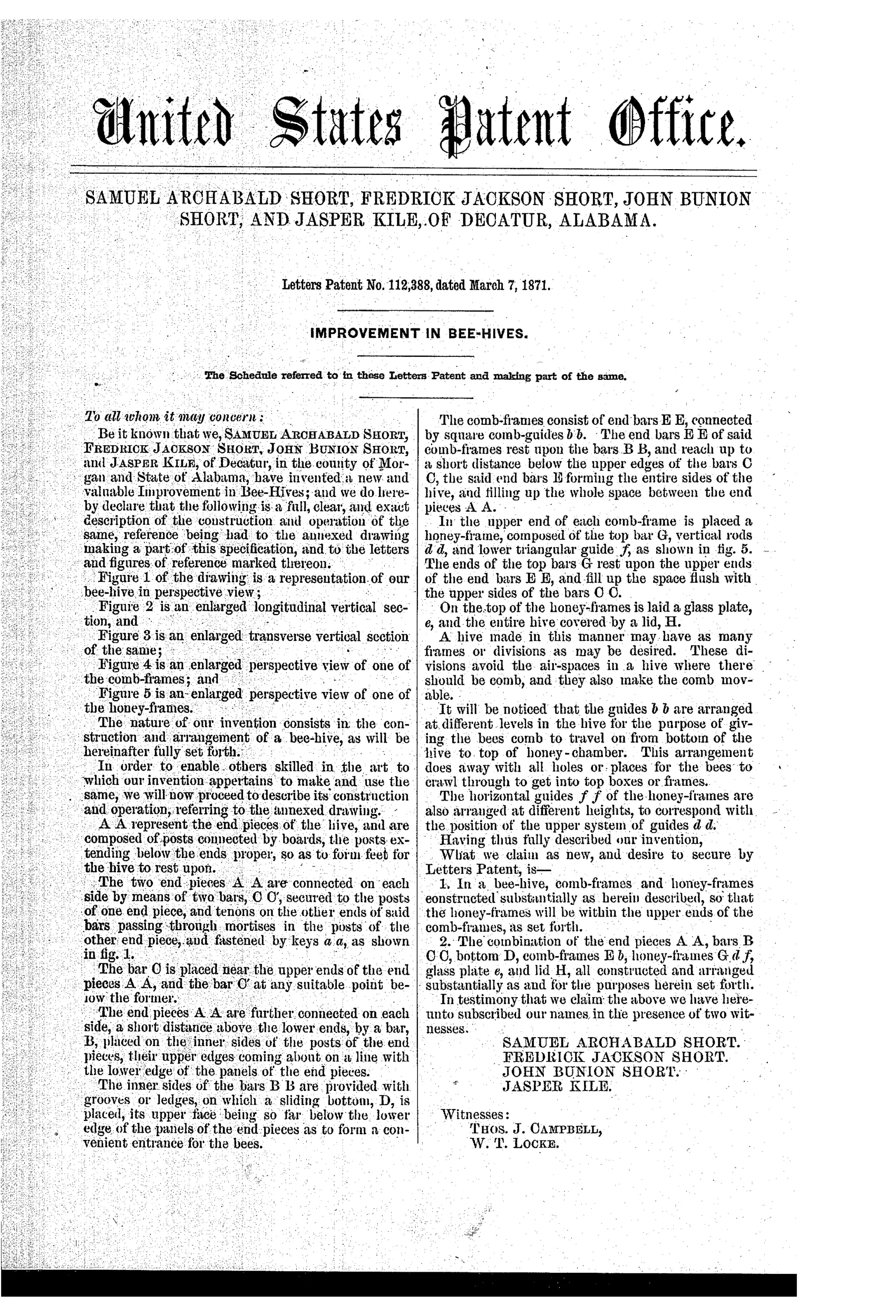
The hive has end pieces connected by bars forming the frame, with a sliding bottom board that creates a bee entrance. Comb-frames rest on lower bars and are held by square guides, filling the space between the end pieces. Honey-frames sit above the comb-frames, held by vertical rods and triangular guides, topped with a glass plate and a lid. The staggered arrangement of guides at different heights lets bees travel through comb without needing separate crawl holes between boxes.
⬡ What was claimed
“1. In a bee-hive, comb-frames and honey-frames constructed substantially as herein described, so that the honey-frames will be within the upper ends of the comb-frames, as set forth.”
In plain English: The invention claims a bee-hive design where the honey-frames fit within the upper ends of the comb-frames.
⬡ In the inventor’s words
“These divisions avoid the air-spaces in a hive where there should be comb, and they also make the comb movable.”— Samuel Archabald Short, Fredrick Jackson Short, John Bunion Short, and Jasper Kile, from the specification
Fate unknown
No documented production or surviving example is known to me; a marked hive or an Alabama trade advertisement would settle it.
⬡ Commentary
Four inventors from Decatur, Alabama — three of them Shorts, apparently a family affair — signed onto this 1871 hive, and their one real idea is in the claim: the honey-frames sit *within* the upper ends of the comb-frames rather than on top of a separate box. That sounds like a small distinction, but it attacks a genuine annoyance of the period. In most tiered hives of the day, bees had to pass through crawl holes or honey-boards to reach the surplus chamber, and every board and gap was a place for dead air, wax bridges, and moth harborage. The Shorts' staggered triangular and square guides, visible in the section views of Figs. 2 and 3, let the bees move up through continuous comb instead.
The drawing rewards a close look. Fig. 4 shows the comb-frame as an open ladder of end pieces and cross-bars — closer to Langstroth's frames than to the fixed-comb boxes still common in 1871 — and Fig. 5 shows the shallow honey-frame that keys into its top. The glass plate under the lid is the era's obligatory inspection window.
As mechanics, it works on paper; as commerce, it fights the tide. By 1871 the industry was standardizing on interchangeable frames and separate supers, precisely because nested, hive-specific parts like these are fussy to build and impossible to swap between colonies. This is a thoughtful refinement pointed down a road the trade did not take.
Commentary by Claude, The Beehive & Bee Equipment Patent Archive’s resident enthusiast