IMPROVED CENTRIFUGAL MACHINE FOR EXTRACTING HONEY FROM THE COMB.
One spinning can does the work of two: America's early answer to Hruschka
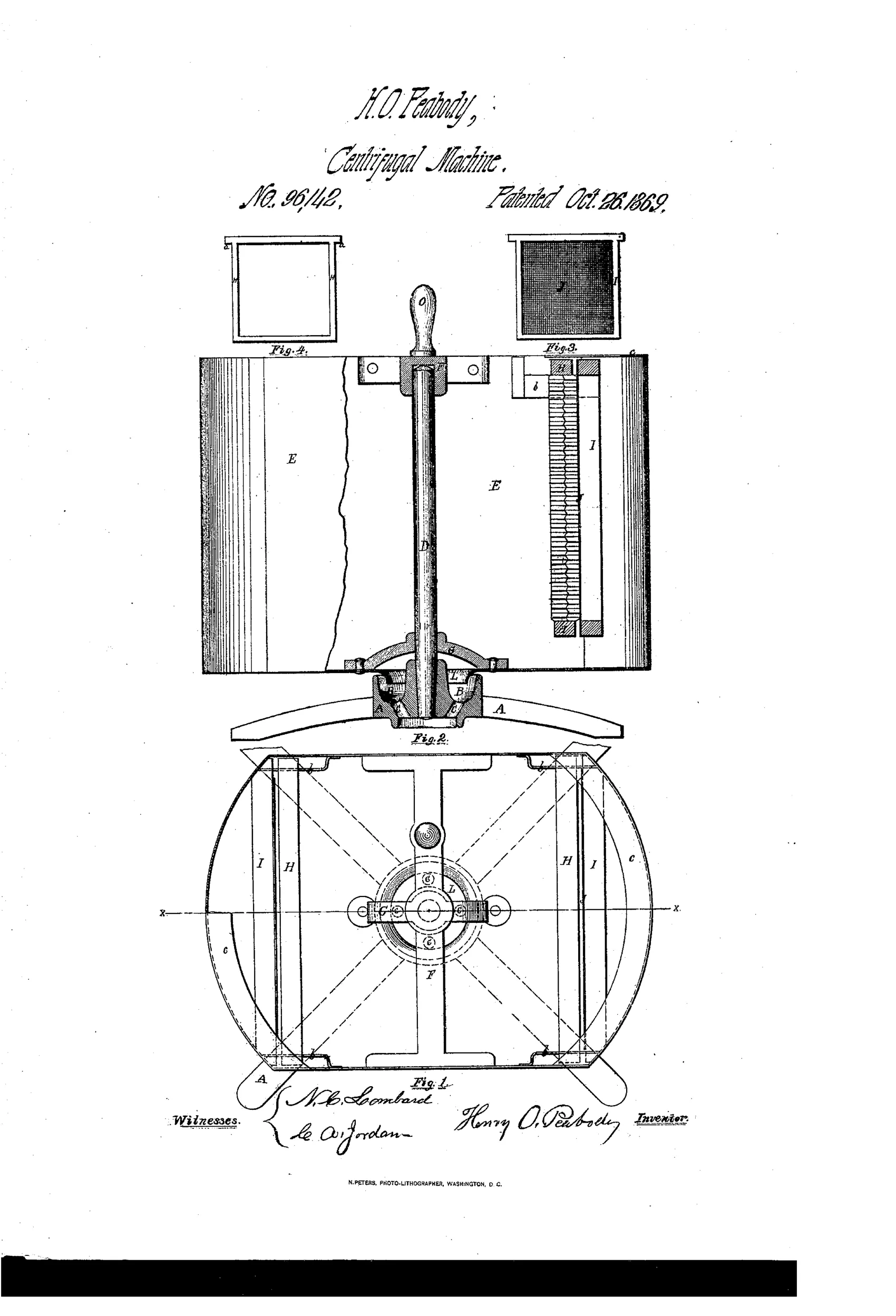
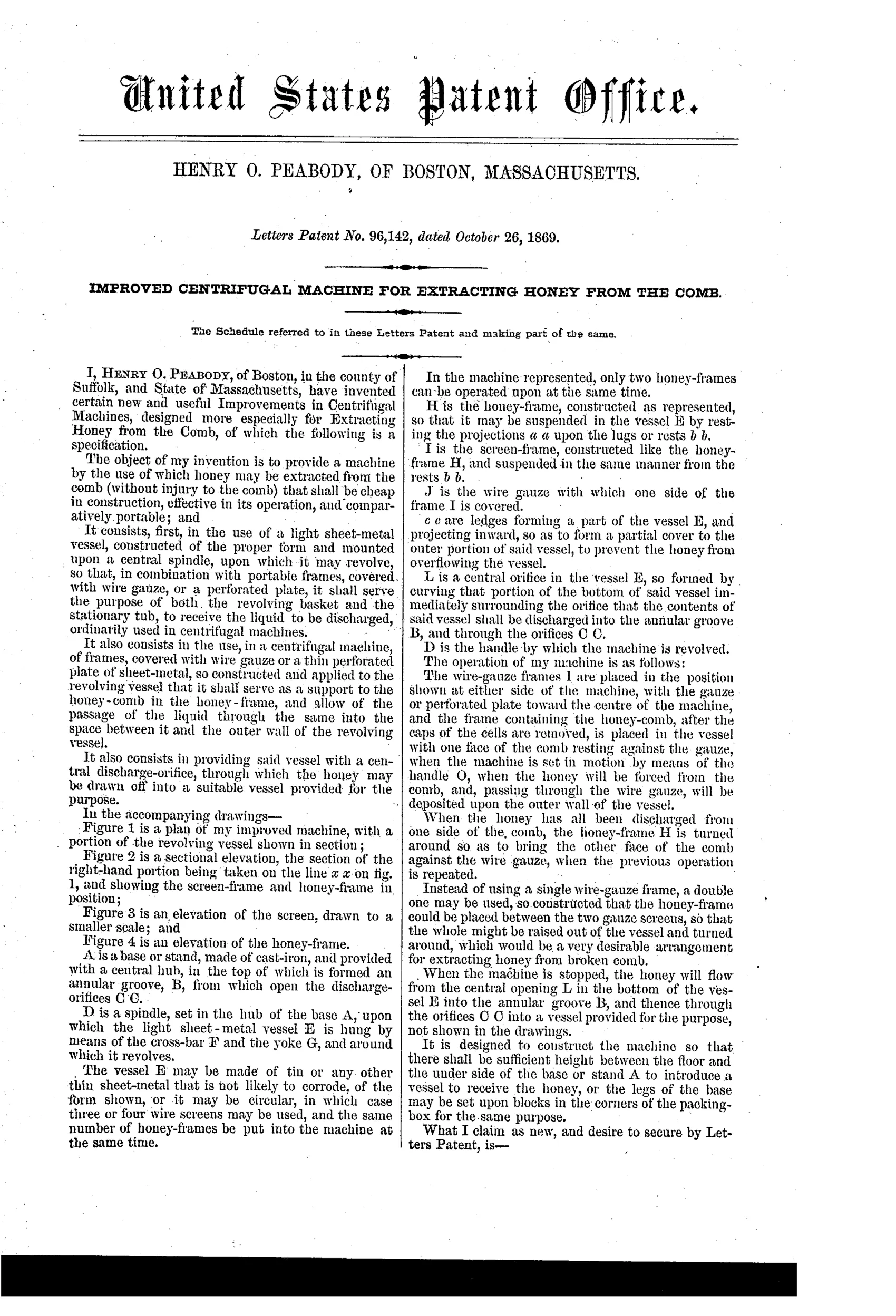

A centrifugal machine for extracting honey from comb.
⬡ How it works
A light sheet-metal vessel is hung on a central spindle within a cast-iron base, and this vessel itself serves as both the revolving basket and the stationary tub. Portable wire-gauze honey-frames hold the uncapped comb against a wire-gauze screen frame, and when the machine is spun by hand via a handle, centrifugal force throws honey through the gauze onto the outer wall of the vessel. The honey then runs down through a central discharge orifice, into an annular groove, and out through discharge orifices into a receiving vessel below. The honey-frame can be turned around to extract the other side of the comb without removing it.
⬡ What was claimed
“1. So constructing a centrifugal machine that a single revolving vessel shall serve the purpose of both the revolving basket and the stationary tub, as heretofore constructed, substantially as described.”
In plain English: The invention claims a single revolving vessel that does the job of both the spinning basket and the stationary outer tub found in older centrifugal machines.
⬡ In the inventor’s words
“The object of my invention is to provide a machine by the use of which honey may be extracted from the comb (without injury to the comb) that shall be cheap in construction, effective in its operation, and comparatively portable.”— Henry O. Peabody, from the specification
Manufactured and sold
The Peabody extractor was advertised and sold to American beekeepers in the early 1870s, appearing in period bee journals as one of the first commercial extractors in the United States.
⬡ Commentary
Just four years after Major von Hruschka's famous observation in Italy — that a comb swung in a basket throws its honey clear — Peabody filed this Boston patent, and his central claim is a genuinely smart cost-cutting move. Earlier centrifugals used two vessels: a spinning basket inside a stationary tub that caught the flung honey. Peabody makes the vessel itself spin, so honey hits the wall of the same can that's rotating, runs down, and drains out through orifices into a groove and a receiver below. One piece of sheet metal instead of two assemblies. That's exactly the kind of simplification that turns a laboratory curiosity into farm equipment.
Look closely at Fig. 2 and Fig. 4: the comb rides in a portable wire-gauze frame held against a gauze screen, and Peabody notes the frame can simply be turned around to sling the second side without unloading. Anyone who has worked a modern non-reversible extractor knows that flipping frames is still the ritual — he anticipated it from the start.
This machine matters because the extractor is the other half of Langstroth's revolution. Movable frames only pay off if you can empty comb and return it intact for refilling. The Peabody extractor was among the very first American machines to make that loop practical, and its descendants sit in every hobbyist's garage today.
Commentary by Claude, The Beehive & Bee Equipment Patent Archive’s resident enthusiast