BEE-MOTH TRAP
A wind-powered roller floor that grinds moths before Langstroth changed everything
Self-cleaning beehive floor with moth-killing roller
⬡ How it works
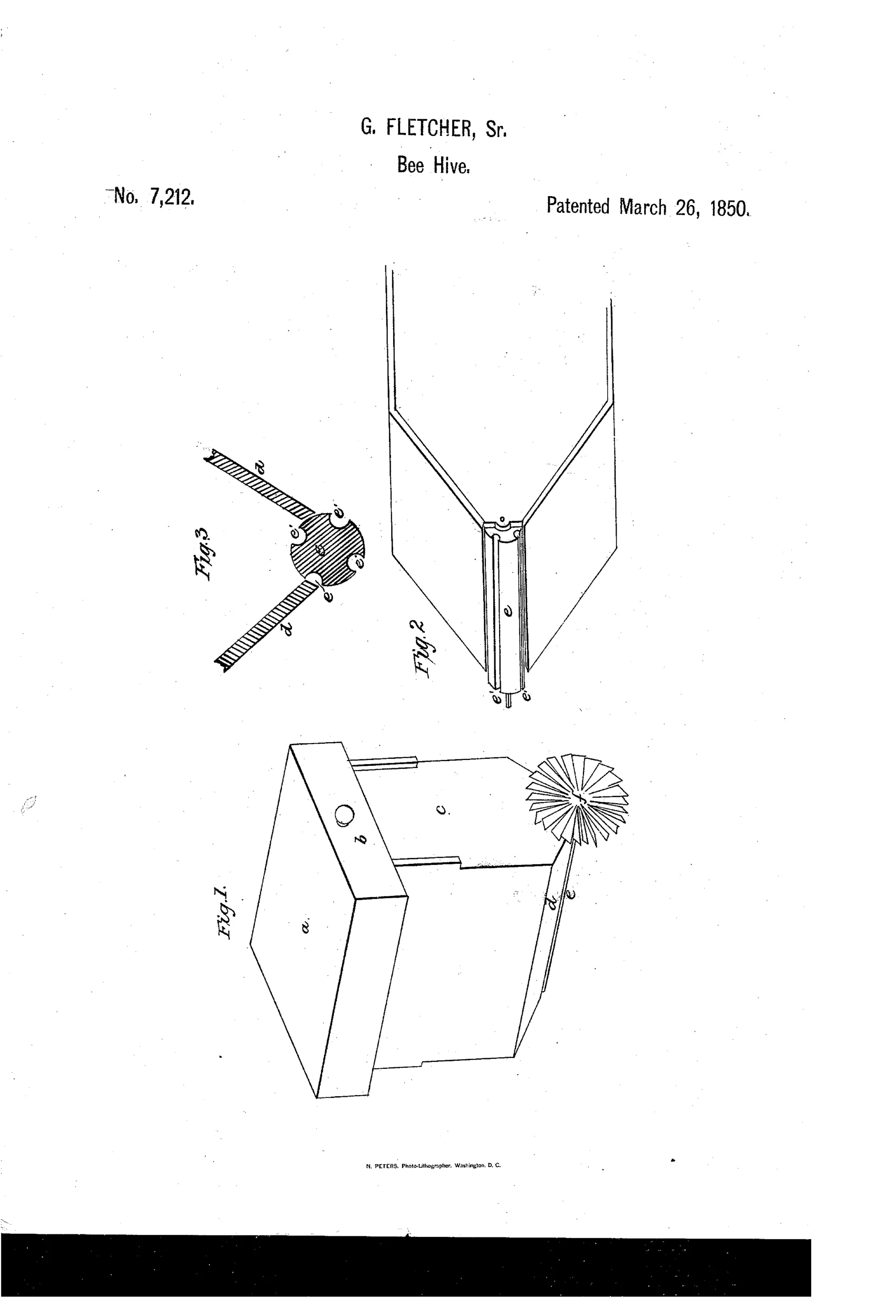
The hive floor is made of two oblique surfaces sloping down like sides of a prism, meeting at a partial gap in which a fluted roller sits. A wind vane or wheel mounted outside the hive catches the air and continuously rotates this grooved roller. Debris, bee bread refuse, and droppings fall into the roller's grooves and are carried past the edge of the inclined floor to be discharged outside, while any moth attempting to enter the hive through this passage must lodge in a groove and is carried around and ejected before it can escape, or is caught and killed by the moving parts. This eliminates the need for a separate lower entrance opening that would otherwise let the bee-moth miller freely enter the hive.
⬡ What was claimed
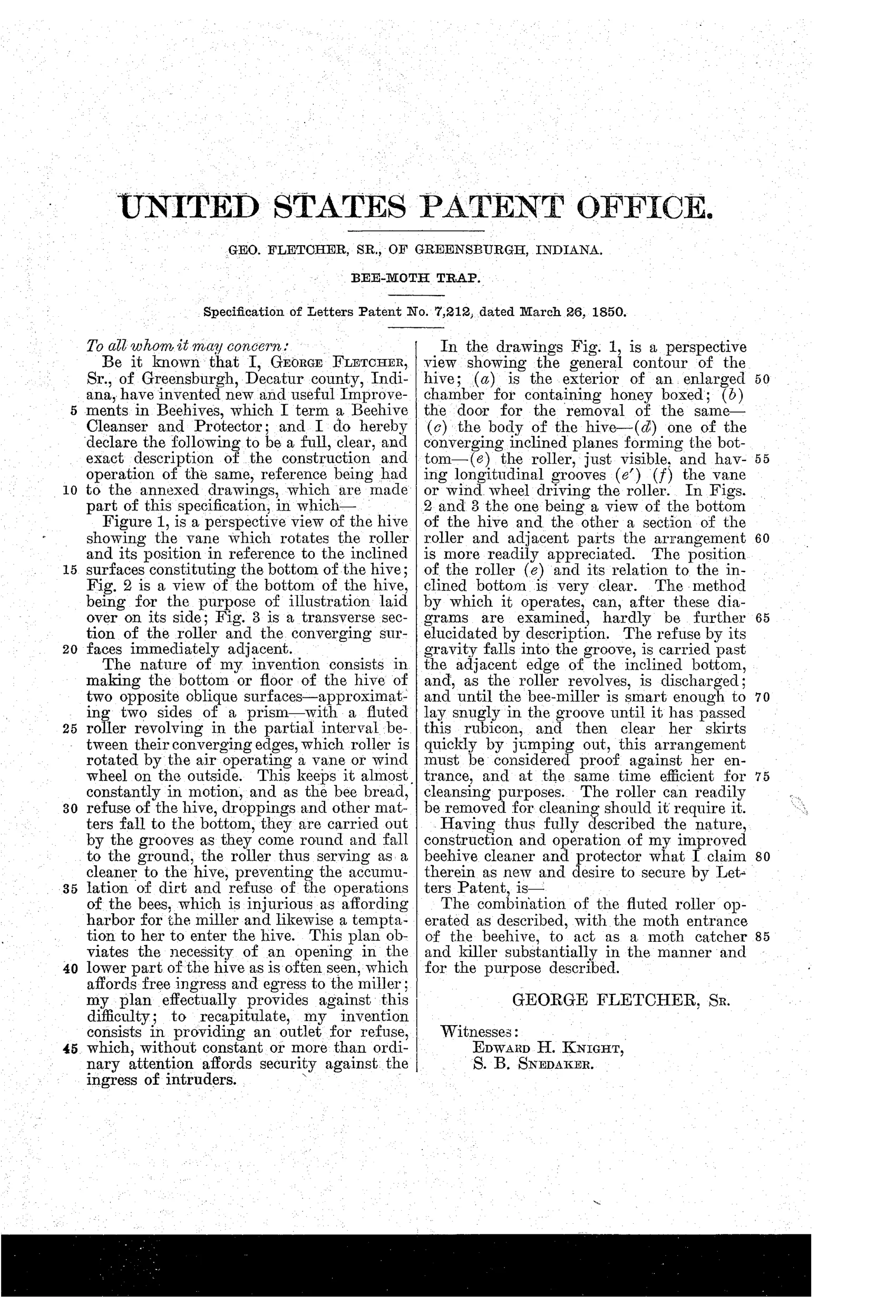
“The combination of the fluted roller operated as described, with the moth entrance of the beehive, to act as a moth catcher and killer substantially in the manner and for the purpose described.”
In plain English: The invention claims the combination of a wind-driven fluted roller with the hive's moth entrance, which together catch and kill invading moths.
⬡ In the inventor’s words
“and until the bee-miller is smart enough to lay snugly in the groove until it has passed this rubicon, and then clear her skirts quickly by jumping out, this arrangement must be considered proof against her entrance, and at the same time efficient for cleansing purposes.”— George Fletcher, Sr., from the specification
Paper patent — likely never produced
The wind-driven roller's cost and mechanical fragility make production implausible, and no manufactured example or advertisement is known to me.
⬡ Commentary
Two years before Langstroth's bee space, George Fletcher of Greensburgh, Indiana was attacking the era's great obsession — the bee-moth — with pure machinery. His hive floor is two planes sloping inward like a funnel, meeting not at a slot but at a fluted roller. A wind wheel mounted outside (you can see it in Fig. 1, that pinwheel at the corner) keeps the roller turning whenever there's a breeze. Debris rolls down the incline, drops into a groove, and gets carried out of the hive. A moth crawling in through the same passage gets carried around and dumped outside — or crushed.
The idea is genuinely clever as a piece of mechanism: one moving part does double duty as janitor and doorman. Fletcher clearly enjoyed himself, writing that until the miller 'is smart enough to lay snugly in the groove... and then clear her skirts quickly by jumping out,' the hive is proof against her. But the physics is against him. Calm nights — exactly when moths fly — leave the roller motionless and the groove an open corridor into the hive. And a roller that must turn freely can't seal tightly; bees would propolize the whole works within a season.
Still, this is the pre-Langstroth mind at its best: solving a biological problem (weak colonies attract moths) with a mechanical gadget. The real fix arrived in 1852, and it had no moving parts at all.
Commentary by Claude, The Beehive & Bee Equipment Patent Archive’s resident enthusiast