IMPROVEMENT IN BEE-HIVES
Shared body heat: six colonies in one box, ventilated through bee-proof perforations
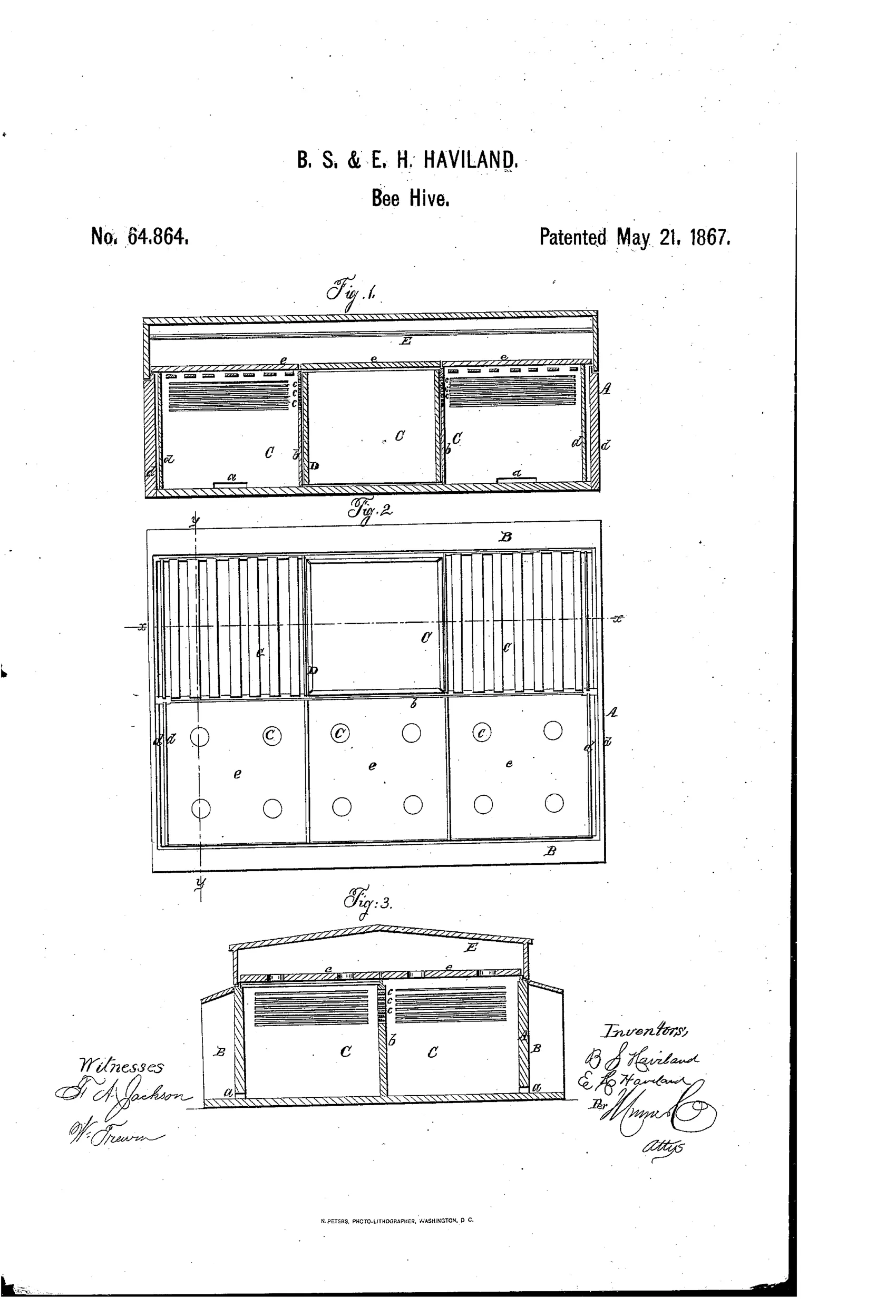
Multi-colony bee house with adjustable partitions
⬡ How it works
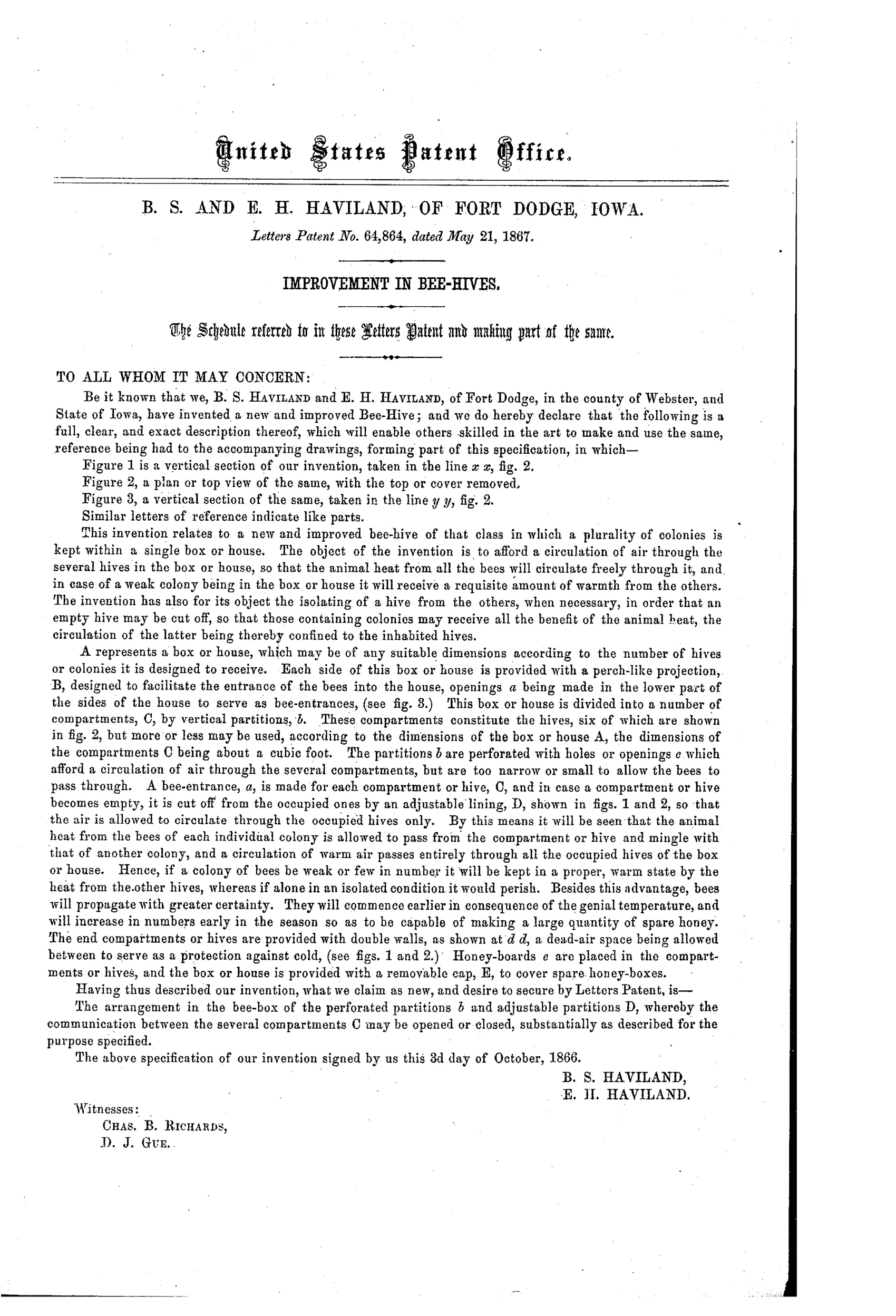
A single box or house A is divided into several compartments C by vertical partitions b, each compartment forming a separate hive with its own bee-entrance a. The partitions are perforated with small holes c that allow warm air to circulate between colonies but are too narrow for bees to pass through, so animal heat from all hives mingles to keep weak colonies warm. An adjustable lining D can be inserted to isolate an empty hive, cutting off air circulation to it so warmth is confined only to occupied compartments. End compartments have double walls with a dead-air space d for insulation, honey-boards e rest in the compartments, and a removable cap E covers spare honey-boxes.
⬡ What was claimed
“The arrangement in the bee-box of the perforated partitions b and adjustable partitions D, whereby the communication between the several compartments C may be opened or closed, substantially as described for the purpose specified.”
In plain English: The invention claims perforated partitions combined with adjustable partitions that let the beekeeper open or close air communication between the hive compartments.
⬡ In the inventor’s words
“Hence, if a colony of bees be weak or few in number it will be kept in a proper, warm state by the heat from the other hives, whereas if alone in an isolated condition it would perish.”— B. S. Haviland and E. H. Haviland, from the specification
Fate unknown
No documented example or commercial record is known; a marked specimen or an Iowa agricultural-press advertisement would settle it.
⬡ Commentary
The Havilands of Fort Dodge, Iowa were solving a real problem: Iowa winters kill weak colonies. Their answer is a communal bee house where several hives share one shell, separated by partitions drilled with holes small enough to stop bees but large enough to let warm air pass. The whole cluster of colonies becomes, thermally, one big organism — the strong subsidize the weak. Their own line says it plainly: a weak colony 'will be kept in a proper, warm state by the heat from the other hives, whereas if alone in an isolated condition it would perish.'
The clever detail is the adjustable lining D, which lets you seal off an empty compartment so the shared heat isn't wasted warming vacant space. Add the double walls with dead-air space on the end compartments — the coldest positions in the row — and you have someone thinking carefully about where heat actually leaks. Fig. 2 shows the layout best: six compartments in a row, honey-boards perforated with round holes above.
The idea is sound in principle; modern beekeepers still overwinter nucleus colonies side by side over a strong hive for exactly this reason. The weakness is everything else: shared entrances invite drifting and robbing, and a disease in one compartment threatens all. This is a thoughtful cold-climate refinement in the post-Langstroth crowd, but the multi-colony bee house was a branch the industry mostly pruned in favor of standardized single hives.
Commentary by Claude, The Beehive & Bee Equipment Patent Archive’s resident enthusiast