IMPROVEMENT IN BEE-HIVES
A pit of sloping metal shelves beneath the brood, built to swallow wax-moth larvae
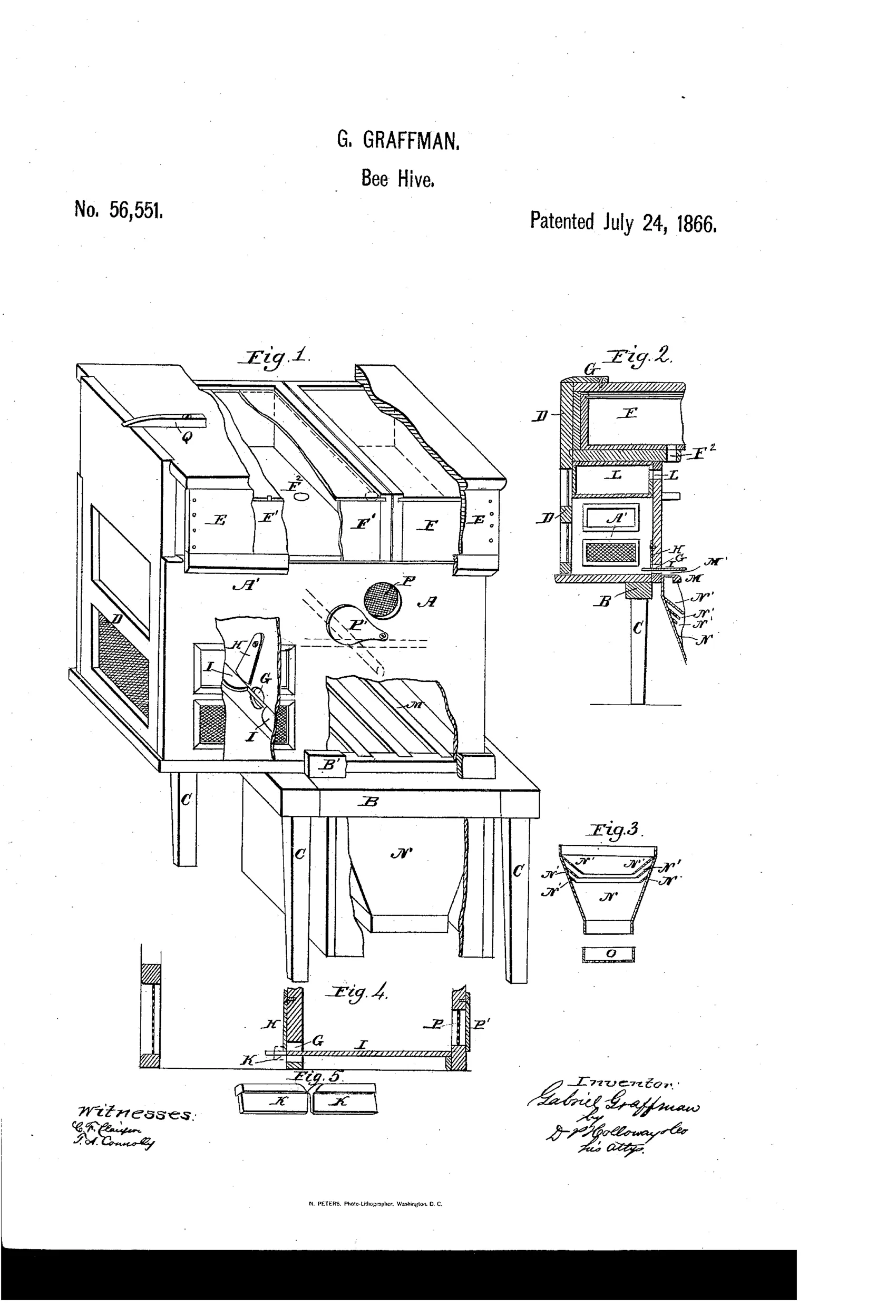
A beehive with larvae-trapping pit and drawer
⬡ How it works
The case A holding the bee body rests on a frame B supported by legs C, and slides between guide rails B' so the entire hive box can be removed. A grated bottom M separates the case from a pit N below, and larvae or other intruders falling through the grating land in the pit but cannot climb back up because the pit's sides are lined with sloping metal shelves N'. Bees enter through a front porch A' via a hole G, the porch being closable by a sliding door D fitted with wire screens and glass windows for light and ventilation. Caps F and F' with bee-passage openings F2 sit atop the case under a hinged cover E, and a drawer L slides into the upper porch area to communicate with the case interior through an opening L'.
⬡ What was claimed
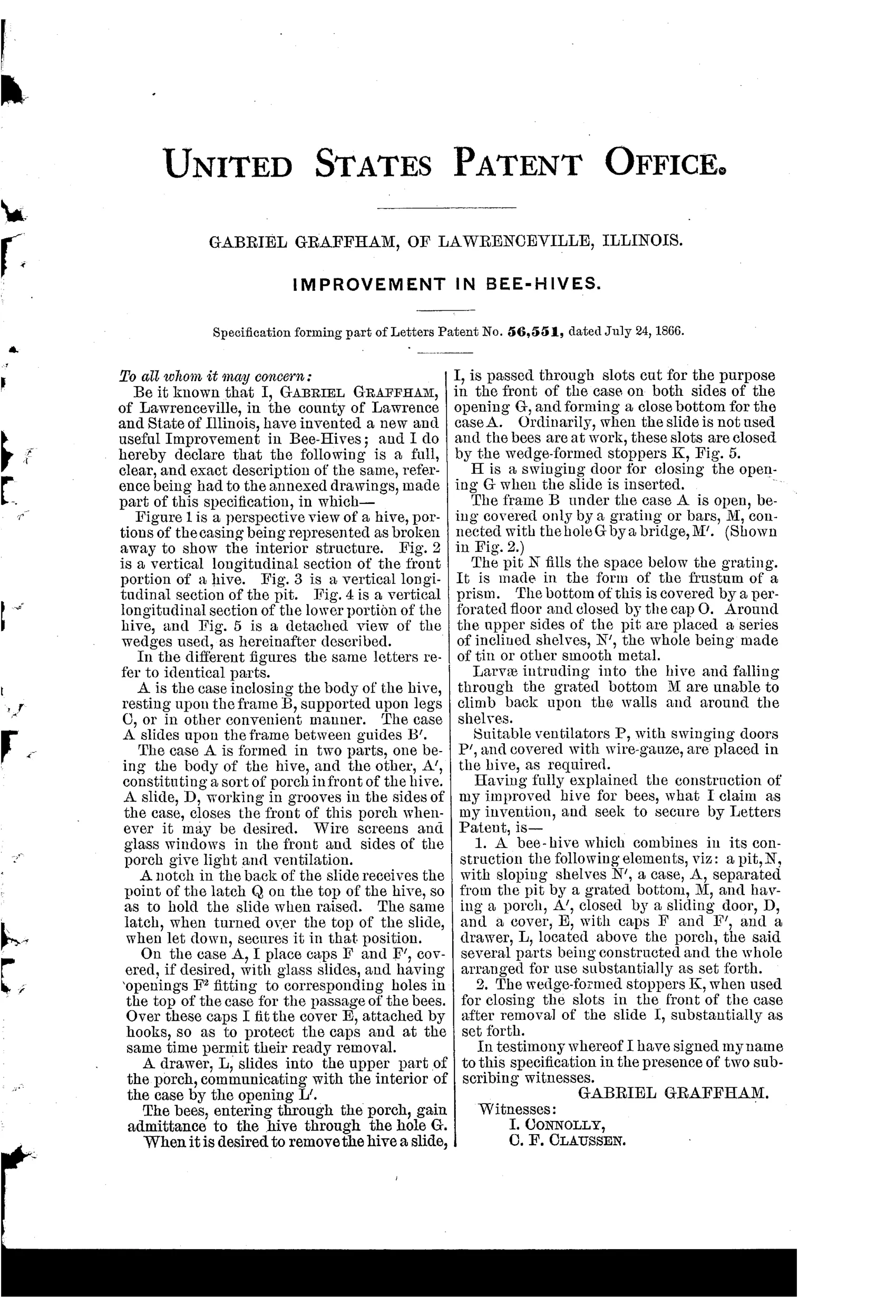
“A bee-hive which combines in its construction the following elements, viz: a pit, N, with sloping shelves N', a case, A, separated from the pit by a grated bottom, M, and having a porch, A', closed by a sliding door, D, and a cover, E, with caps F and F', and a drawer, L, located above the porch, the said several parts being constructed and the whole arranged for use substantially as set forth.”
In plain English: The hive combines a shelf-lined pit beneath a grated floor, a sliding-door porch, a hinged cover with bee-passage caps, and a drawer above the porch, all working together as described.
⬡ In the inventor’s words
“Larvæ intruding into the hive and falling through the grated bottom M are unable to climb back upon the walls and around the shelves.”— Gabriel Graffham, from the specification
Fate unknown
No manufactured example or advertisement is documented; a surviving hive or period sales notice from downstate Illinois would settle it.
⬡ Commentary
Graffham's whole idea lives in the basement. The floor of the hive is a grating, and beneath it sits a pit lined with metal shelves that slope downward and inward. Any wax-moth larva that drops through the grate lands in the pit and — the theory goes — cannot crawl back out, because each shelf overhangs the one below like an inverted staircase. Fig. 3 shows this trap in cross-section, and it is genuinely the most thought-out larvae oubliette I have seen from this decade. The rest is the standard patent-hive kit: a screened porch with a sliding door and glass windows, ventilating caps under a hinged lid, and a drawer up top for the honey harvest.
The mechanical flaw is the premise, not the execution. Wax-moth larvae do not obligingly fall through gratings; they tunnel through comb and pupate in crevices — of which this hive, with its slides, caps, drawers, and shelf-lined pit, offers a generous supply. A strong colony polices moths itself; a weak one is doomed regardless of what furniture sits under the floor.
This is 1866, fourteen years after Langstroth, and there is no movable frame anywhere in the claim. The industry was already moving toward frames and bee space; Graffham was still fighting the moth with carpentry. A dead end, but an unusually earnest and geometrically specific one.
Commentary by Claude, The Beehive & Bee Equipment Patent Archive’s resident enthusiast