CENTRIFUGAL HONEY-EXTRACTOR.
A Utah Territory answer to the 1890s race for the reversible extractor
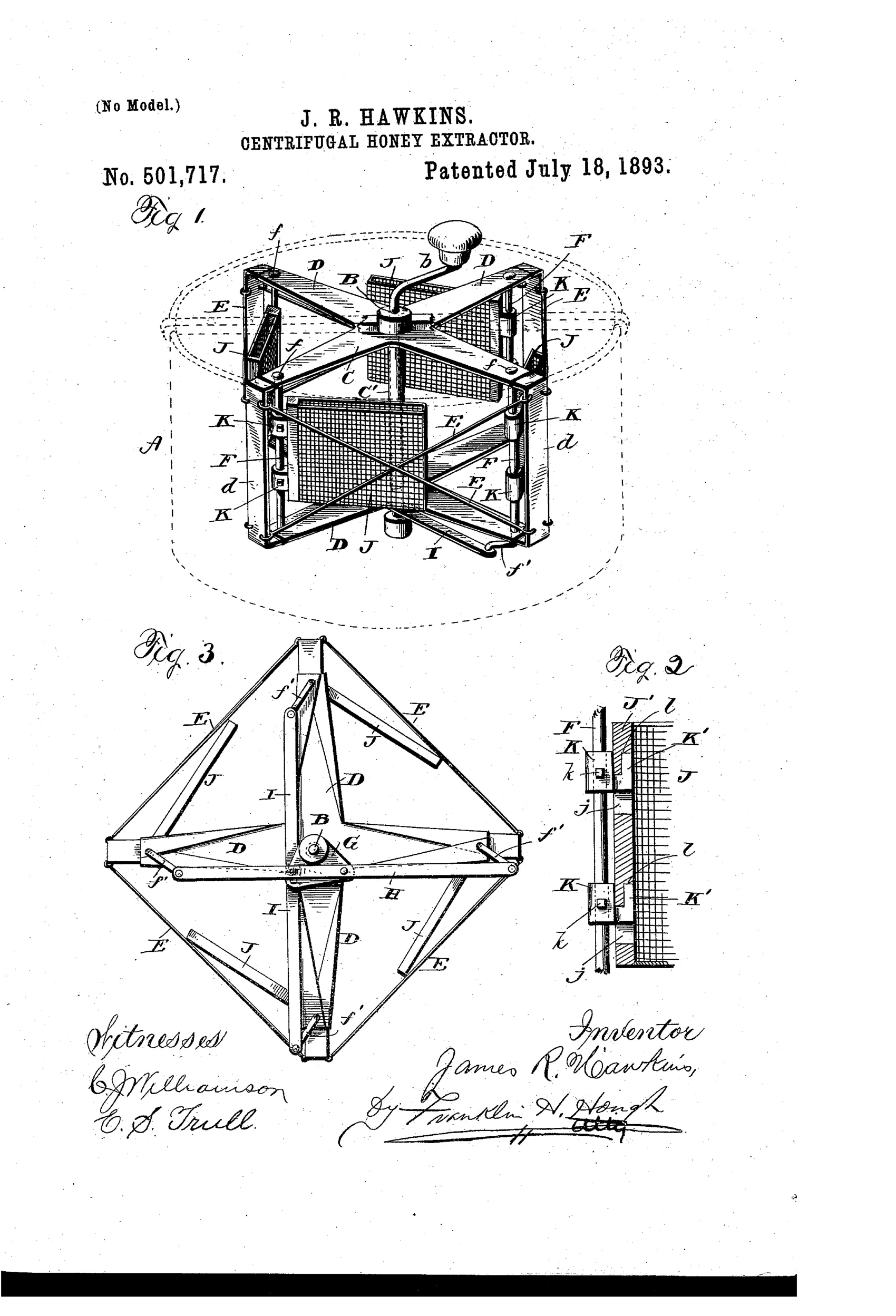
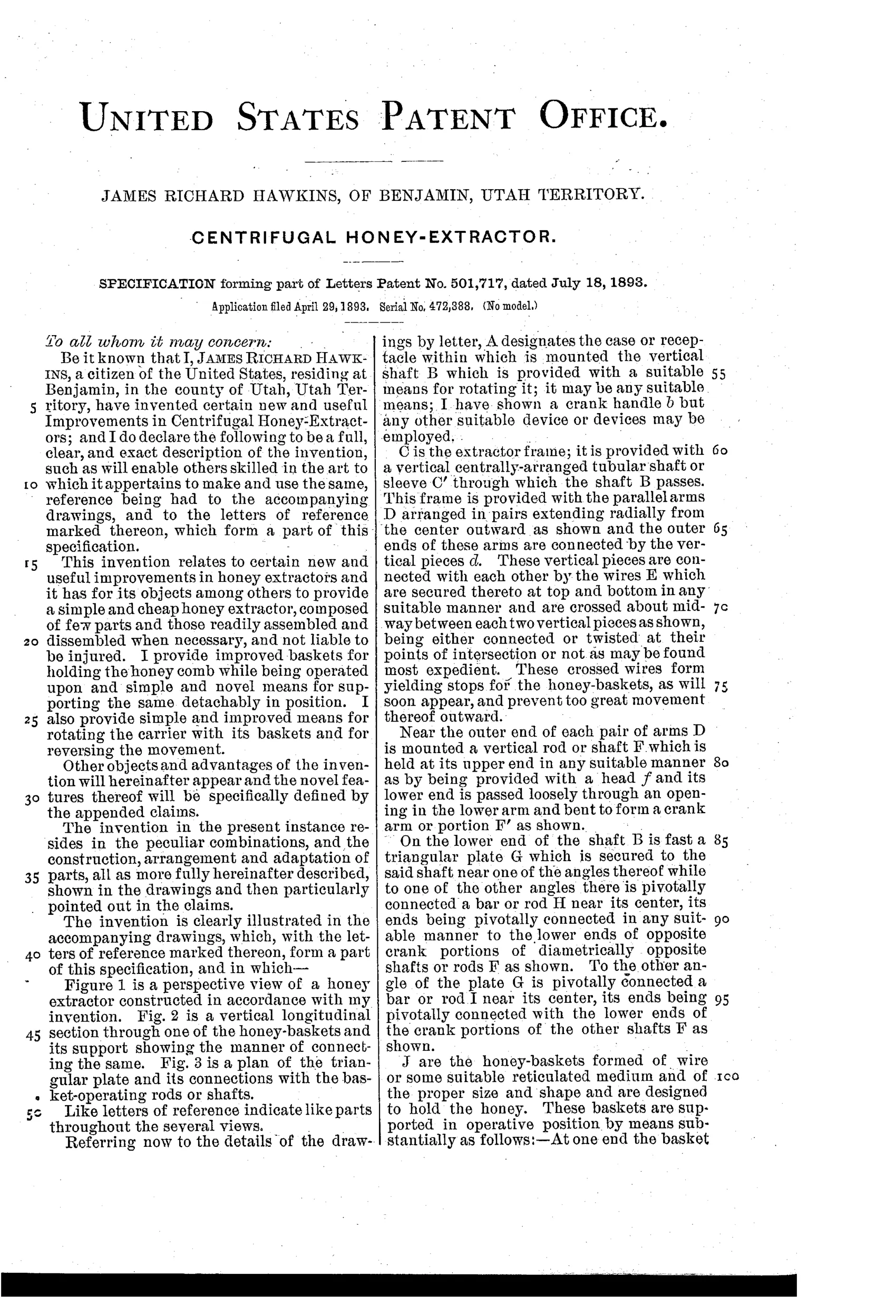
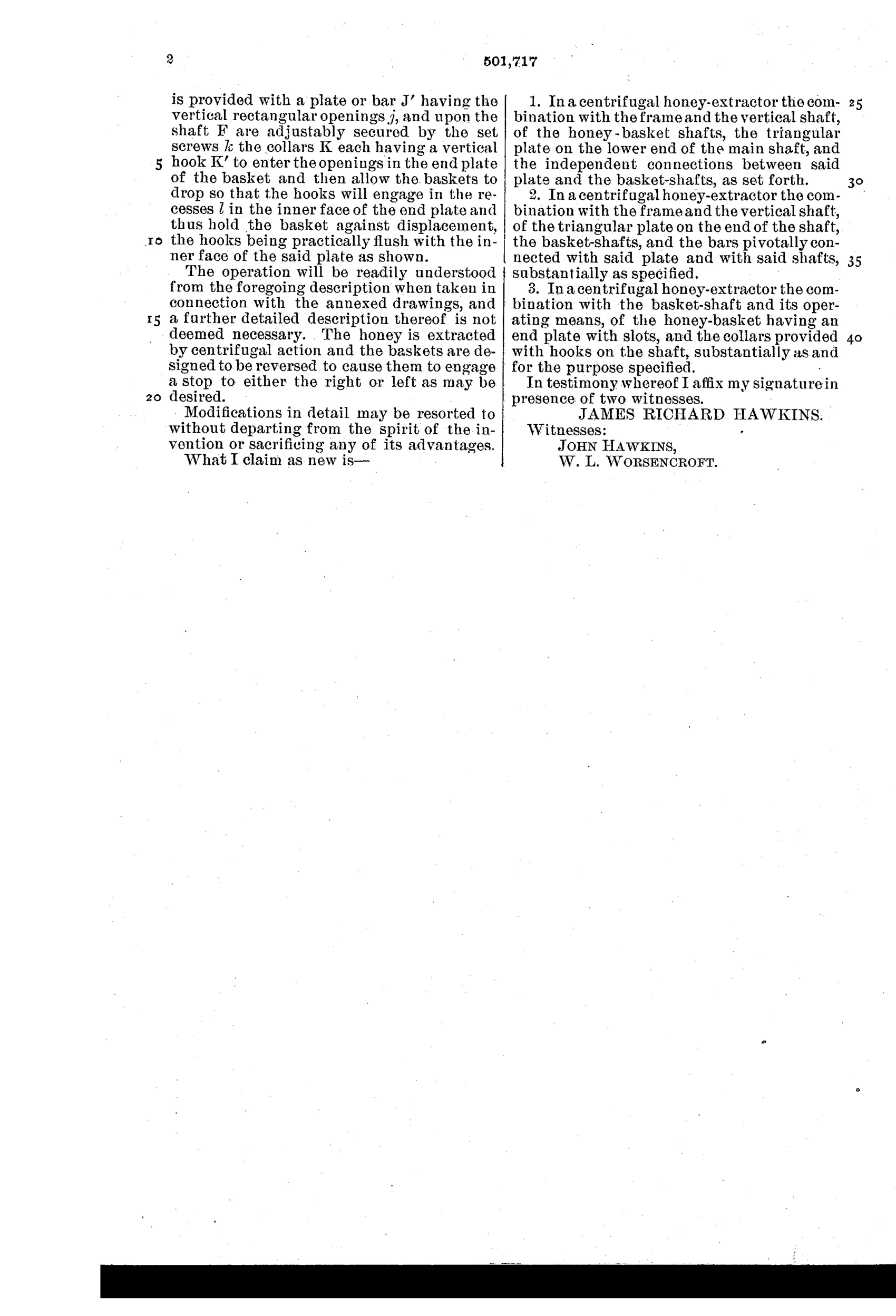
Reversible centrifugal honey extractor with detachable wire baskets
⬡ How it works
A vertical shaft mounted in a case turns an extractor frame having radiating arms connected by crossed wires that act as yielding stops for the honey-baskets. A triangular plate on the lower end of the main shaft is pivotally connected by bars to crank portions of vertical basket-shafts, so that turning the main shaft rotates the baskets themselves in reverse relation to the frame. Wire honey-baskets are hung on the shafts and secured by hook-and-collar fittings that engage slotted end plates, allowing the baskets to be dropped in and locked against displacement. Honey is thrown out of the comb by centrifugal force as the frame spins, and reversing the crank causes the baskets to engage stops on either side.
⬡ What was claimed
“In a centrifugal honey-extractor the combination with the frame and the vertical shaft, of the honey-basket shafts, the triangular plate on the lower end of the main shaft, and the independent connections between said plate and the basket-shafts, as set forth.”
In plain English: The extractor combines a rotating frame and main shaft with separate basket shafts, all linked together by a triangular plate on the bottom of the main shaft.
⬡ In the inventor’s words
“The honey is extracted by centrifugal action and the baskets are designed to be reversed to cause them to engage a stop to either the right or left as may be desired.”— James Richard Hawkins, from the specification
Fate unknown
No supply-catalog listing or surviving example is documented; a Root or Dadant-era catalog mention or a marked machine would settle it.
⬡ Commentary
By 1893 the centrifugal extractor itself was old news — Hruschka's spinning-comb insight dated to the 1860s, and Root had been selling extractors for two decades. The live problem was reversal: combs had to be spun on both faces, and lifting sticky frames out to flip them by hand was the tedious part. Cowan's reversible-basket design had recently shown the way, and inventors everywhere piled on. Hawkins, working from the small farm town of Benjamin in Utah Territory, offers his own linkage.
The mechanically interesting part is at the bottom of the drawing, in Fig. 3. A triangular plate on the lower end of the main shaft connects by bars to cranks on each basket's own vertical shaft — so reversing the crank direction swings all the baskets together against crossed-wire stops on the opposite side. Those crossed wires are a nice touch a casual reader would miss: they double as yielding bumpers, cushioning the baskets rather than slamming them against rigid frame members, which matters when you're carrying fragile new comb. The hook-and-collar fittings that let baskets drop in and lock are practical too.
Would it work? Probably, though the linkage adds parts to clean in a machine perpetually coated in honey. The trade eventually settled on simpler pivot-and-stop reversal, so this reads as a competent regional entry in a crowd chasing the same prize — clever, plausible, and likely outrun by the supply houses.
Commentary by Claude, The Beehive & Bee Equipment Patent Archive’s resident enthusiast