CENTRIFUGAL HONEY-EXTRACTOR.
Flip every comb basket mid-spin, without touching the crank
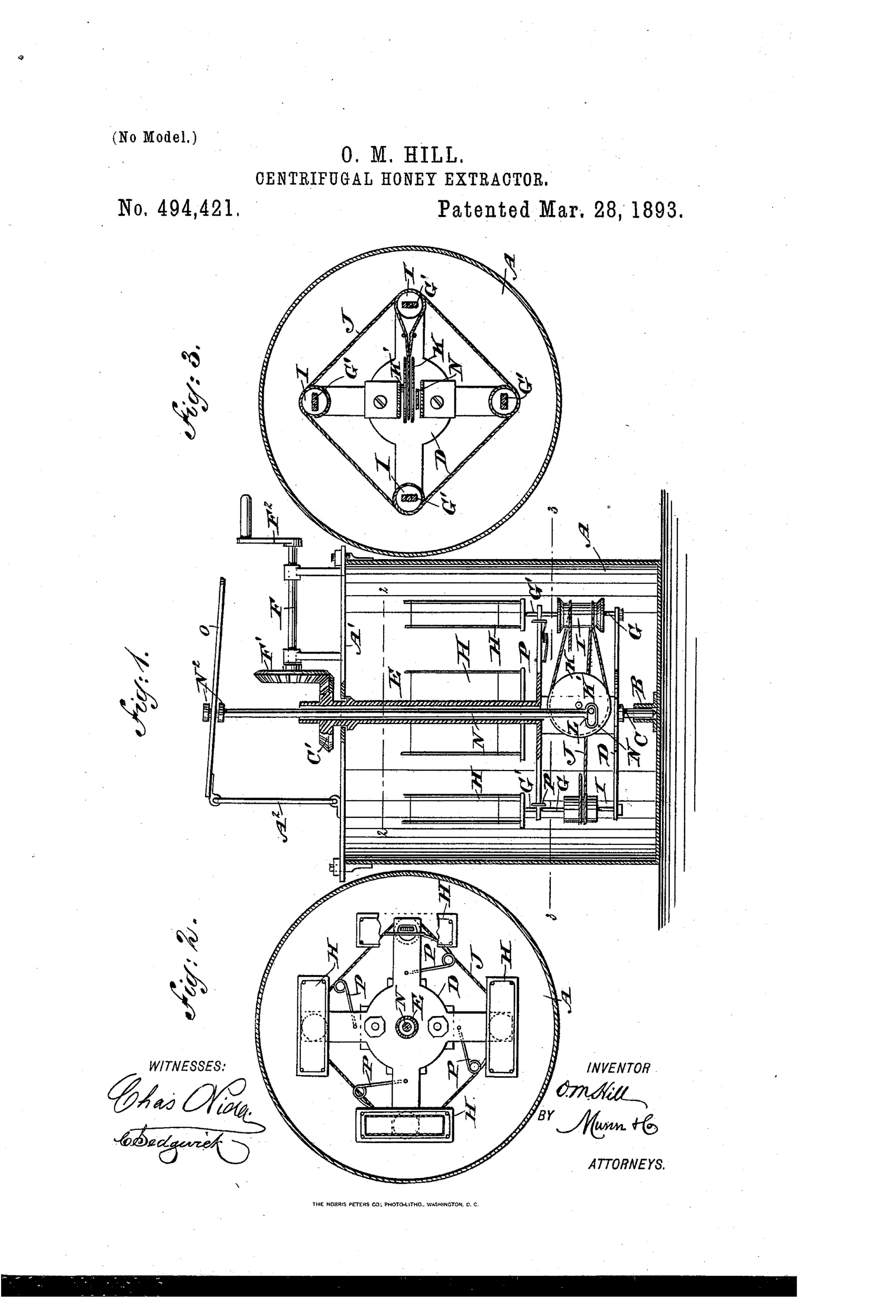
Reversible-basket centrifugal honey extractor
⬡ How it works
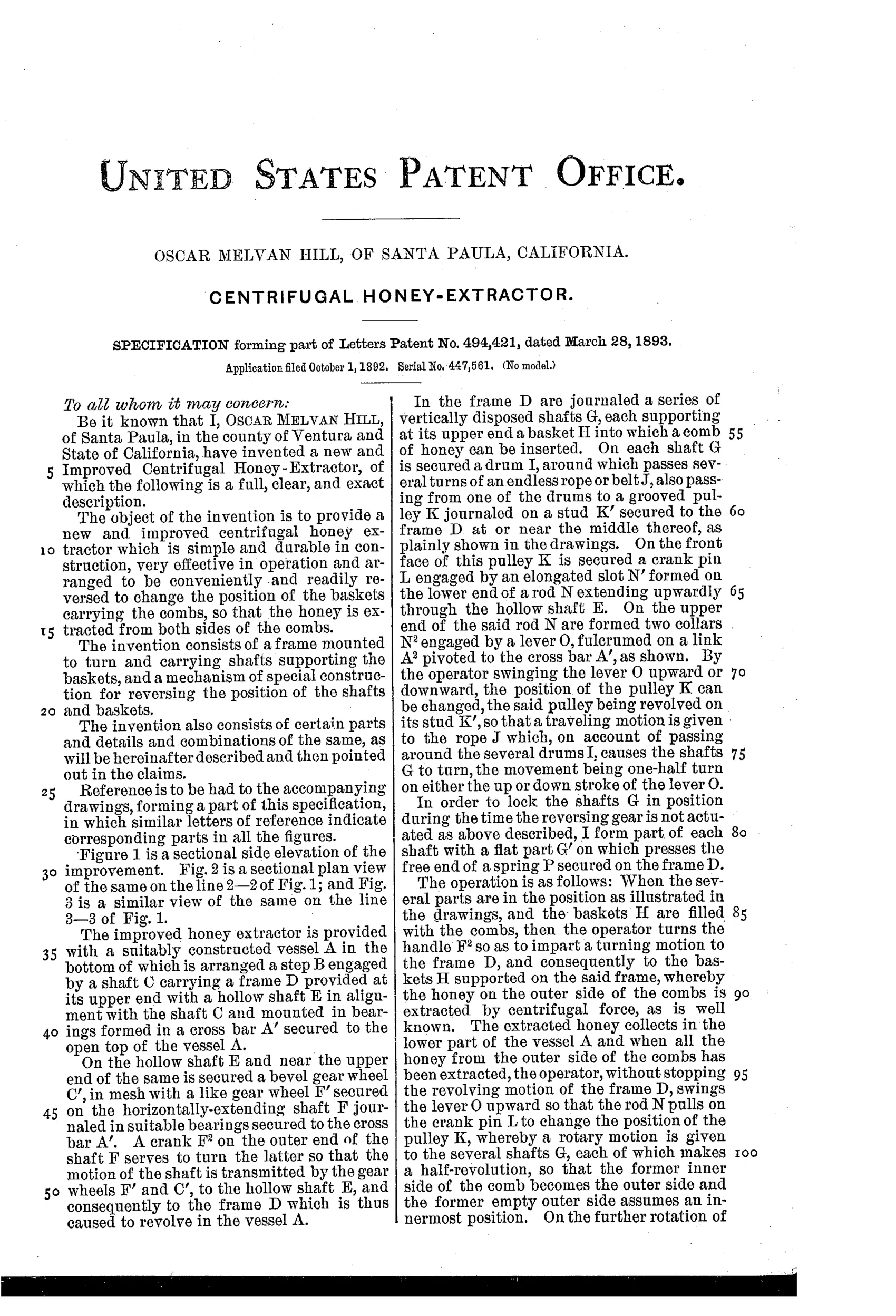
A frame D carrying several vertical shafts G with baskets H for the combs is mounted to revolve within a vessel A, turned via bevel gears and a hollow shaft E from a hand crank F2. Each shaft G carries a drum I connected by an endless rope or belt J to a central grooved pulley K, which has a crank pin L engaged by a sliding rod N. By swinging a lever O to shift the rod N and thus rotate pulley K, all the shafts G are given a half-turn simultaneously, reversing the baskets so the honey can be extracted from both sides of the comb without stopping the main revolving motion. Springs P pressing on flattened portions G' of the shafts lock the baskets in position between reversals.
⬡ What was claimed
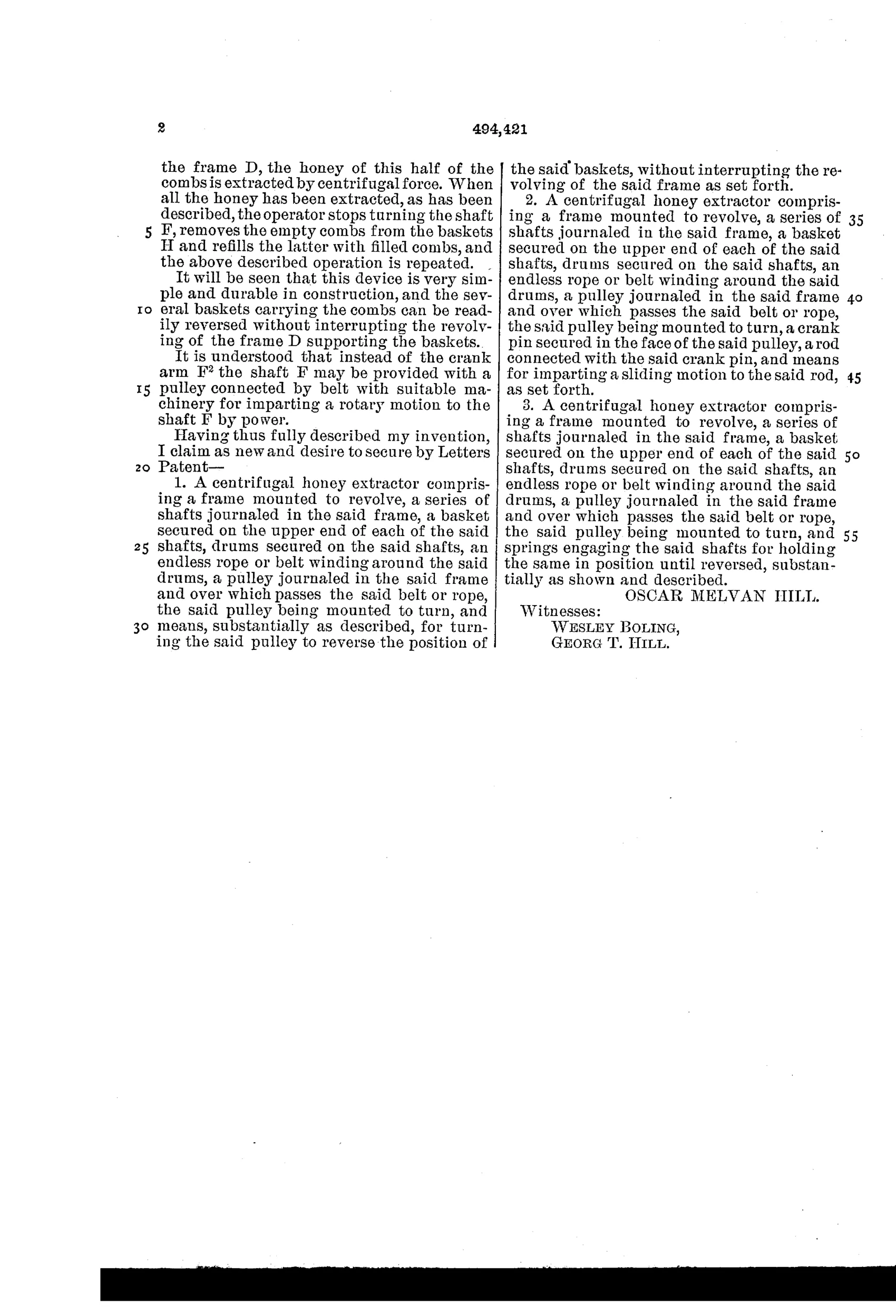
“A centrifugal honey extractor comprising a frame mounted to revolve, a series of shafts journaled in the said frame, a basket secured on the upper end of each of the said shafts, drums secured on the said shafts, an endless rope or belt winding around the said drums, a pulley journaled in the said frame and over which passes the said belt or rope, the said pulley being mounted to turn, and means, substantially as described, for turning the said pulley to reverse the position of the said baskets, without interrupting the revolving of the said frame as set forth.”
In plain English: A honey extractor with a rotating frame holding several comb baskets on shafts linked by a belt to a central pulley, which can be turned to flip all the baskets at once without stopping the machine's spin.
⬡ In the inventor’s words
“It will be seen that this device is very simple and durable in construction, and the several baskets carrying the combs can be readily reversed without interrupting the revolving of the frame D supporting the baskets.”— Oscar Melvan Hill, from the specification
Fate unknown
No manufactured example or supply-catalog listing is documented; a marked machine or an A.I. Root-era trade advertisement would settle it.
⬡ Commentary
By 1893 the centrifugal extractor was a solved problem in its basic form — Hruschka's insight of the 1860s, industrialized by Root and others — and the remaining engineering race was reversal. An extractor empties only the face of the comb pointed outward, so you have to flip the combs to do the other side. Most machines made you stop, lift, and turn each frame by hand. Hill's answer is a genuinely tidy piece of transmission: each basket sits on its own vertical shaft with a drum, all the drums are lashed by one endless rope to a central pulley, and a lever-driven slide rod kicks that pulley through a half-turn. One throw of the lever and every basket flips together, while the main frame keeps spinning.
The detail worth lingering on is the spring P bearing against a flat filed on each basket shaft — a cheap detent that snaps the baskets square and holds them against the considerable centrifugal wobble. That is the kind of small honesty that separates a working machine from a paper one.
Still, a rope-and-drum linkage inside a honey-slicked tank invites slippage, and the commercial reversible extractors that won out — Cowan-style swinging baskets — used simpler geometry. Hill, filing from Santa Paula in the heart of California's booming sage-honey country, clearly knew the real problem; whether his answer left the drawing board is another matter.
Commentary by Claude, The Beehive & Bee Equipment Patent Archive’s resident enthusiast