CENTRIFUGAL HONEY-EXTRACTOR.
Stop the crank and the baskets flip themselves — reversing without touching the combs
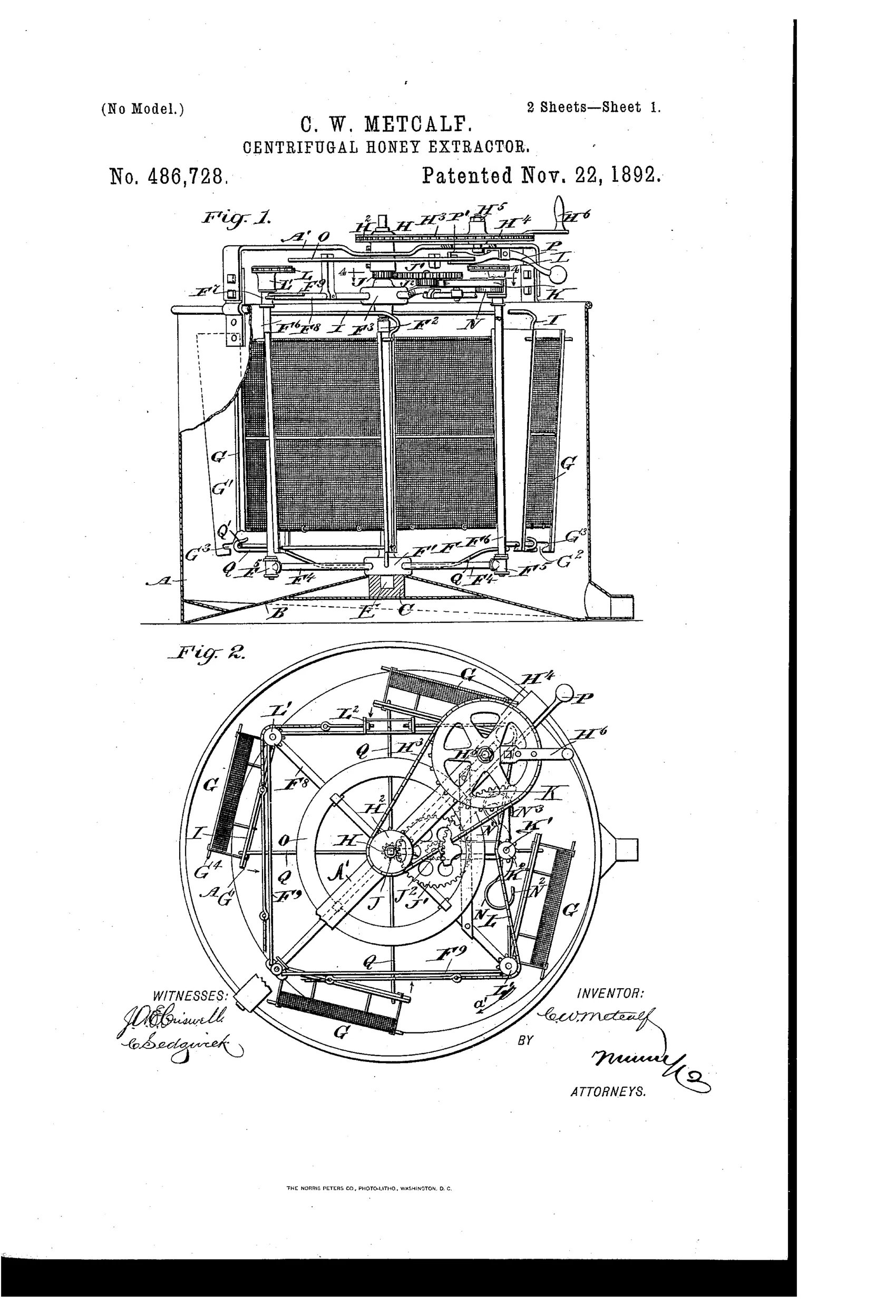
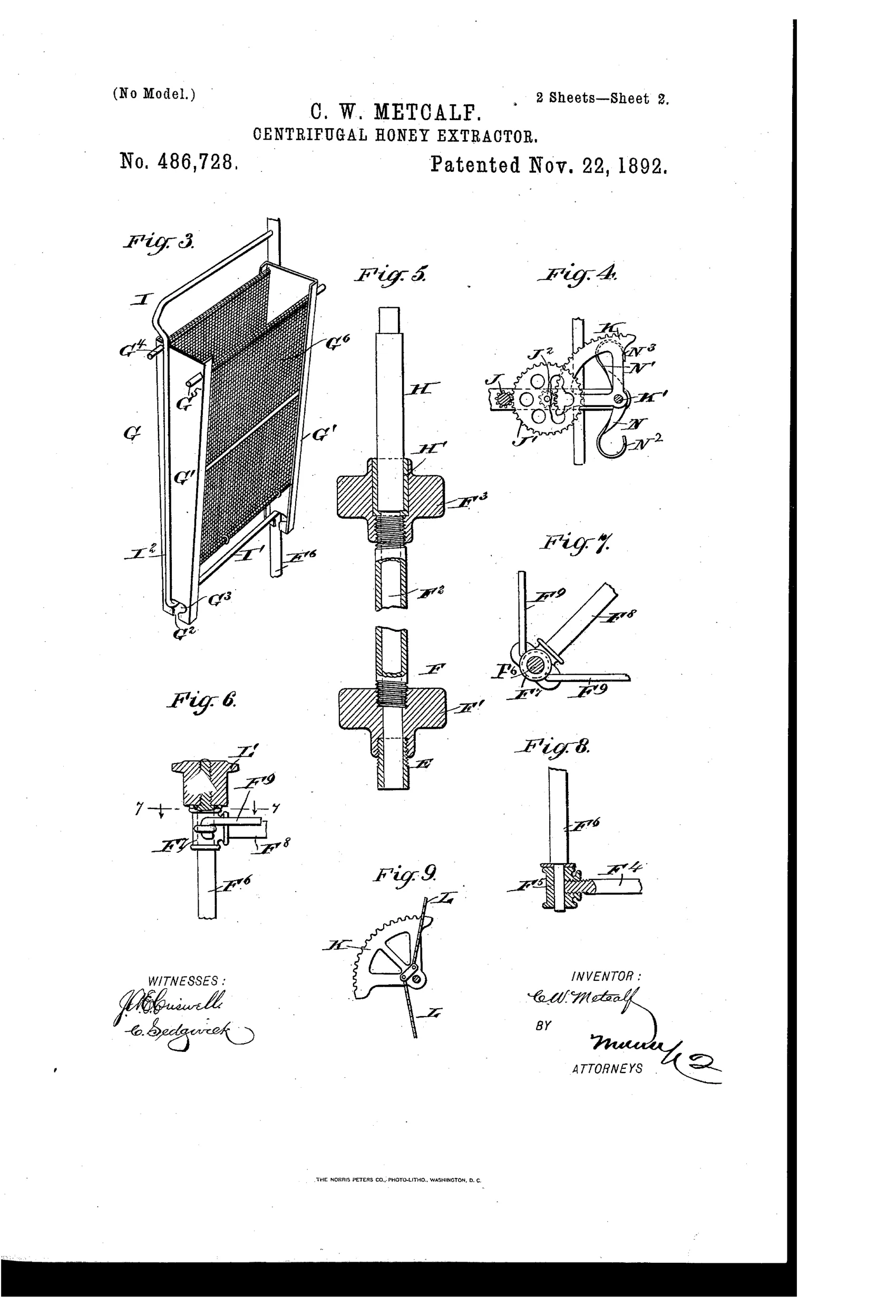
Reversible-basket centrifugal machine for extracting honey
⬡ How it works
A vessel A holds a rotating basket-frame F carrying wire-netting comb-holders G on swinging shafts F6. A hand crank turns a sprocket-and-gear train (H, H2-H6, J, J2, K) that spins the frame so centrifugal force throws honey from the outer face of the combs. When the operator stops the crank, a segmental gear-wheel K reverses the shafts F6 via a sprocket-chain L, swinging the baskets inward on rod I so the opposite comb face becomes outer and can be emptied by resuming forward rotation. Springs N with lugs N2/N3 cushion the segmental gear-wheel's motion to prevent jarring, and a brake-wheel O with lever P lets the operator slow the frame.
⬡ What was claimed
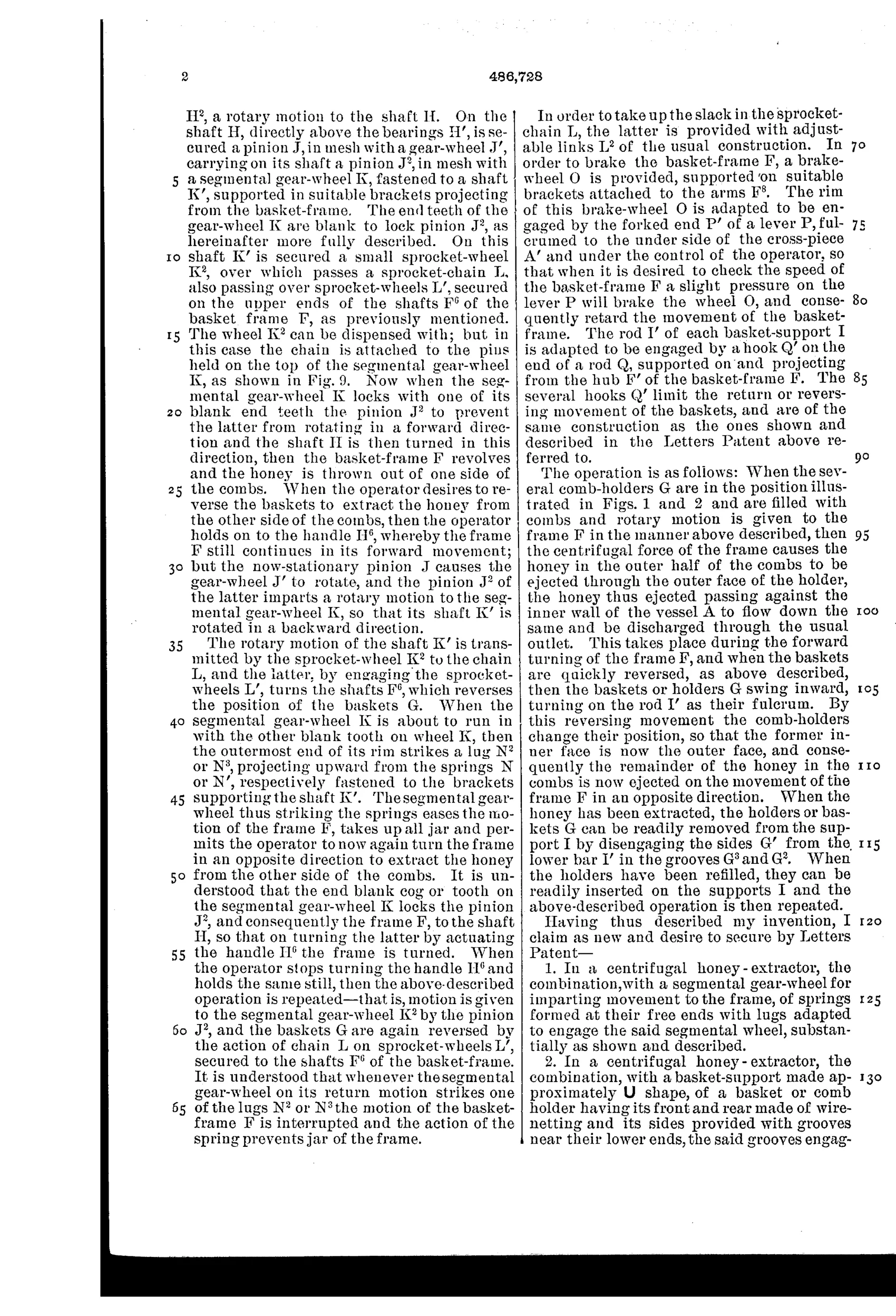
“6. In a centrifugal honey-extractor, the combination, with a frame mounted to turn and holders or baskets supported on the said frame and mounted to swing, of a main driving-shaft mounted to rotate, a series of gear-wheels connected with the said shaft, a segmental gear-wheel in mesh with a pinion of the said series of gear-wheels and connected by a sprocket-chain with the said frame, and a brake mechanism, substantially as described, and connected with the said frame, as set forth.”
In plain English: The extractor combines a turning basket frame, a hand-cranked gear train linked by a segmental gear-wheel and chain to reverse the baskets, plus a brake to control the frame's speed.
⬡ In the inventor’s words
“The object of the present invention is to provide a new and improved centrifugal honey-extractor which is very simple and durable in construction, very effective in operation, and arranged to give a rapid motion to the baskets without creating much noise; also, permitting of convenient and quick removal of the baskets for refilling the same with the combs and removing the empty ones.”— Charles W. Metcalf, from the specification
Fate unknown
Reversible extractors were certainly manufactured in this era, but I know of no documented Metcalf machine; a marked specimen or trade-catalog listing would settle it.
⬡ Commentary
By 1892 the extractor was a settled tool — Hruschka's insight and Langstroth-era refinement had made centrifugal extraction routine — but the surviving annoyance was reversing. A full comb has honey on both faces, and slinging one side dry means stopping the machine, lifting each sticky frame, and turning it around by hand. The whole late-century extractor patent literature is a hunt for a way to flip the combs mechanically, and Metcalf's entry is one of the more ambitious answers.
His trick lives in that segmental gear-wheel K visible in Fig. 2: when the operator stops cranking, the segment engages and a sprocket-chain swings all the basket shafts at once, so the inner comb face rotates outward. Resume cranking and you're emptying side two without ever opening the can. He even worried about the details — cushioning springs so the reversal doesn't slam, and a proper brake wheel with a lever, which matters because a heavy loaded rotor coasts a long time.
The worry is the same one that haunts every chain-and-segment mechanism in a honey house: everything here is bathed in honey mist and wax crumbs, and a sprocket-chain reversal gear is a lot of small parts to keep clean and timed. Commercial reversible extractors (Cowan's line, notably) mostly won with simpler swinging baskets. Metcalf's machine reads as workable but over-geared — clever engineering aimed at a real problem, solved elsewhere with less.
Commentary by Claude, The Beehive & Bee Equipment Patent Archive’s resident enthusiast