CENTRIFUGAL HONEY-EXTRACTOR.
Reverse the crank and the combs flip themselves — an 1892 self-reversing extractor
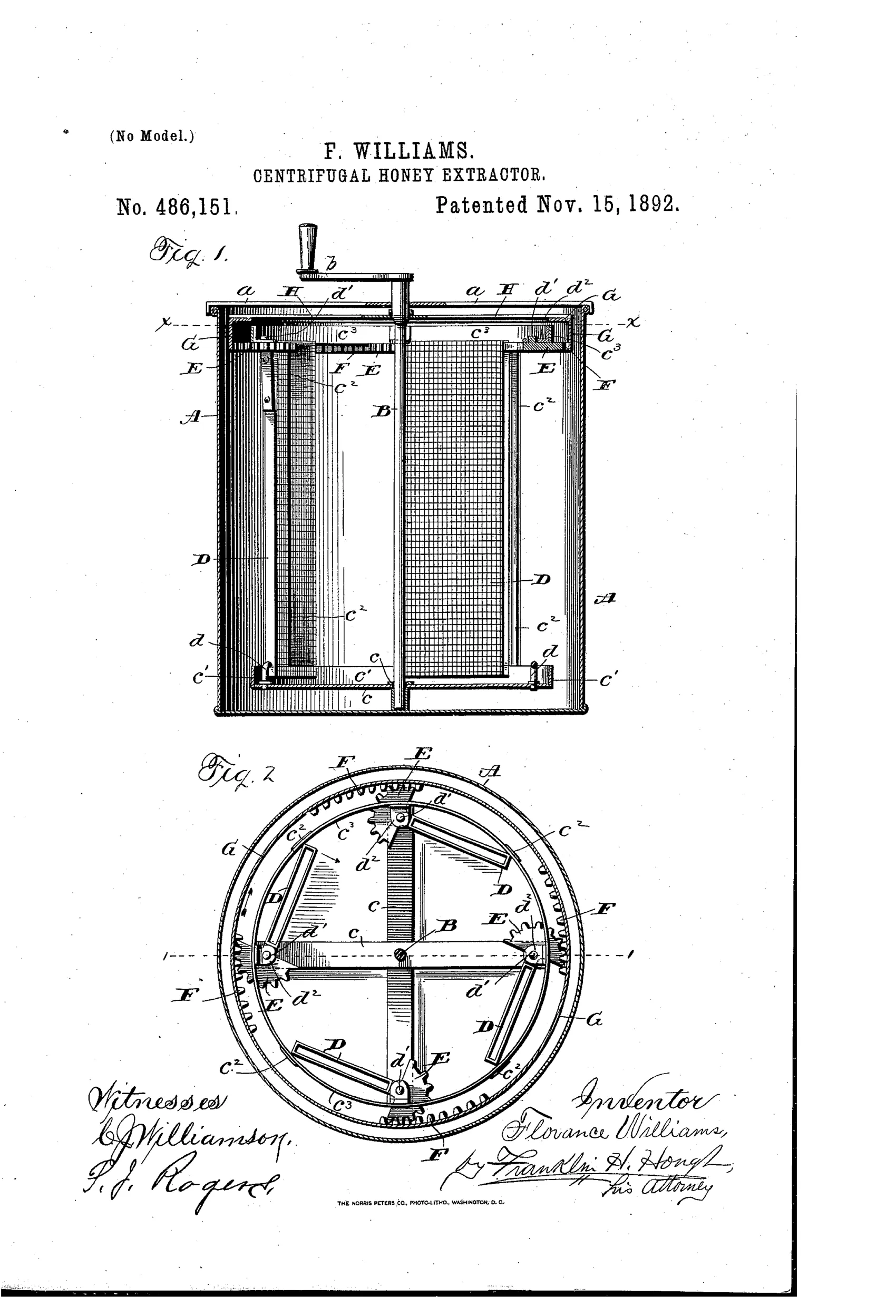

Self-reversing centrifugal honey extractor with pivoting comb holders
⬡ How it works
A cylindrical vessel holds a central shaft turned by a hand crank, which carries a frame with four upright bars and pivoted comb holders. Each holder has a gear-segment near its pivot that meshes with a rack-segment on a ring attached to the shaft, so rotating the shaft first swings the holders outward against stop rings before the frame itself begins to spin. Reversing the crank direction automatically reverses the holders' orientation, allowing both sides of the comb to be extracted by centrifugal force without the operator handling the frames.
⬡ What was claimed
“In a centrifugal honey-extractor, the combination, with the comb-holder frame comprising two or more bars at its lower end, a ring uniting the same, upright bars, and a ring uniting them at their upper ends, of comb-holders pivoted to said frame at points midway between the upright bars, a gear-segment carried by the pivot of each holder at its upper end, a ring having a rack for each segment, and a shaft carrying said ring and journaled in said frame at its lower end, substantially as shown and described, and for the purpose specified.”
In plain English: The extractor combines a holder frame with pivoting comb baskets that automatically swing to the opposite side when the driving shaft's rotation is reversed, using meshing gear and rack segments to do so without manual adjustment.
⬡ In the inventor’s words
“It will be seen that my device is exceedingly simple and thoroughly efficient in action.”— Florance Williams, from the specification
Fate unknown
The mechanism is practical and was assigned to a third party, suggesting commercial intent, but no marked Williams-pattern extractor or trade listing is documented; a supply-catalog entry or surviving machine would settle it.
⬡ Commentary
The extractor was one of the great labor problems of early frame beekeeping: spin a comb and you empty only the outward-facing side, so someone had to stop the machine, pull each frame, turn it around, and spin again. By 1892 inventors everywhere were chasing the 'reversible' extractor, and Florance Williams of Seneca, Wisconsin offered a genuinely tidy answer — gear segments on each comb-holder pivot meshing with rack segments on a ring fixed to the shaft. Crank one way and the holders swing outward against their stops before the frame starts spinning; crank the other way and they automatically flip to present the opposite comb face. The operator never touches the frames.
Fig. 2 is where the cleverness lives. Look at the small toothed segments at each holder pivot engaging the racked ring: the reversing action costs the design nothing more than four little gear pairs, and it uses the inevitable lag between shaft and frame as its power source. That is the kind of economy you want in a mechanism.
Williams was refining, not inventing — Cowan's reversible extractor was already established in the trade, and the big supply houses (Root especially) were selling reversing machines. Whether this particular geared arrangement ever went past the assignee, L. S. Haskins, is another question. The mechanism looks buildable, but the market was already crowded with proven designs.
Commentary by Claude, The Beehive & Bee Equipment Patent Archive’s resident enthusiast