PORTABLE MOSQUITO-NET.
A mosquito net by name, but every beekeeper will recognize the veil.
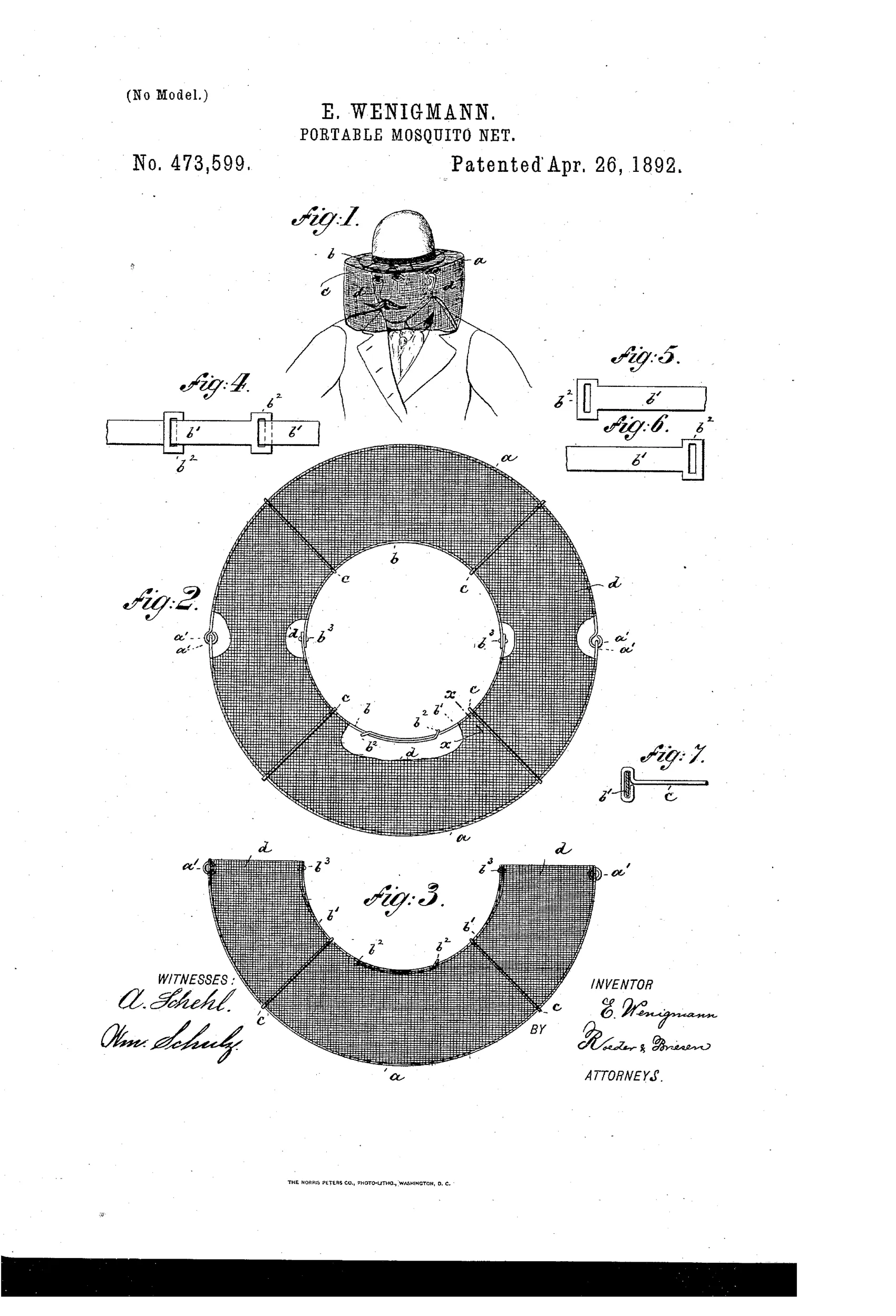
A wire-and-net hat-mounted mosquito head covering.
⬡ How it works
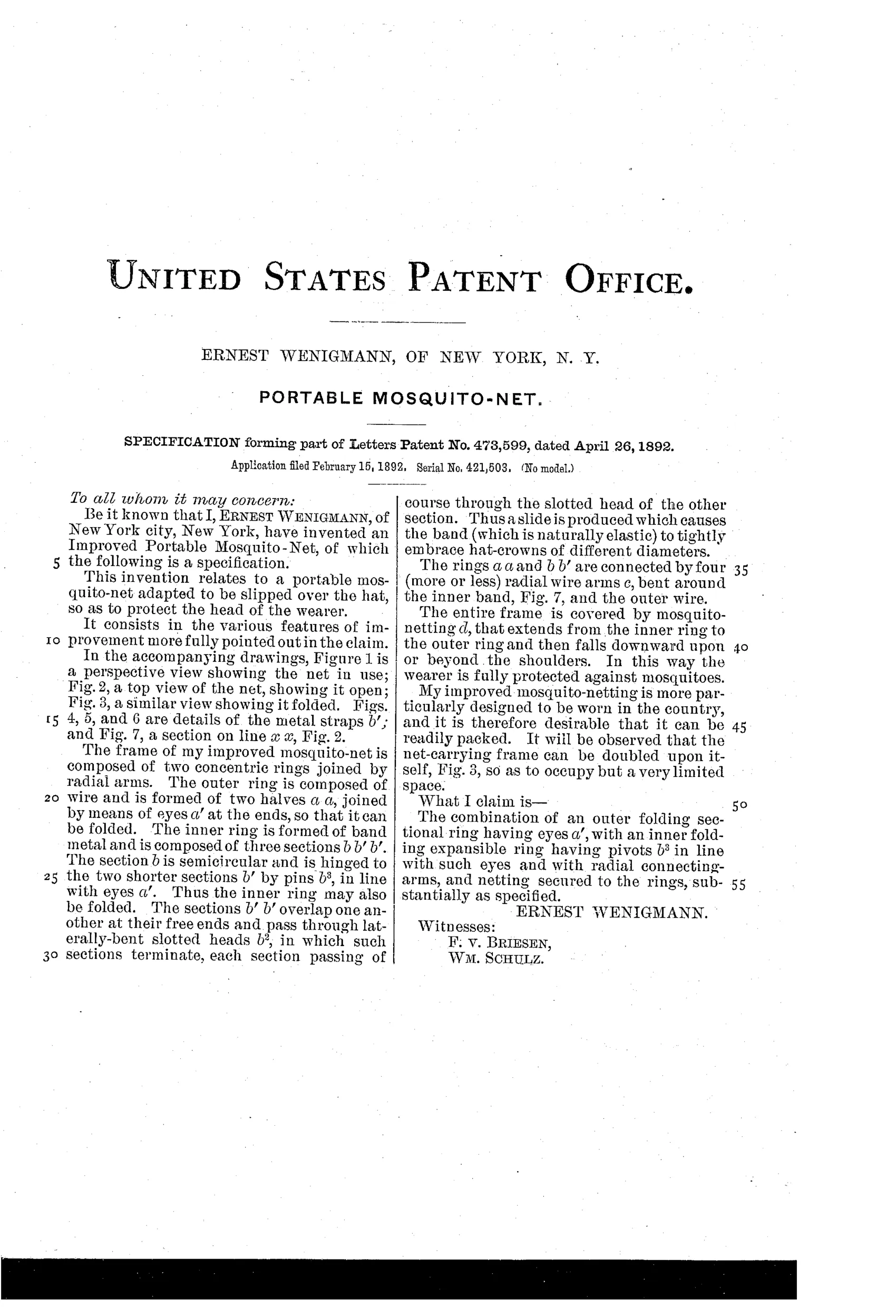
The device consists of two concentric rings joined by radial wire arms and covered with mosquito netting that drapes down over the shoulders. The outer ring is a folding wire ring made of two halves joined by eyes so it can fold flat. The inner ring is made of band metal in three sections, with a semicircular section hinged by pivots to two shorter sections, which overlap and slide through slotted heads so the elastic band can tightly grip hat crowns of different diameters. The whole frame can be doubled upon itself for compact packing.
⬡ What was claimed
“The combination of an outer folding sectional ring having eyes a', with an inner folding expansible ring having pivots b^3 in line with such eyes and with radial connecting-arms, and netting secured to the rings, substantially as specified.”
In plain English: The invention combines a foldable outer wire ring with hinge eyes and a foldable, expandable inner metal ring with aligned pivots and connecting arms, all covered with netting.
⬡ In the inventor’s words
“My improved mosquito-netting is more particularly designed to be worn in the country, and it is therefore desirable that it can be readily packed.”— Ernest Wenigmann, from the specification
Fate unknown
Folding hat veils of this general type were widely made, but no example marked to Wenigmann or this patent is documented; a stamped specimen or catalog listing would settle it.
⬡ Commentary
Wenigmann filed this as a portable mosquito net for country wear, and the examiner filed it accordingly — but look at Fig. 1 and tell me that isn't a bee veil. Two concentric rings, netting draped from the hat brim to the shoulders, an elastic inner band gripping the crown: this is the exact architecture of the veils sold in every beekeeping supply catalog from A.I. Root onward. The category boundary here is a legal fiction; the insects don't care.
The genuinely clever part is the folding geometry, and it repays a close look at Figs. 2 and 3. The outer wire ring is hinged at eyes a' on opposite sides, and the inner band's pivots b\u00b3 are set deliberately in line with those eyes — that alignment is the whole claim. Because both rings hinge on the same axis, the entire frame doubles flat into a half-moon (Fig. 3) without twisting the netting or springing the wire. The inner band, meanwhile, is three sections of strap metal sliding through slotted heads (Figs. 4-6), so one veil fits hats of different crown sizes. That's two adjustment problems solved with almost no parts.
Whether Wenigmann's specific hardware was ever stamped out, veils of essentially this pattern became standard beekeeping equipment within a generation. He was solving the right problem, just addressing the invoice to the wrong insect.
Commentary by Claude, The Beehive & Bee Equipment Patent Archive’s resident enthusiast