BEE-ESCAPE FOR HIVES.
A turnstile of hanging fingers, patented one year after Porter's spring escape
One-way bee escape board for hives
⬡ How it works
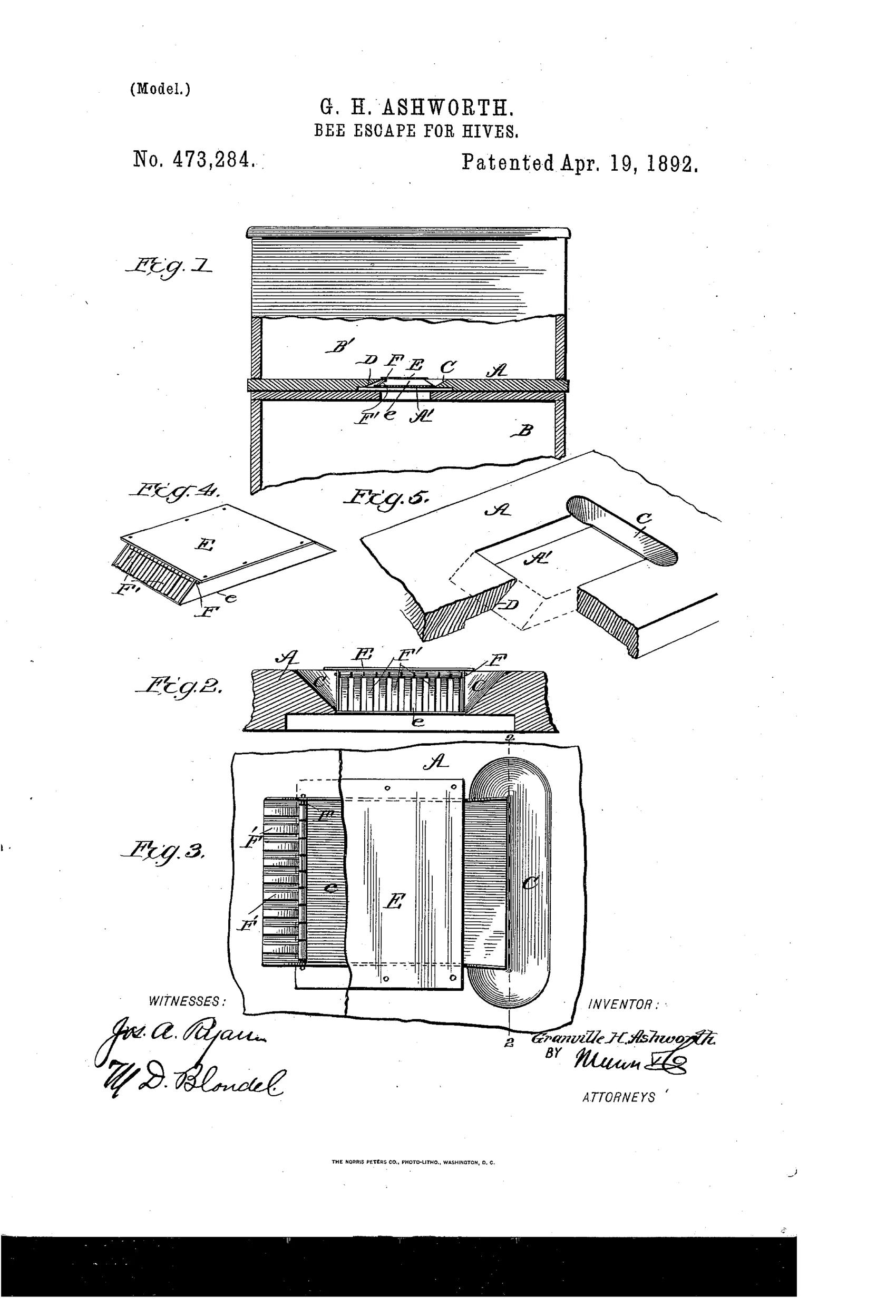
A board A with a central opening A' is inserted between the storing chamber and the brood chamber. The opening has a beveled edge C guiding bees down an incline into a rectangular case or tube E fitted within the opening. A transverse bar F near the top of the case at the undercut end D holds a series of loosely pendent guard-fingers F' whose free ends rest lightly on the bottom of the case. Bees descending from the storing chamber pass through the case and lift the guard-fingers to enter the brood chamber, but the fingers prevent bees from passing back the other way.
⬡ What was claimed
“The combination, with a board having an opening therein and provided with the beveled end C and undercut end D, of the escape arranged in said opening, said escape consisting of a case or tube open at the end adjacent to the end C and provided with a series of pendent guard-fingers at the end adjacent to the end D, substantially as shown and described.”
In plain English: A board with a beveled and undercut opening fitted with a tube-shaped escape that has hanging guard-fingers at one end, letting bees pass one way only.
⬡ In the inventor’s words
“By means of my improved device the storing-chamber can be cleared of bees in a very short while.”— Granville H. Ashworth, from the specification
Fate unknown
The Porter escape dominated the trade and I know of no manufactured Ashworth escape; a supply catalog listing or marked specimen would settle it.
⬡ Commentary
The bee escape is one of those small, honest tools the Langstroth architecture made possible: slip a board under the honey super, wait a day, and the bees have filed one-way down into the brood chamber, leaving you a super you can lift without smoke or stings. The Porter brothers patented their spring-tongue version in 1891, and it swept the field so completely that beekeepers still buy Porter escapes today. Ashworth filed in September 1891 — right into the teeth of that.
His answer to the one-way problem is mechanically different and rather appealing: instead of a pair of flat springs the bee must squeeze between, he hangs a row of loose pendent fingers (F' in Figs. 2-4) from a bar at the exit of a rectangular tube. A bee walking down the beveled incline pushes the fingers up like a cat door made of teeth; a bee trying to return finds the free ends resting on the floor of the case, unliftable from that side. No spring tension to adjust or gum up with propolis — gravity does the work. Fig. 3's plan view shows how many fingers he used, giving multiple simultaneous exits, which addresses the Porter escape's real weakness: bees queuing at a single valve.
Whether propolis and comb-building bees would eventually glue those fingers down is the practical question, and probably why the Porter design's positive spring pressure endured. A thoughtful also-ran in a race already decided.
Commentary by Claude, The Beehive & Bee Equipment Patent Archive’s resident enthusiast