IMPROVEMENT IN BEE-HIVES.
Twelve years after Langstroth, a Catskills hive that never mentions frames
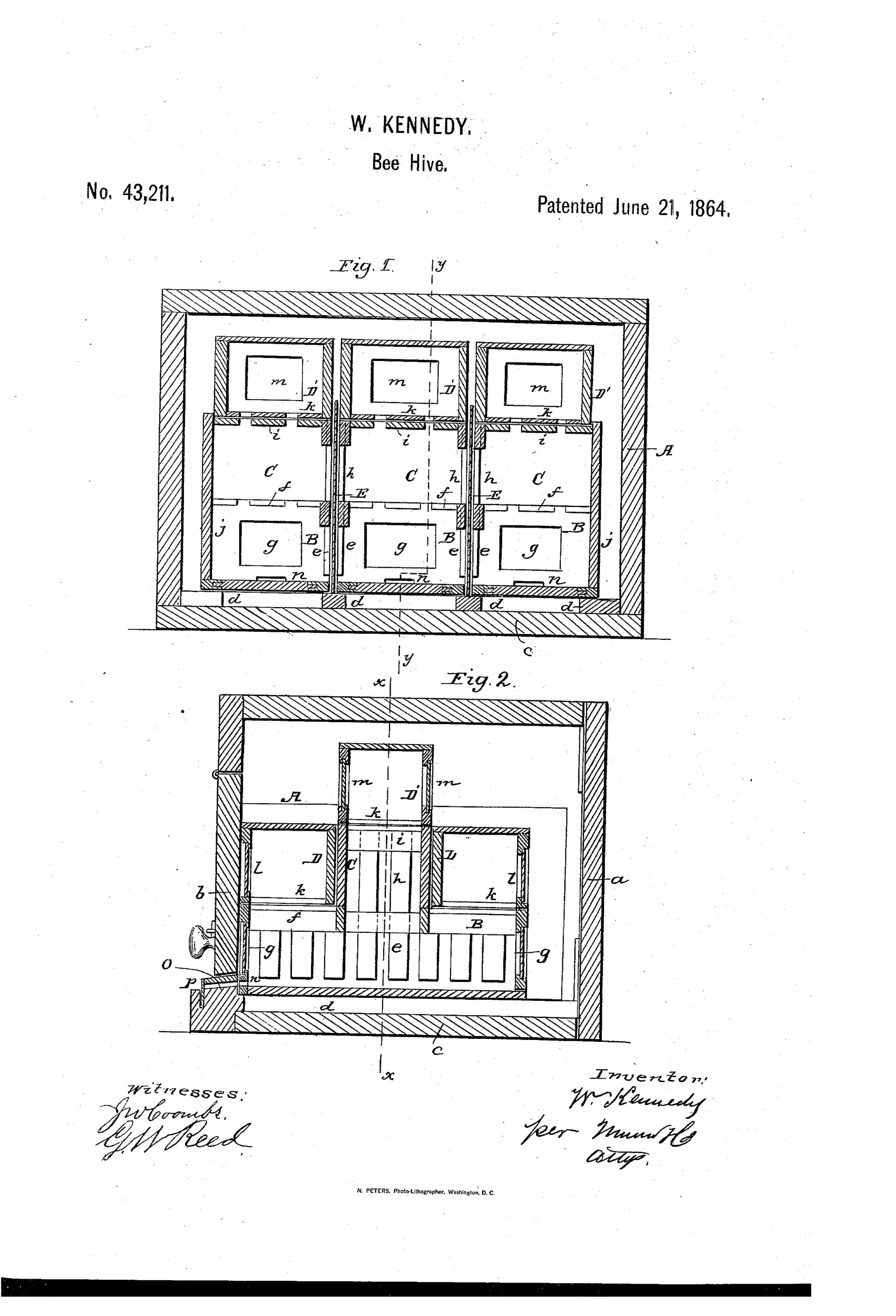
Sectional wooden bee-hive with removable stacked honey boxes
⬡ How it works
The hive consists of an outer case A with front and rear doors, holding three side-by-side boxes B, each resting on cleats and having slatted sides and top forming a central comb chamber C. Smaller surplus-honey boxes D and D' with glass sides sit atop each box B's slatted compartment, allowing spare honey to be inspected and removed without disturbing the brood below. Sliding partitions E between adjoining boxes B can be removed to give bees access to additional chambers as needed, preventing swarming, while front entrance slides o/p control bee access to the case.
⬡ What was claimed
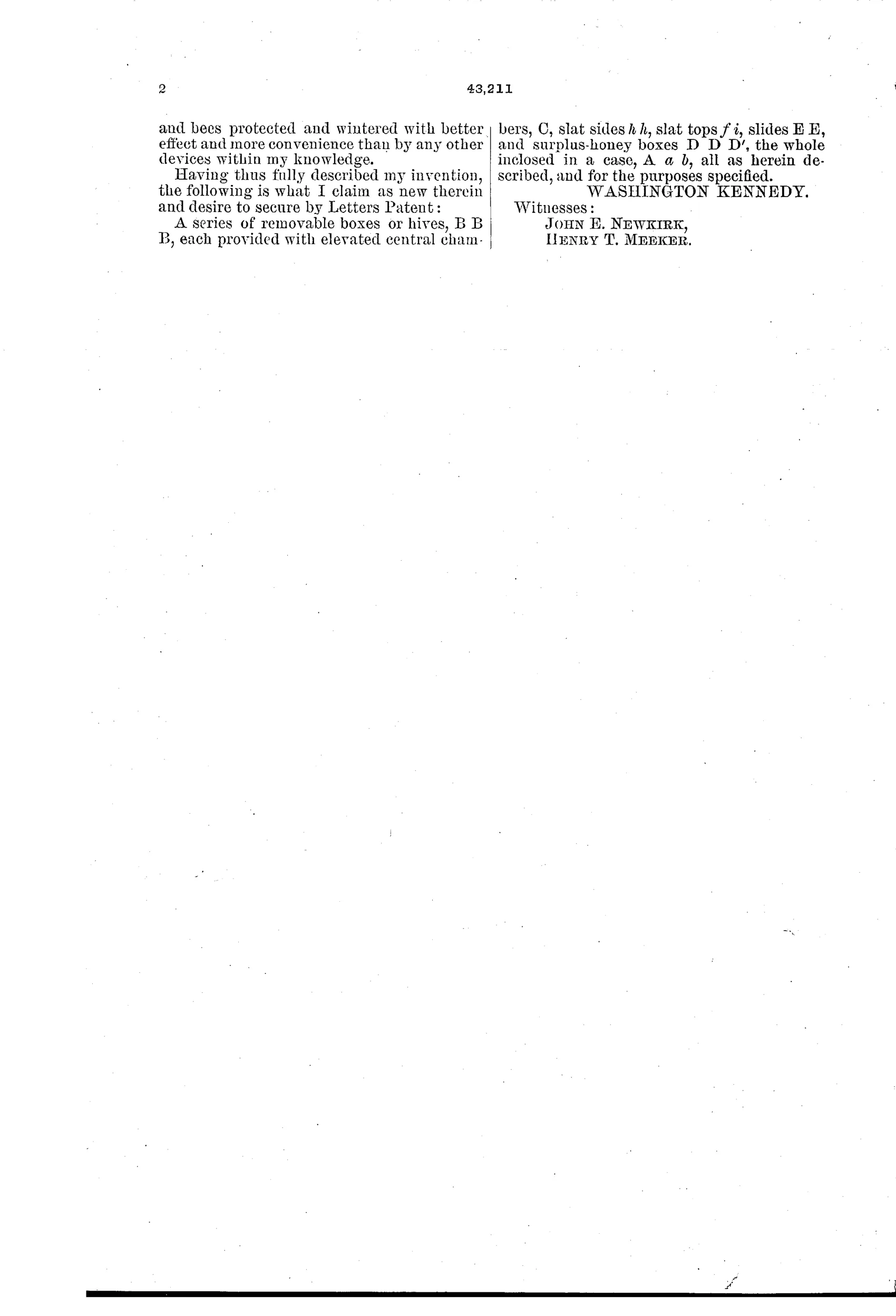
“A series of removable boxes or hives, B B B, each provided with elevated central chambers, C, slat sides h h, slat tops f i, slides E E, and surplus-honey boxes D D D', the whole inclosed in a case, A a b, all as herein described, and for the purposes specified.”
In plain English: The invention claims a set of removable hive boxes, each with a raised slatted central chamber, sliding partitions, and separate surplus-honey boxes, all housed inside an outer case.
⬡ In the inventor’s words
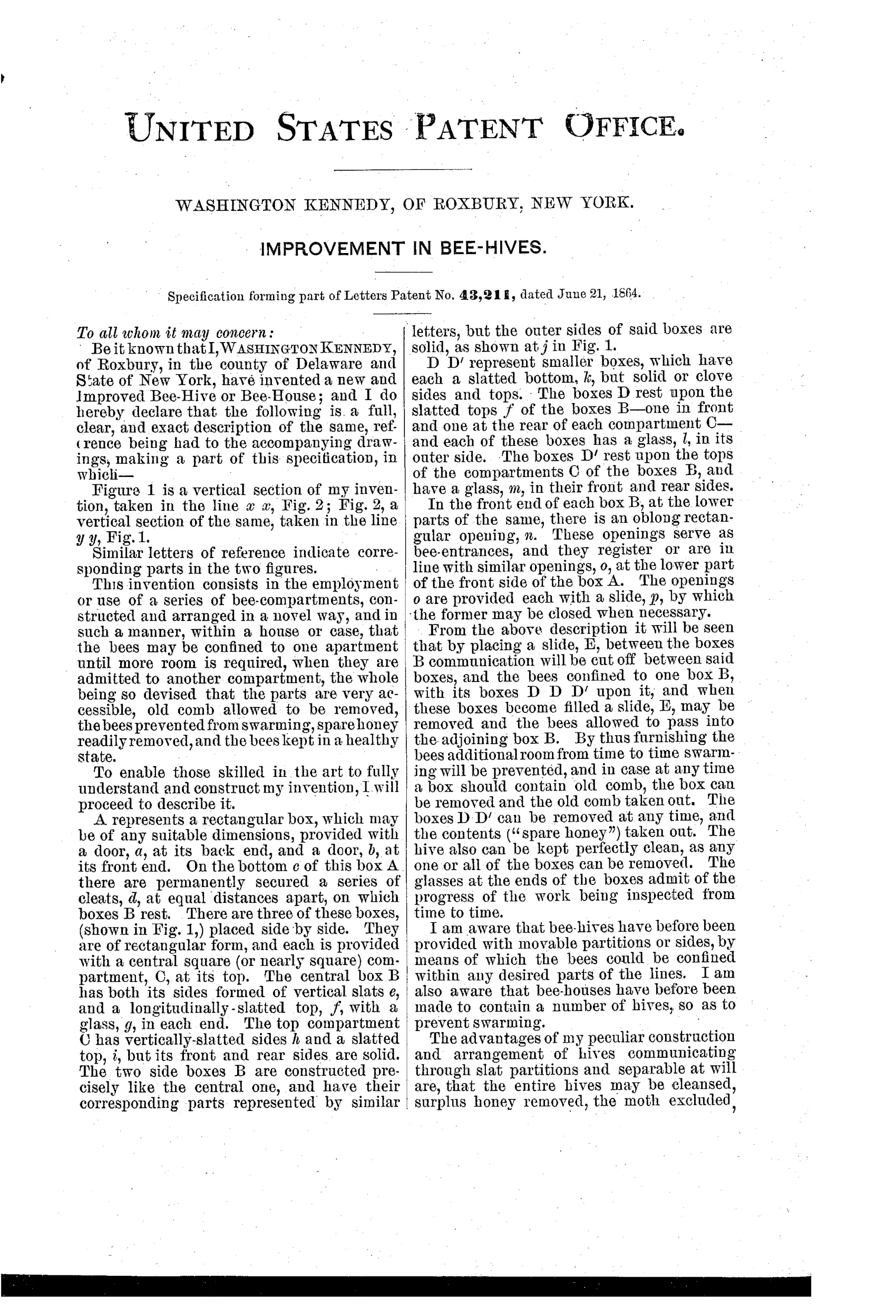
“The advantages of my peculiar construction and arrangement of hives communicating through slat partitions and separable at will are, that the entire hives may be cleansed, surplus honey removed, the moth excluded, and bees protected and wintered with better effect and more convenience than by any other devices within my knowledge.”— Washington Kennedy, from the specification
Fate unknown
No manufacturing record or surviving example is documented; a marked hive or period advertisement from Delaware County would settle it.
⬡ Commentary
By 1864 the movable frame had been patented for a dozen years, and here is Washington Kennedy of Roxbury, New York, building a hive with no frames at all. Instead he offers modularity by the box: three side-by-side chambers B inside an outer case, each topped with a slatted deck and a glass-sided surplus box D. Pull the sliding partitions E and the bees flow sideways into the next chamber; the theory is that giving them room on demand prevents swarming. It is the box hive tradition trying to solve Langstroth's problems with Langstroth's competitor's tools — divisible space rather than removable comb.
The drawing rewards a close look. Fig. 2 shows the slatted floors f and i under each honey box: crude precursors of a queen excluder, meant to keep brood below while letting workers carry honey up into the glass-walled boxes where the harvest could be inspected and lifted out clean. The double-walled outer case with front and rear doors, plus the entrance slides o and p, is a real gesture toward wintering in the Catskills.
Kennedy's closing boast — cleansing, moth exclusion, wintering, all 'better than any other devices within my knowledge' — is the standard 1860s patent-hive litany. The honest problem is that without frames, the combs in chambers C are still fixed. It is a thoughtful, well-drawn entry on the losing side of the architecture question.
Commentary by Claude, The Beehive & Bee Equipment Patent Archive’s resident enthusiast