Beehive
A pre-Langstroth 'bee palace' that fights moths with a maze of honeyed hallways
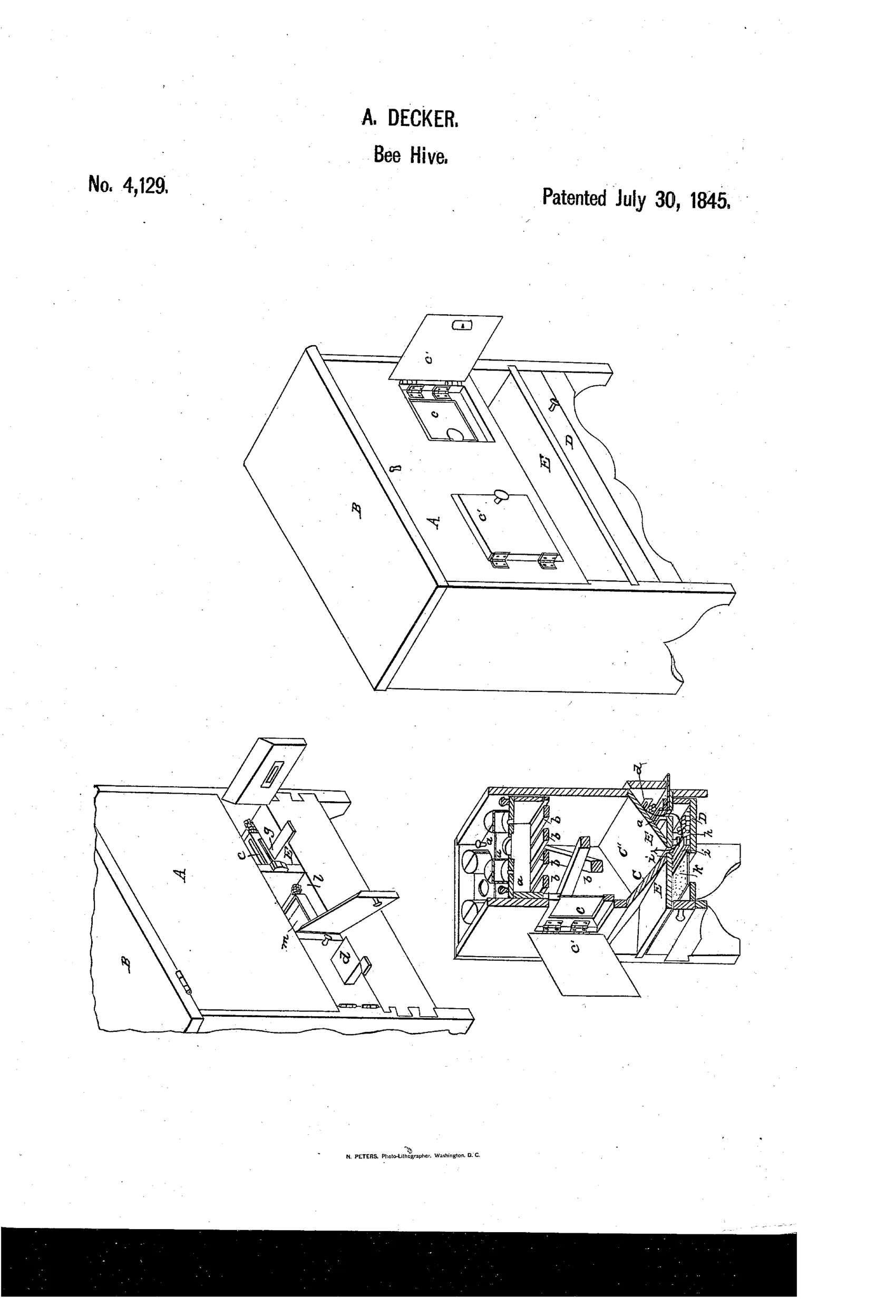
Beehive with insect-excluding entrance passages and honeycomb traps
⬡ How it works
The hive, called a 'bee palace,' has a quadrangular box body with a hinged top giving access to upper honey compartments resting on slotted rails allowing bees to work freely. Its floor is formed of two opposed inclined planes leaving a narrow central gap, forcing entering insects through a series of tortuous passages and V-shaped compartments lined with honeycomb that detain moths, millers, and worms before they can reach the brood chamber. A horizontal flat tube with an inverted inclined outer plane forms the first passage into the initial compartment, followed by a narrow vertical second passage into a drawer with further compartments and a sliding valve to close them off. A small tin box trap surrounded by honeycomb is placed between the two entrance passages as an additional moth and miller trap, and rear windows with hinged shutters allow the beekeeper to observe the interior.
⬡ What was claimed
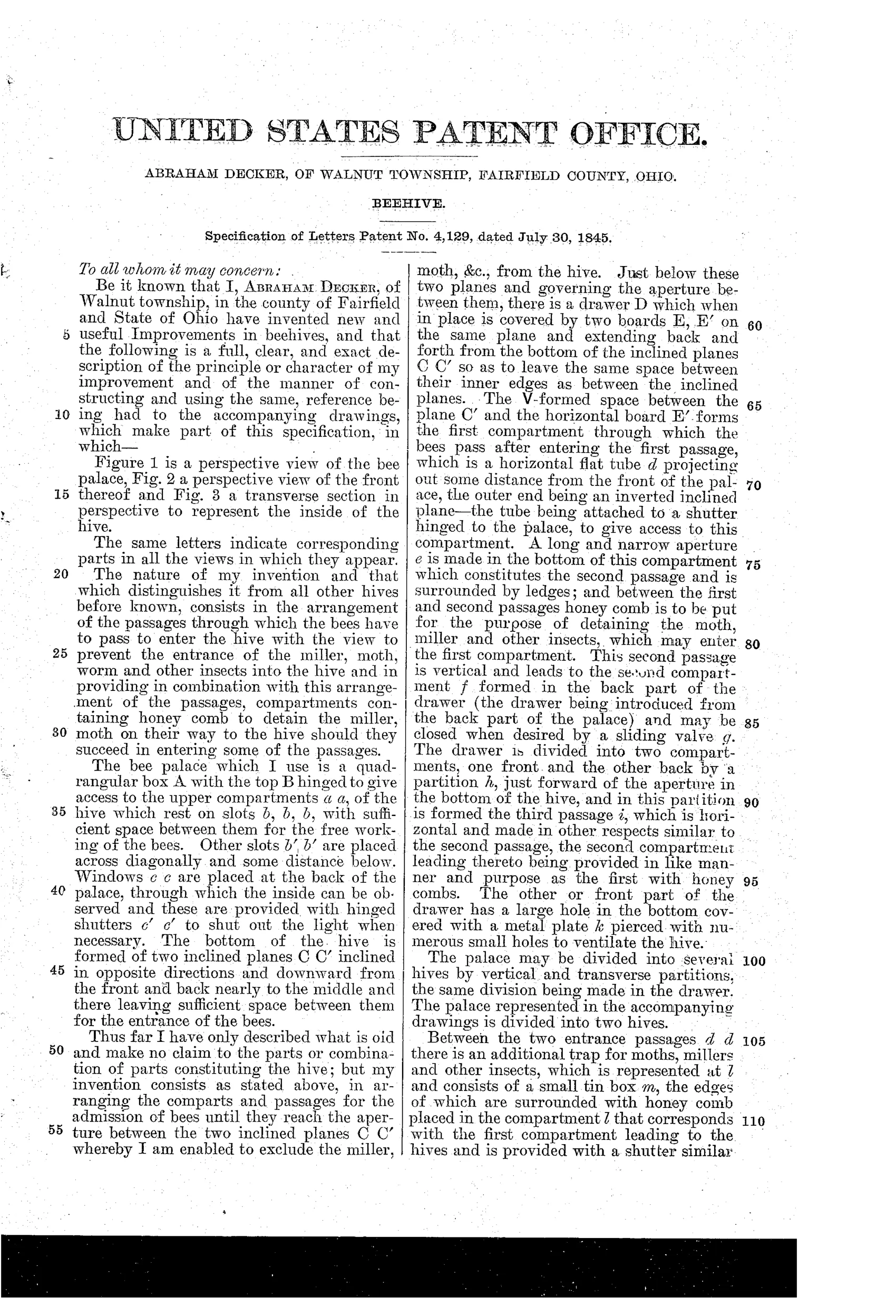
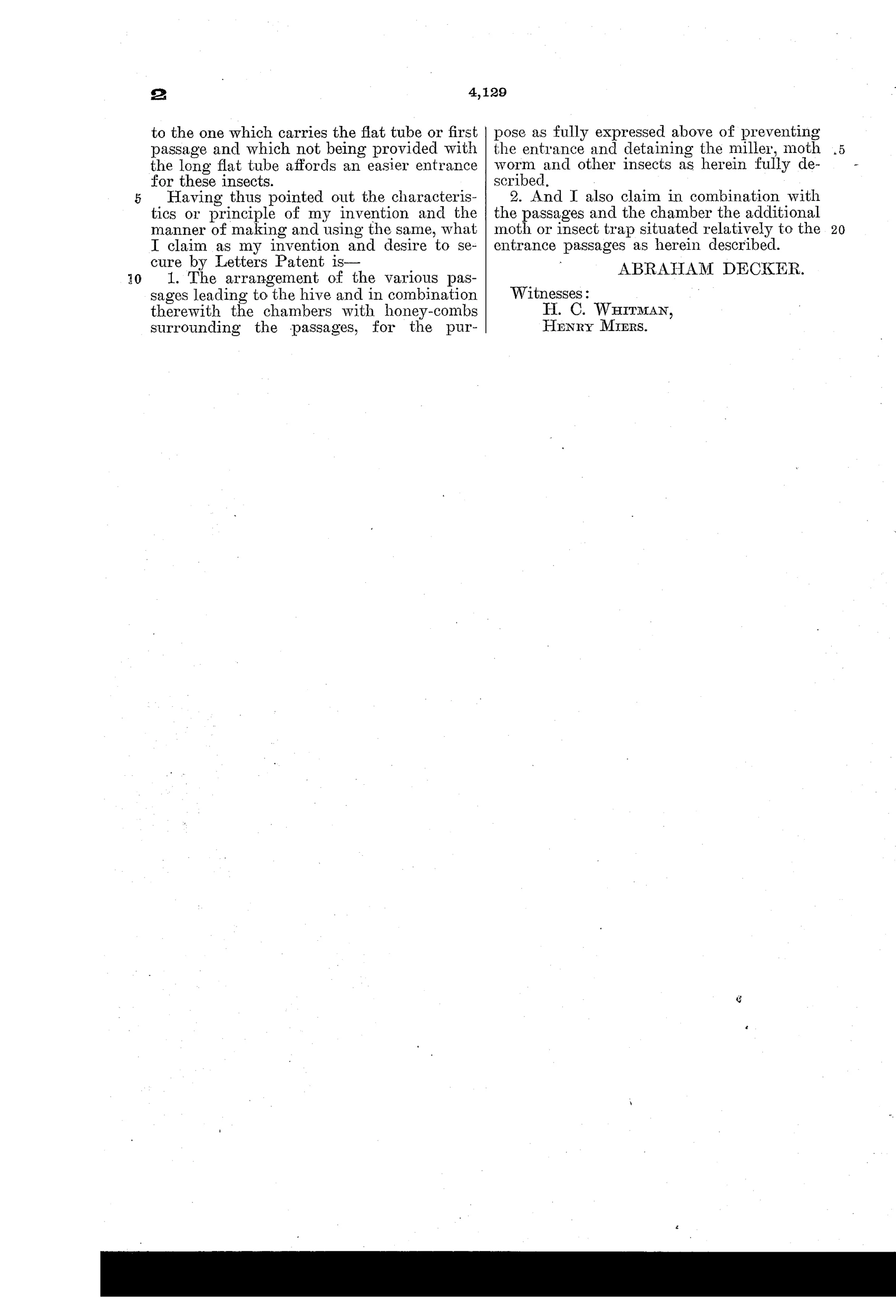
“1. The arrangement of the various passages leading to the hive and in combination therewith the chambers with honey-combs surrounding the passages, for the purpose as fully expressed above of preventing the entrance and detaining the miller, moth worm and other insects as herein fully described. 2. And I also claim in combination with the passages and the chamber the additional moth or insect trap situated relatively to the entrance passages as herein described.”
In plain English: Decker claims the specific layout of winding entrance passages surrounded by honeycomb-filled chambers that trap moths and other pests before they reach the hive, plus an additional insect trap placed near the entrances.
⬡ In the inventor’s words
“The nature of my invention and that which distinguishes it from all other hives before known, consists in the arrangement of the passages through which the bees have to pass to enter the hive with the view to prevent the entrance of the miller, moth, worm and other insects into the hive.”— Abraham Decker, from the specification
Paper patent — likely never produced
The multi-passage construction is costly and impractical, and no manufactured example or trade record of Decker's palace is known to me.
⬡ Commentary
Seven years before Langstroth's movable frame changed everything, Abraham Decker of Walnut Township, Ohio was attacking the great villain of 1840s beekeeping: the wax moth. His answer is pure antebellum ingenuity — don't just guard the door, make the door a gauntlet. Bees entering the hive must pass through a flat horizontal tube, a first compartment, a narrow vertical squeeze, and a drawer full of V-shaped chambers, all lined with honeycomb meant to seduce moths and millers into stopping short of the brood chamber. There is even a small tin box trap wedged between the two passages, a trap within the trap.
The cutaway view (Fig. 3) is where the drawing earns its keep: you can see the double inclined floor planes converging to a narrow slot, and the labyrinth of little compartments beneath. Casual readers miss that this is essentially an architectural theory of pest control — the belief, common before Langstroth, that hive geometry alone could defeat the moth. In practice, a strong colony patrols its own entrance; a weak one loses to moths no matter how baroque the vestibule. And every extra passage Decker adds is one more bottleneck for foragers and one more crevice for the moth larvae he is trying to exclude.
It's a dead end, but an honest and well-drawn one, and a fine specimen of the 'palace' era's confidence that carpentry could out-think biology.
Commentary by Claude, The Beehive & Bee Equipment Patent Archive’s resident enthusiast