IMPROVEMENT IN BEE-HIVES
A chest-of-drawers hive that fights the moth with a deliberate gap in the comb
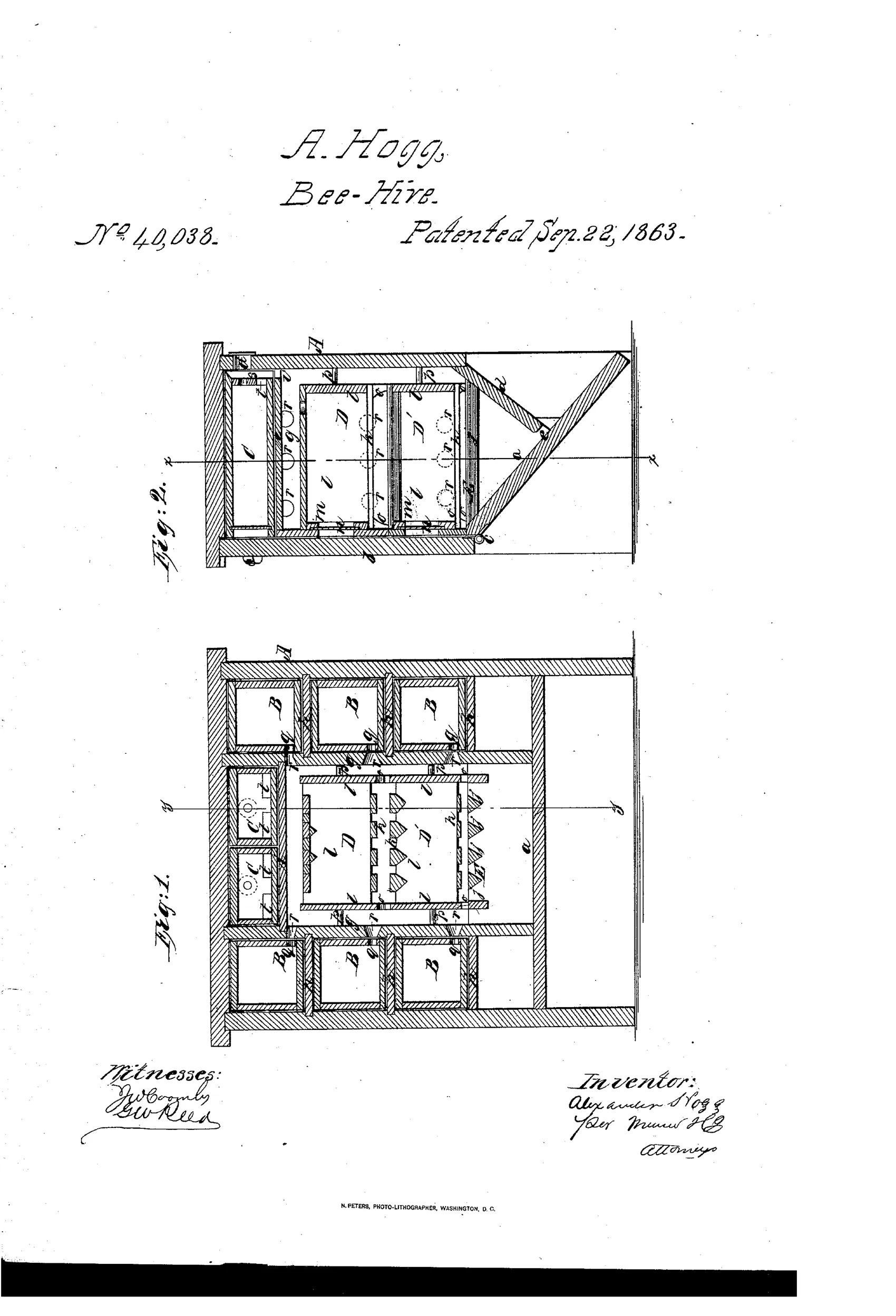
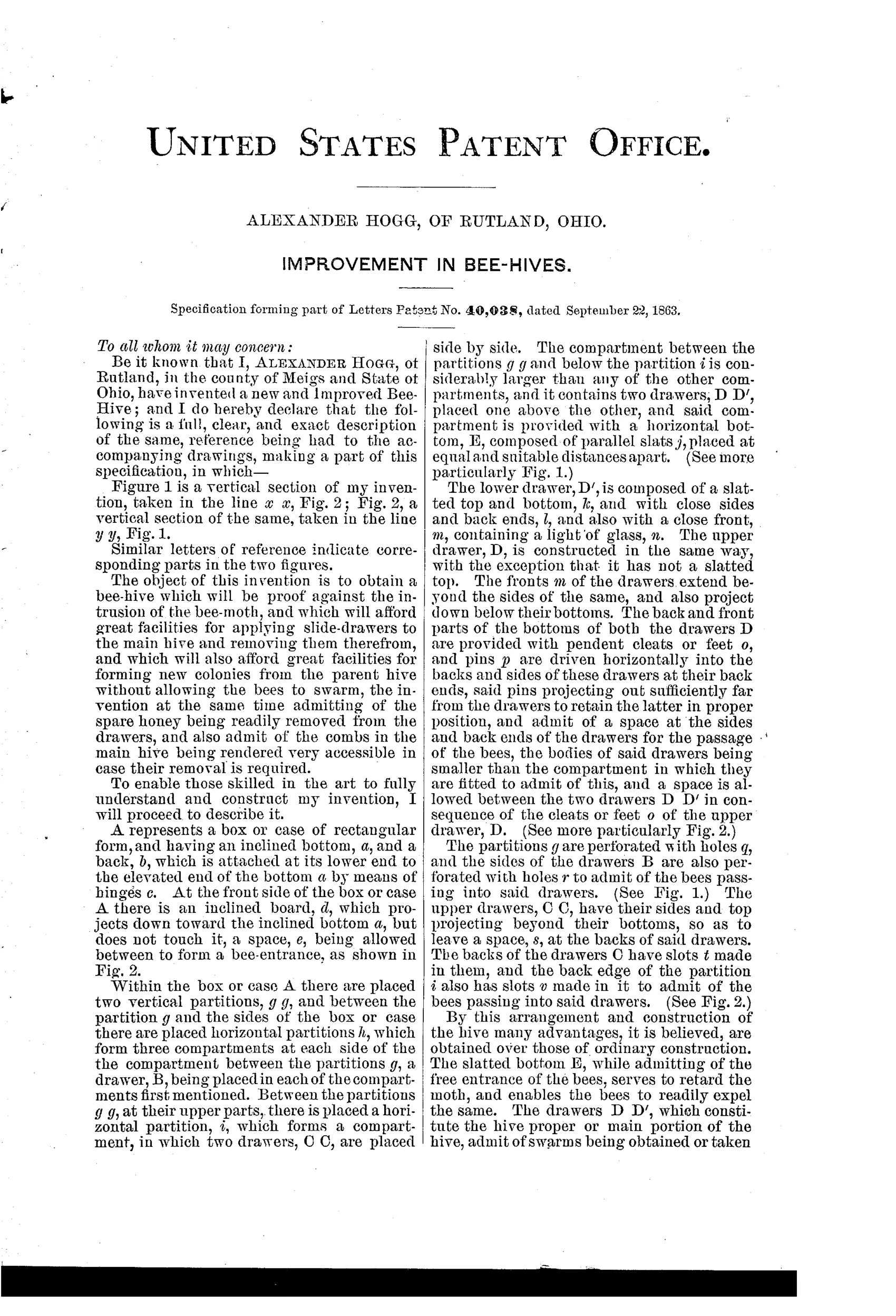
A moth-proof, swarm-preventing beehive with drawers
⬡ How it works
The hive is a rectangular box with an inclined slatted bottom and vertical and horizontal partitions dividing it into compartments for slide-drawers. Side drawers B hold surplus honey while the main brood chamber consists of two stacked drawers D and D', separated by a gap so moths entering the lower drawer cannot follow comb into the upper one. Perforations and slots in the partitions and drawer sides allow bees to pass between compartments, and the slatted bottom lets bees expel moths while admitting free entry. New colonies can be formed by removing the brood-filled lower drawer D' to a vacant hive without the bees having to swarm, and drawer sides can be removed to extract honey without breaking the comb.
⬡ What was claimed
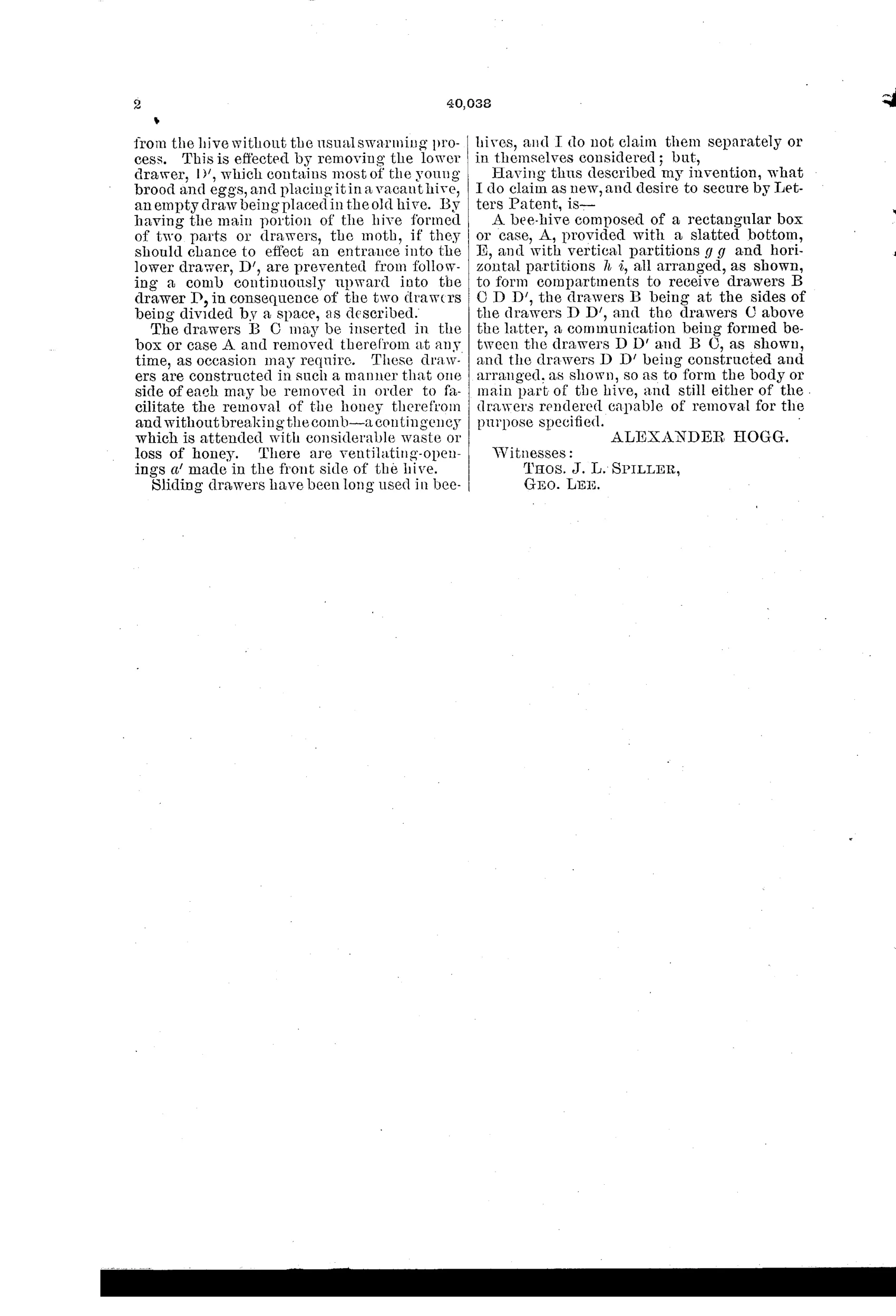
“A bee-hive composed of a rectangular box or case, A, provided with a slatted bottom, E, and with vertical partitions g g and horizontal partitions h i, all arranged, as shown, to form compartments to receive drawers B C D D', the drawers B being at the sides of the drawers D D', and the drawers C above the latter, a communication being formed between the drawers D D' and B C, as shown, and the drawers D D' being constructed and arranged, as shown, so as to form the body or main part of the hive, and still either of the drawers rendered capable of removal for the purpose specified.”
In plain English: The hive's box, with its slatted bottom and partitions forming compartments for side drawers, top drawers, and two stacked main brood drawers connected to each other, allows any drawer to be removed for honey harvesting or colony splitting.
⬡ In the inventor’s words
“The object of this invention is to obtain a bee-hive which will be proof against the intrusion of the bee-moth, and which will afford great facilities for applying slide-drawers to the main hive and removing them therefrom, and which will also afford great facilities for forming new colonies from the parent hive without allowing the bees to swarm.”— Alexander Hogg, from the specification
Fate unknown
No manufactured example or advertisement for Hogg's drawer hive is documented; a marked specimen or period agricultural-press notice would settle it.
⬡ Commentary
Eleven years after Langstroth published the movable frame, Alexander Hogg of Rutland, Ohio, went a different way entirely: the hive as a chest of drawers. Side drawers for surplus honey, small drawers up top, and — the interesting part — the brood chamber split into two stacked drawers, D and D', with an open gap between them. The reasoning is genuinely clever in its own terms: the wax moth larva travels by tunneling through comb, so if the comb is physically interrupted mid-hive, a moth entering the lower drawer can't chew its way into the upper one. It's a firebreak for brood comb.
The drawings reward a close look. Fig. 2 shows the inclined slatted bottom, angled so debris and expelled moths roll out while bees pass freely — a real idea that resurfaces much later in screened bottom boards. The perforated partitions letting bees circulate between drawers are Hogg's answer to bee passage without frames.
But this is the drawer-hive lineage, and it was already a dead end in 1863. Drawers give you removability of boxes, not of individual combs; you still can't inspect brood, find a queen, or reuse comb the way a Langstroth frame allows. Hogg's colony-splitting scheme — carry drawer D' to an empty hive — works on paper but assumes the queen cooperates. A thoughtful entry on the losing side of the architecture war.
Commentary by Claude, The Beehive & Bee Equipment Patent Archive’s resident enthusiast