BEE-HIVE
A terra-cotta hive buried in a hillside, patented 37 years after Langstroth
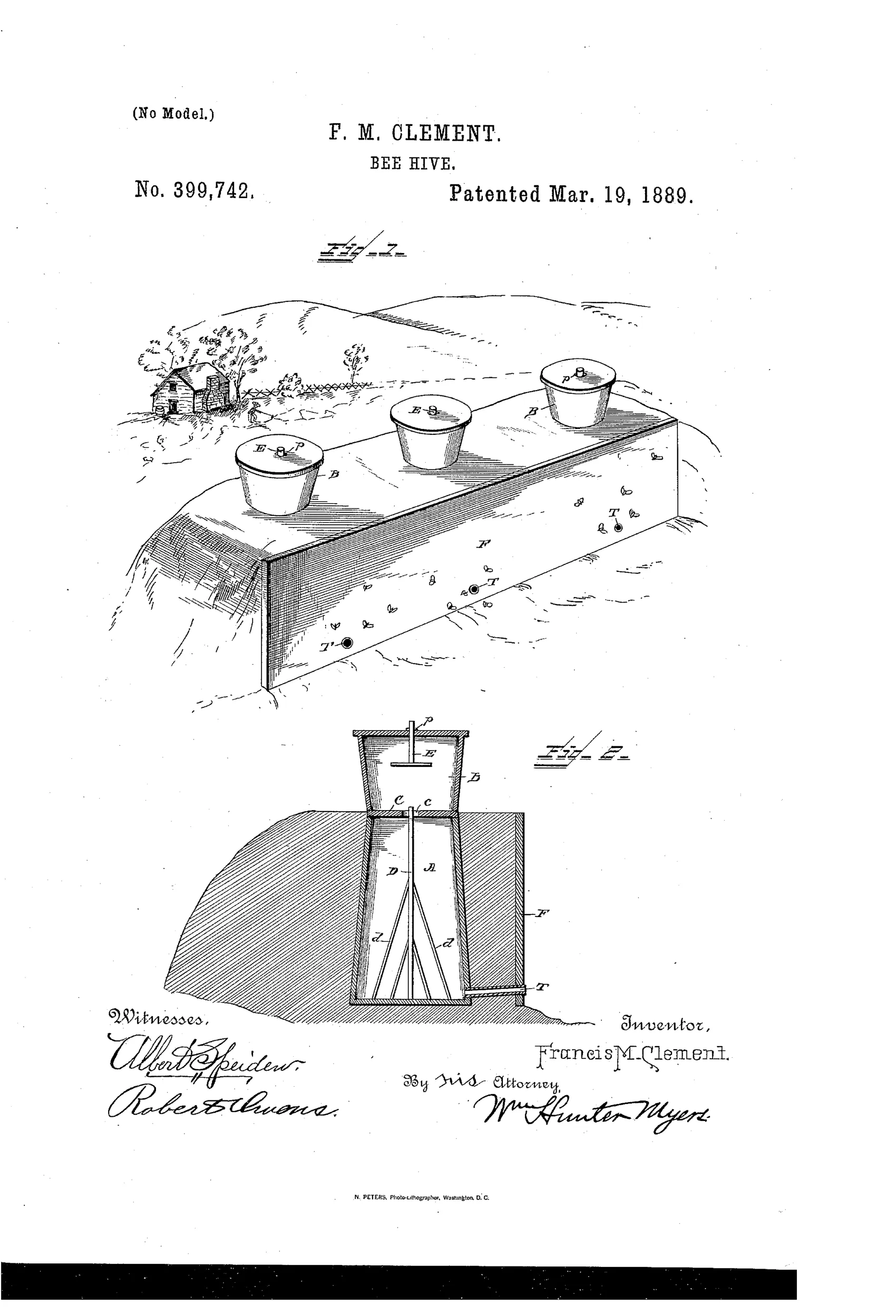
Earthenware bee-hive buried in earthen embankment
⬡ How it works
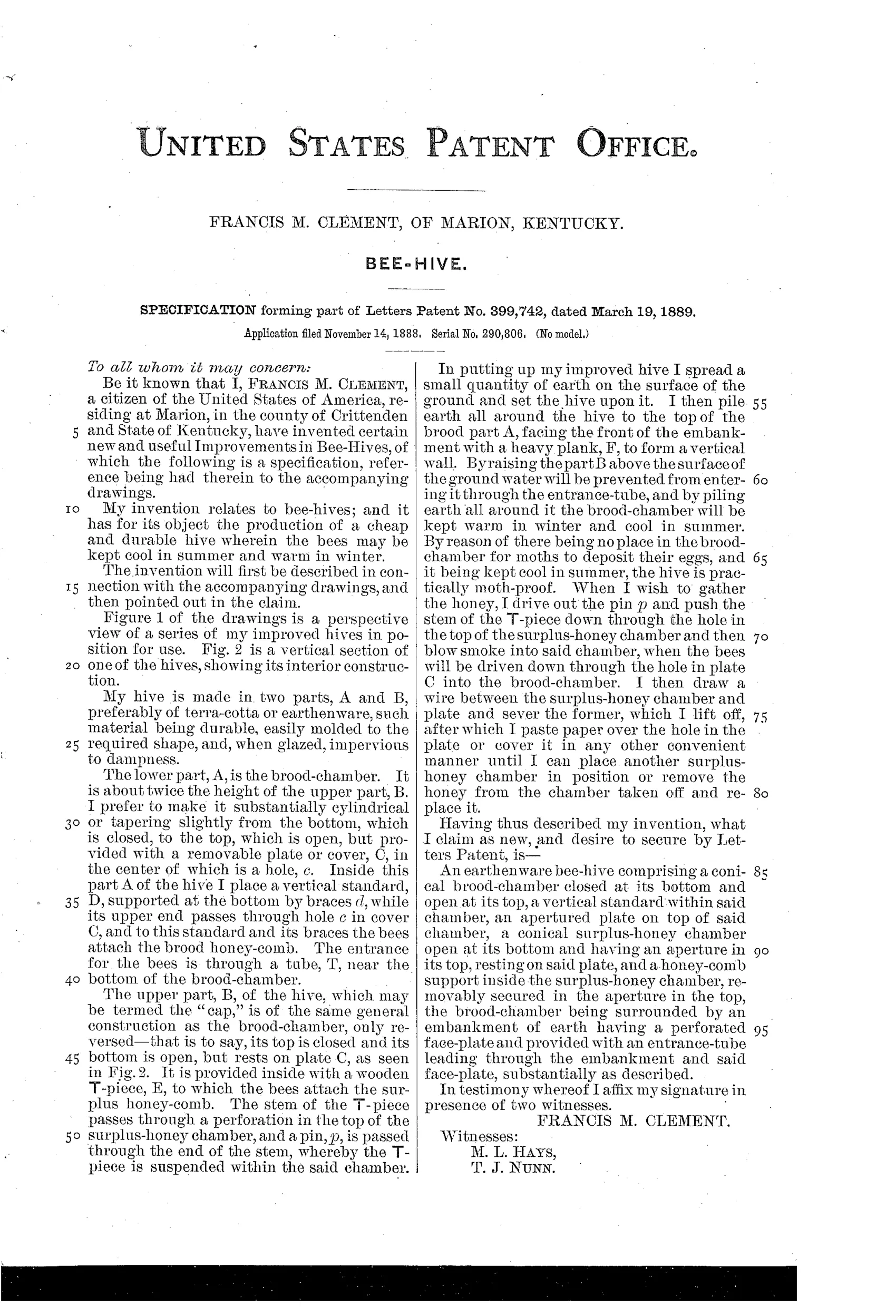
The hive is made of two terra-cotta or earthenware parts: a tall conical brood-chamber closed at the bottom and open at the top, and a smaller inverted conical surplus-honey chamber that rests atop it via an apertured plate. A vertical standard braced inside the brood-chamber gives the bees a surface to attach brood comb, while a suspended wooden T-piece inside the surplus chamber serves as honey-comb support. The whole hive is set on earth and then banked over with soil up to the top of the brood part, with a heavy plank forming a vertical face-wall pierced by an entrance tube, so the earth insulates the hive against heat and cold and eliminates crevices where moths could lay eggs. To harvest, the pin is removed, the T-piece stem is pushed down through the top hole and smoke drives the bees down through the plate hole into the brood-chamber, after which a wire is drawn to sever and lift off the surplus-honey chamber.
⬡ What was claimed
“An earthenware bee-hive comprising a conical brood-chamber closed at its bottom and open at its top, a vertical standard within said chamber, an apertured plate on top of said chamber, a conical surplus-honey chamber open at its bottom and having an aperture in its top, resting on said plate, and a honey-comb support inside the surplus-honey chamber, removably secured in the aperture in the top, the brood-chamber being surrounded by an embankment of earth having a perforated face-plate and provided with an entrance-tube leading through the embankment and said face-plate, substantially as described.”
In plain English: The hive is an earthenware brood chamber with an internal comb standard, topped by a removable conical honey chamber with its own comb support, all buried in an earth embankment with a perforated face plate and entrance tube.
⬡ In the inventor’s words
“By reason of there being no place in the brood-chamber for moths to deposit their eggs, and it being kept cool in summer, the hive is practically moth-proof.”— Francis M. Clement, from the specification
Paper patent — likely never produced
A fixed-comb ceramic hive requiring pottery manufacture and earthworks, patented long after movable frames became standard; no example or trade mention is known, and commercial production is implausible.
⬡ Commentary
Clement's idea is essentially a return to first principles — or maybe to antiquity. Buried ceramic hives with earth insulation would have made sense to a Roman farmer, and here one appears in Kentucky in 1889, decades after the movable-frame hive had already restructured American beekeeping. There are no frames here at all: bees attach brood comb to a braced vertical standard inside a sealed cone, and surplus honey builds on a suspended wooden T-piece in the upper chamber. Harvest means smoking the bees down through a hole, drawing a wire to sever the comb, and lifting the top cone off whole. It is the old destructive-ish harvest dressed in earthenware.
That said, the reasoning isn't stupid. Earth banking genuinely moderates temperature swings, and Clement's moth argument — a smooth ceramic interior with no crevices, kept cool in summer — targets the wax moth, the great terror of 19th-century beekeepers. Fig. 1 is worth a close look: three lidded pots poking from a graded embankment with a plank face-wall and entrance tubes, looking more like a root cellar than an apiary.
But you cannot inspect this hive. No frames means no checking the brood, no disease management, no requeening — everything the Langstroth revolution made possible. By 1889 the industry had chosen. This is a thoughtful dead end, aimed at the wrong decade.
Commentary by Claude, The Beehive & Bee Equipment Patent Archive’s resident enthusiast