HEAD-SCREEN
Shot sewn into the hem: a bee veil that seals itself by gravity
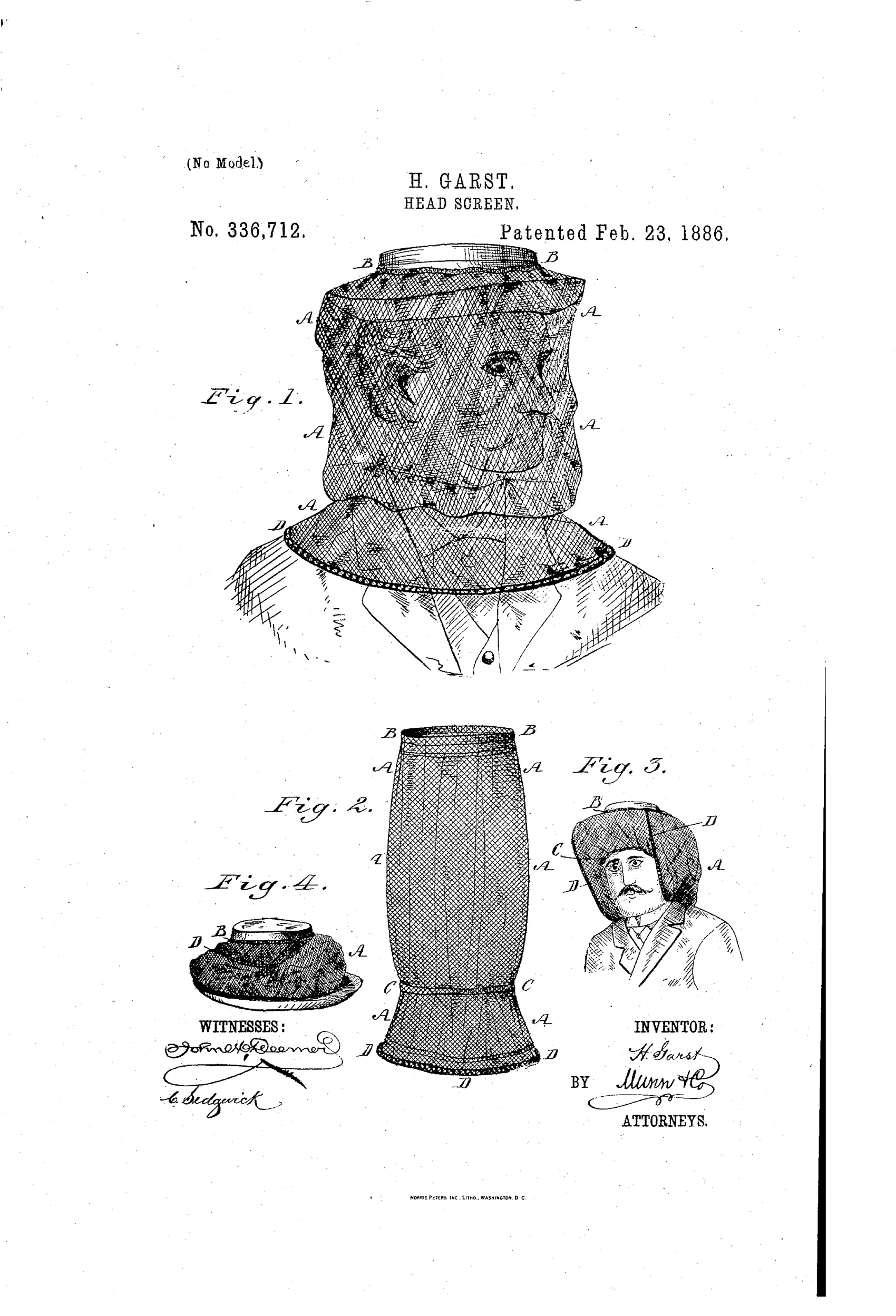
Mosquito-net head and neck screen worn over a hat
⬡ How it works
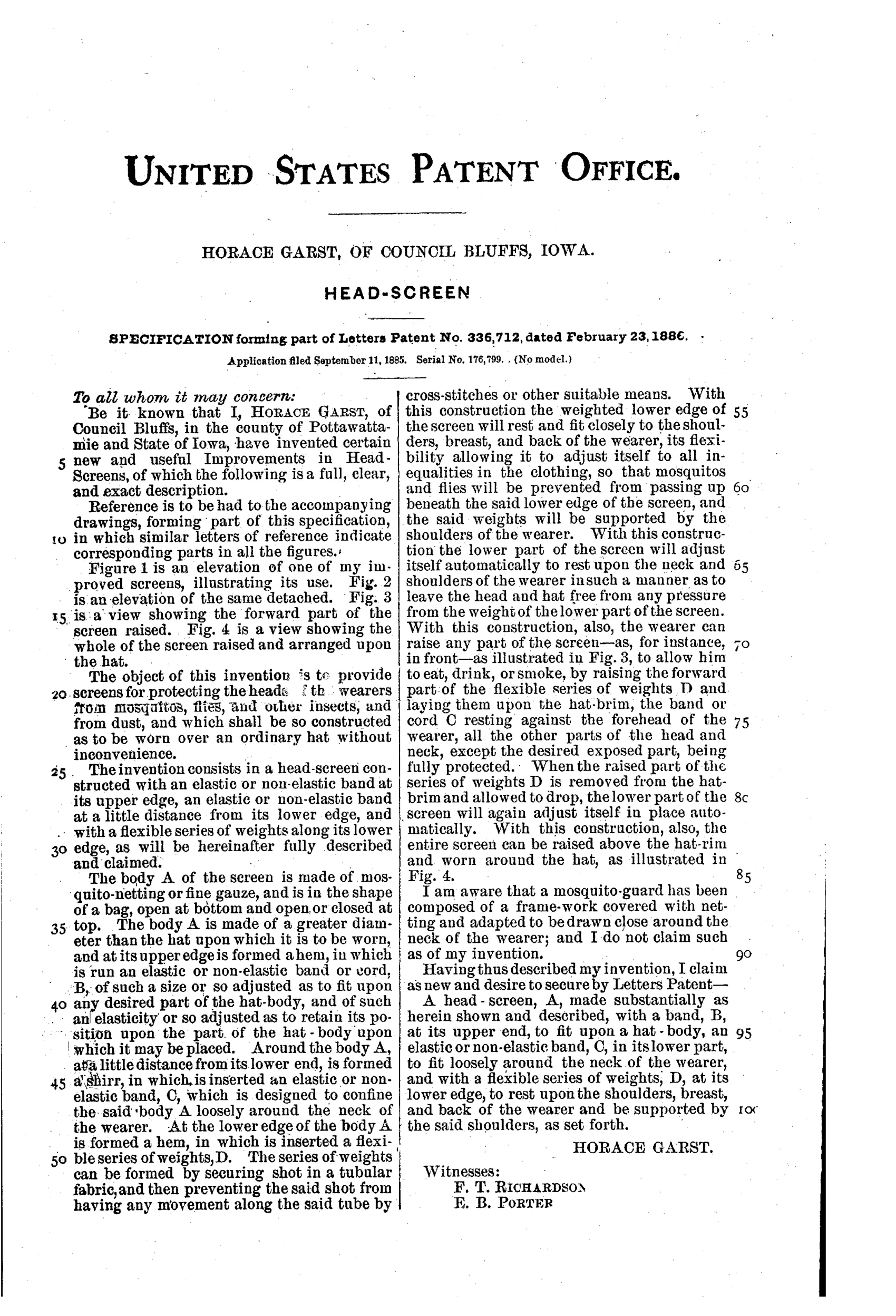
The screen is a bag-shaped body of mosquito netting or fine gauze, open at the bottom, with an elastic or non-elastic band at its upper hemmed edge to fit over the hat body. A second elastic band is set in a shirr partway down the body to loosely encircle the wearer's neck. A flexible series of weights, such as shot secured in a tubular fabric, is sewn into the lower hem so the netting hangs closely and automatically against the shoulders, breast, and back, sealing out insects. The wearer can raise part of the weighted lower edge and lay it over the hat brim to expose the face for eating, drinking, or smoking, and the whole screen can be lifted above the hat brim and arranged around the hat when not in use.
⬡ What was claimed
“A head-screen, A, made substantially as herein shown and described, with a band, B, at its upper end, to fit upon a hat-body, an elastic or non-elastic band, C, in its lower part, to fit loosely around the neck of the wearer, and with a flexible series of weights, D, at its lower edge, to rest upon the shoulders, breast, and back of the wearer and be supported by the said shoulders, as set forth.”
In plain English: A netting head-screen with a band that fits over the hat, a loose band around the neck, and a weighted bottom edge that rests on and is held in place by the wearer's shoulders.
⬡ In the inventor’s words
“I am aware that a mosquito-guard has been composed of a frame-work covered with netting and adapted to be drawn close around the neck of the wearer; and I do not claim such as of my invention.”— Horace Garst, from the specification
Fate unknown
Weighted-hem veils were later common, but no evidence ties production to Garst's patent specifically; a marked example or supply-catalog listing would settle it.
⬡ Commentary
Every beekeeper knows the failure mode of a veil: the gap. Bees don't sting through netting; they crawl under it, at the collar, where the mesh lifts away from your shirt. Garst's answer is elegantly dumb in the best way — a tube of fabric filled with shot, sewn into the bottom hem, so the netting's own weight drapes it flat against shoulders, chest, and back. No drawstring to forget, no framework to carry. The seal happens automatically the moment you put it on.
The drawing rewards a close look. Fig. 1 shows the working position, but Figs. 3 and 4 show the real cleverness: the weighted edge can be flipped up over the hat brim to bare the face for eating or smoking a pipe, and the whole thing can be bunched around the crown when not needed — the veil stores on the hat itself. Garst is careful to disclaim the framed mosquito-guards that came before him; his claim rests entirely on the shoulder-supported weights.
Filed as a general 'head-screen,' this is nonetheless squarely in the bee-veil lineage, and the problem it attacks — closing the neck gap without a stifling tight band — is the same one modern zippered jacket-veils solve with hardware. The weighted hem is a legitimately good idea; versions of it survive in drape-style veils today, which is more than most 1880s apiary patents can say.
Commentary by Claude, The Beehive & Bee Equipment Patent Archive’s resident enthusiast