HONEY-EXTRACTOR.
One chain flips every comb at once — the reversible extractor arrives early
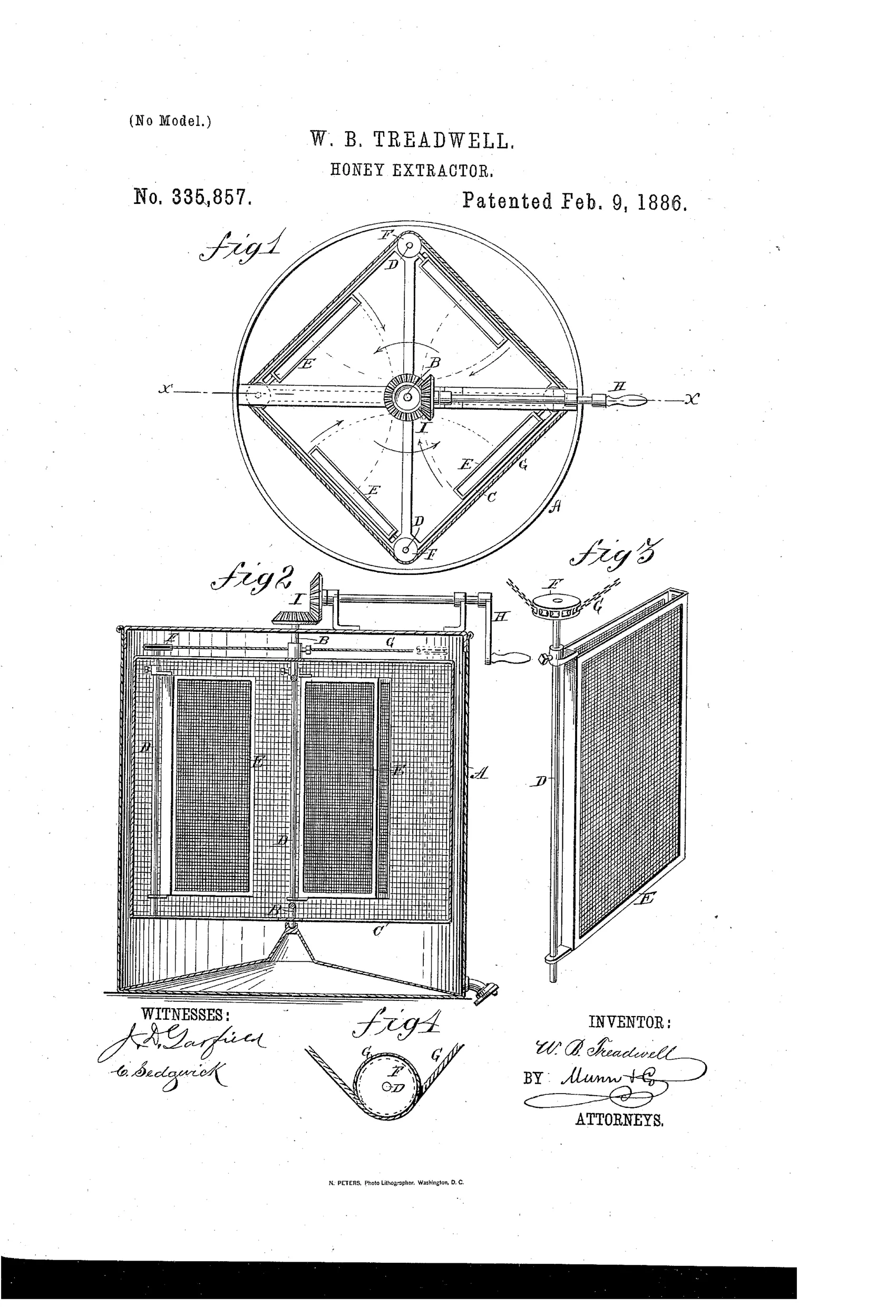
Centrifugal machine for extracting honey from comb
⬡ How it works
A rectangular wire-cloth cage is mounted on a central shaft within a cylindrical tank, and comb-pockets are journaled at the corners of the cage so each can pivot independently. Chain-wheels fixed to the tops of the pocket shafts are linked by a continuous chain so turning one pocket rotates all of them simultaneously to reverse the combs. A hand crank drives the shaft through miter gears to spin the cage, throwing honey outward from the comb through the wire-cloth pockets against the tank walls, where it collects at the bottom. Once one side is emptied, pulling the chain reverses all pockets at once so the opposite side of each comb can be extracted without stopping to turn each pocket by hand.
⬡ What was claimed
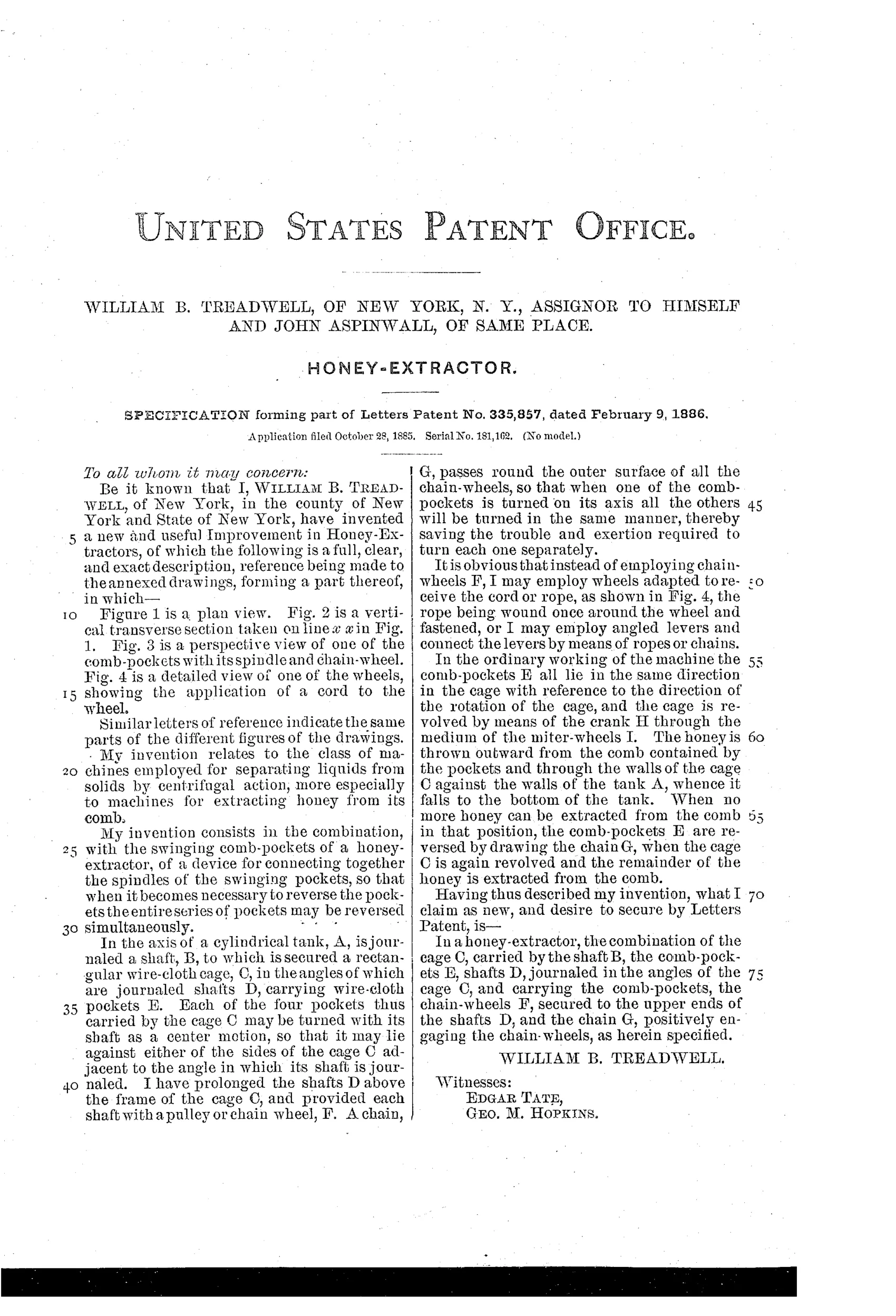
“In a honey-extractor, the combination of the cage C, carried by the shaft B, the comb-pockets E, shafts D, journaled in the angles of the cage C, and carrying the comb-pockets, the chain-wheels F, secured to the upper ends of the shafts D, and the chain G, positively engaging the chain-wheels, as herein specified.”
In plain English: The invention is a honey extractor with a rotating cage holding pivoting comb-pockets on corner shafts, where a chain linking wheels atop those shafts lets all pockets be flipped at once.
⬡ In the inventor’s words
“A chain, G, passes round the outer surface of all the chain-wheels, so that when one of the comb-pockets is turned on its axis all the others will be turned in the same manner, thereby saving the trouble and exertion required to turn each one separately.”— William B. Treadwell, from the specification
Fate unknown
The assignment implies commercial intent, but no marked Treadwell/Aspinwall extractor or supply-catalog listing is documented; either would settle it.
⬡ Commentary
The centrifugal extractor was barely two decades old in 1886, and its great annoyance was already obvious: honey comes off one face of the comb at a time, so halfway through each load the operator had to stop, open the tank, and turn every comb around by hand. Treadwell's answer is neat. Each comb-pocket sits on its own vertical spindle at a corner of the cage, a chain-wheel rides atop each spindle, and a single continuous chain laces around all four. Pull the chain and every pocket pivots in unison — the second face is ready for spinning without lifting a comb.
Look at Fig. 1 and you can see why the diamond arrangement matters: the pockets are journaled at the cage's angles, giving each one clearance to swing without fouling its neighbors. Fig. 4 quietly shows the drive detail on the wheel, the sort of small thing patent drawings reward.
This is a genuine step in the reversible-extractor lineage. Cowan's reversing extractor, which came shortly after and did dominate the trade, let baskets swing freely with centrifugal force; Treadwell's positive chain drive is more deliberate but more fiddly, and a chain slack with honey and wax is a plausible maintenance headache. The assignment to John Aspinwall suggests someone saw commercial value here, but the Cowan pattern is the one the industry kept.
Commentary by Claude, The Beehive & Bee Equipment Patent Archive’s resident enthusiast