DEVICE FOR INVERTING BEE-HIVES.
A crowbar for the 1880s craze of flipping entire hives upside down
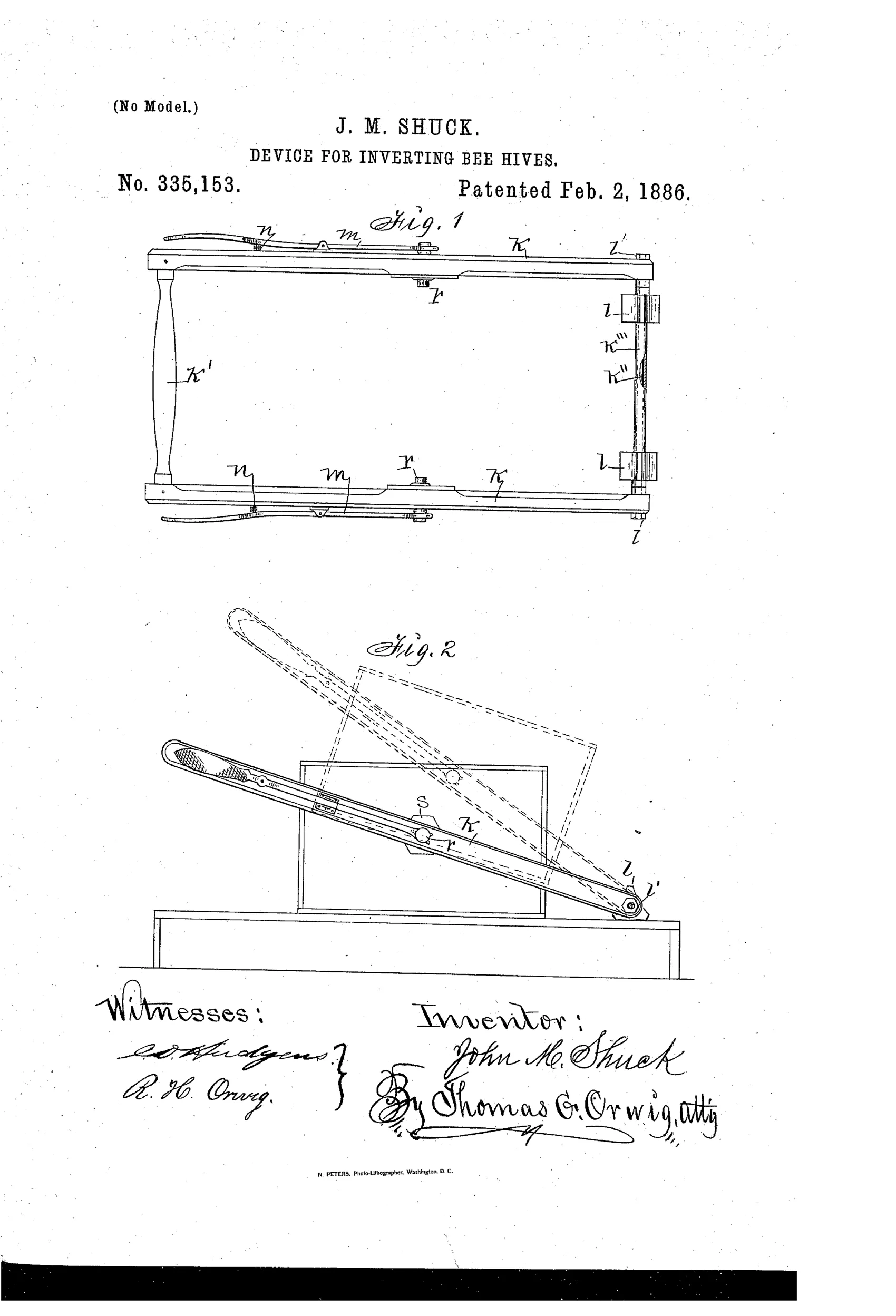
Portable frame for lifting, inverting bee-hives
⬡ How it works
An oblong frame made of two parallel side bars connected by end pieces, one rounded to serve as a handle and the other an iron rod, is placed over a hive. Spring-loaded levers pivoted to the side bars force pins through holes in the bars and into sockets fixed to the sides of the hive, engaging the hive to the frame. Adjustable triangular shoes or fulcrums, mounted on the rod and held by nuts, rest on the ground and act as pivot points. Lifting the handle end of the frame acts as a second-order lever, elevating and suspending the hive so it can be revolved and inverted, then lowered back onto its base in the inverted position.
⬡ What was claimed
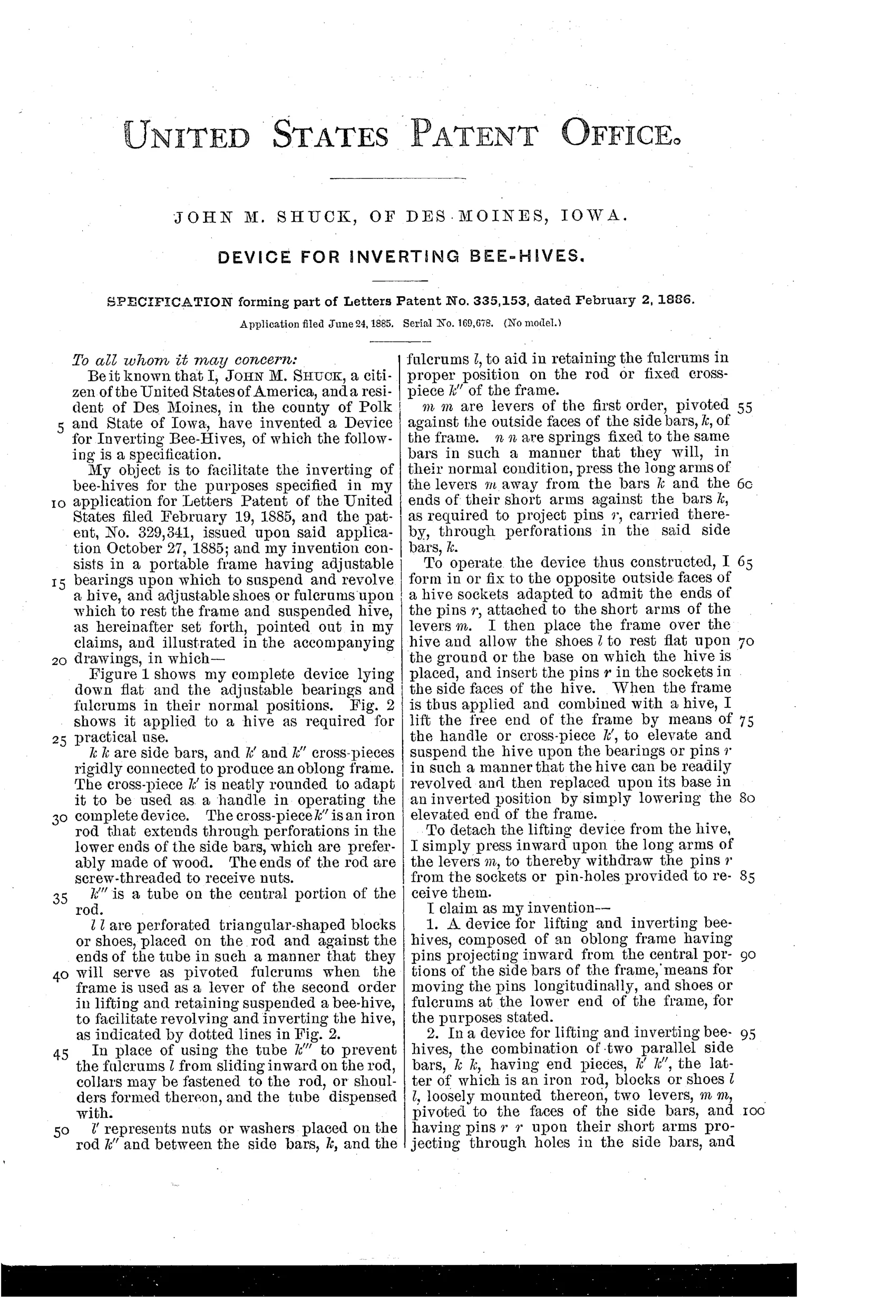
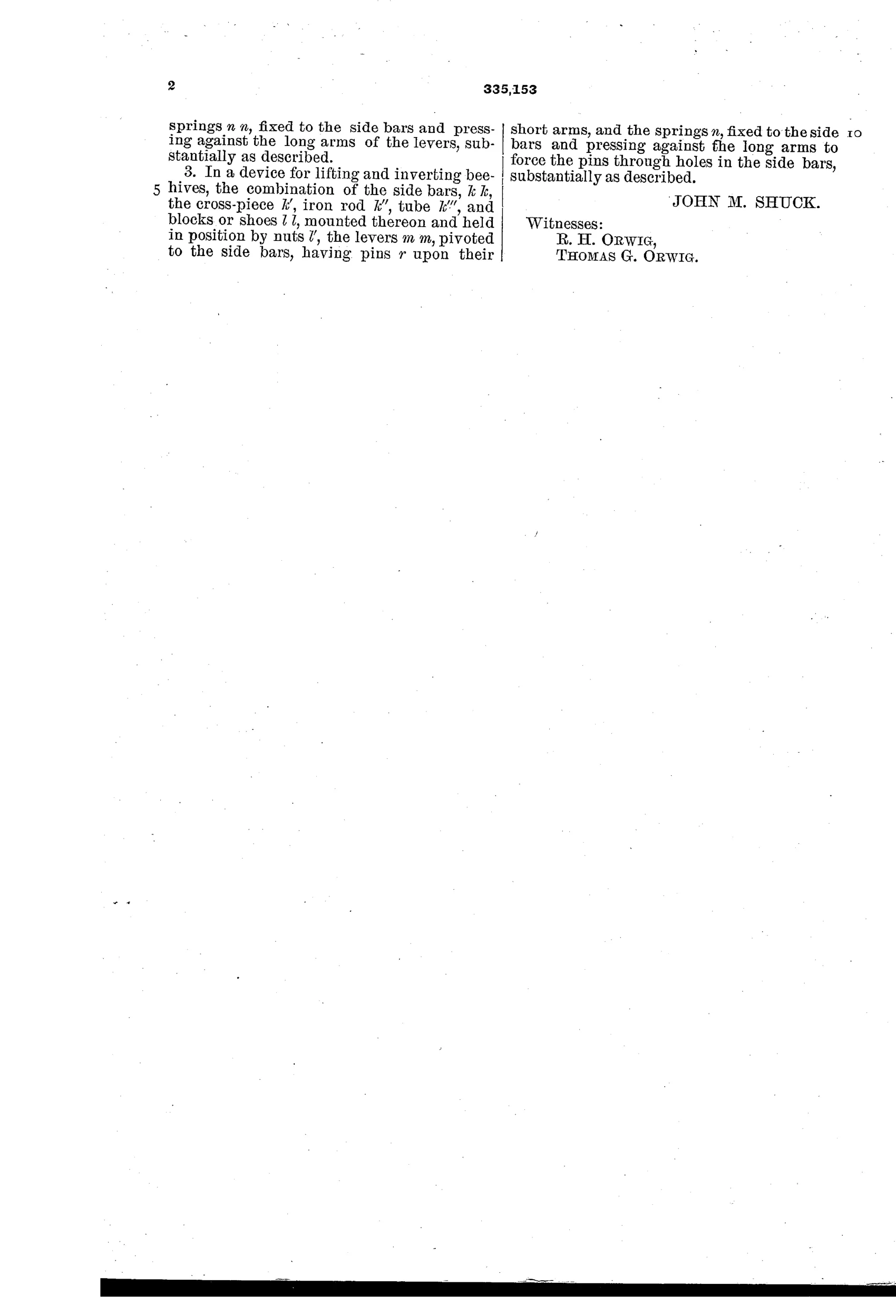
“A device for lifting and inverting bee-hives, composed of an oblong frame having pins projecting inward from the central portions of the side bars of the frame, means for moving the pins longitudinally, and shoes or fulcrums at the lower end of the frame, for the purposes stated.”
In plain English: The invention is a frame with inward-projecting pins on its side bars, a way to slide those pins in and out, and adjustable feet at one end, all used to lift and flip a bee-hive.
⬡ In the inventor’s words
“My object is to facilitate the inverting of bee-hives for the purposes specified in my application for Letters Patent of the United States filed February 19, 1885, and the patent, No. 329,341, issued upon said application October 27, 1885; and my invention consists in a portable frame having adjustable bearings upon which to suspend and revolve a hive, and adjustable shoes or fulcrums upon which to rest the frame and suspended hive.”— John M. Shuck, from the specification
Fate unknown
Shuck was an active Des Moines beekeeper promoting his reversible-hive system, so small-scale production is plausible, but no marked example of this inverter is documented; a surviving specimen or supply-catalog listing would settle it.
⬡ Commentary
This is an accessory patent, and that's what makes it interesting. Shuck had already patented an invertible bee-hive a few months earlier (No. 329,341), and here he admits it plainly: this frame exists to make his own previous invention usable. Hive inversion was a genuine 1880s enthusiasm — proponents argued that flipping the brood chamber forced bees to fill combs completely to the top bars, discouraged swarming, and helped in queen rearing. Whole reversible-hive and reversible-frame systems were marketed on the theory. But a hive full of bees, brood, and honey is heavy and awkward, and the movement's practical bottleneck was exactly this: how does one person actually turn the thing over?
Shuck's answer is honest levering. The oblong frame drops over the hive, spring-loaded pins snap into sockets fixed to the hive's sides so it hangs on a horizontal axis, and adjustable triangular shoes at the far end plant on the ground as fulcrums. Lift the rounded handle end and the whole hive rises as a second-class lever; suspended on its pin bearings, it can be revolved and set back down inverted. Fig. 2's dotted lines show the swing clearly — the hive rotates on the pins while the frame carries the load.
The mechanism would work. The larger idea it served did not survive: inversion faded as beekeepers concluded the gains weren't worth the disruption, leaving this a well-built tool for a dead-end practice.
Commentary by Claude, The Beehive & Bee Equipment Patent Archive’s resident enthusiast