CENTRIFUGAL HONEY-EXTRACTOR.
One crank flips all eight combs at once — the reversing-extractor problem, solved early
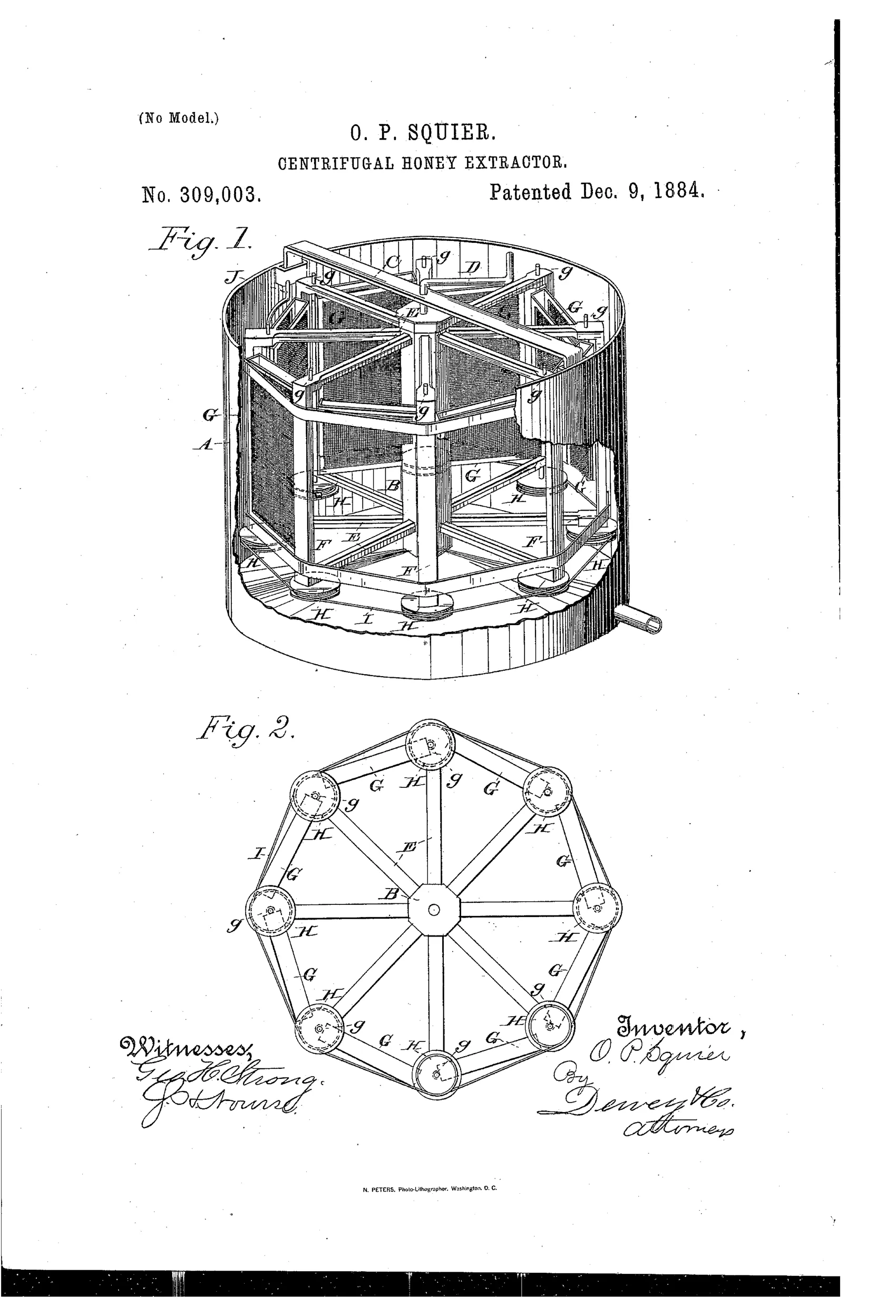

Centrifugal honey extractor with simultaneously reversing comb pockets
⬡ How it works
An outer casing holds a rotating polygonal basket turned by a crank on a central vertical shaft. Around the basket's circumference are perforated comb pockets, each mounted on a vertical pintle so it can pivot. Pulleys fixed to the lower ends of all the pintles are linked together by a single endless cord or belt, so turning one pocket's crank rotates every pocket in unison. This lets the beekeeper spin out honey from one face of each comb, then flip all combs at once to expose their other sides for extraction, without removing them from the basket.
⬡ What was claimed
“The outer vessel, A, and rotating basket provided with radial arms E and connecting-strip F, in combination with a series of comb pockets or holders, G, having pintles or shafts g, pivoted in the radial arms in the circumference of the basket, and a means by which said pockets or holders are simultaneously reversed, consisting of the pulleys H upon the lower ends of the pintles, the endless cord or chain I, passing around said pulleys, and a crank, J, upon the upper end of one of the pintles, substantially as herein described.”
In plain English: The extractor combines an outer vessel, a rotating basket with pivoted comb pockets, and a belt-and-pulley system linking all the pockets' pivots so that turning one crank flips every comb pocket at the same time.
⬡ In the inventor’s words
“The advantage of simultaneously reversing all the pockets is in the saving of time by obviating the necessity of turning each separately, as is usually the case.”— Oliver Perry Squier, from the specification
Fate unknown
No documented production or supply-catalog listing is known to me; a marked example or an A.I. Root-era trade mention would settle it.
⬡ Commentary
The centrifugal extractor was barely fifteen years old in 1884 — Hruschka's Austrian discovery reached America around 1868 — and its one great annoyance was already obvious: combs only give up honey from the face pointing outward. Standard practice was to stop the machine, lift each comb out, turn it around, drop it back in, and spin again. Squier's answer is the mechanically satisfying kind: hang each comb pocket on a vertical pintle, fix a pulley to the bottom of every pintle, and run one endless cord around all of them. Crank the handle on one pocket and all eight pivot together.
Fig. 2 is the drawing to study — the plan view from underneath shows the cord snaking around the eight pulleys inside the octagonal basket. It's an elegant diagram and also the design's weak point. That cord lives in a machine that gets drenched in honey and spun hard; a sticky, stretching, slipping belt at the bottom of an extractor tank is a maintenance headache the patent doesn't address.
This puts Squier right in the middle of the reversible-extractor race of the 1880s, the same problem T.W. Cowan attacked in England with swinging cages. The industry eventually settled on self-reversing baskets driven by the spin itself, or simple flip-over cages — geared and corded linkages like this one mostly fell away. An honest early attempt at the right problem, with the wrong transmission.
Commentary by Claude, The Beehive & Bee Equipment Patent Archive’s resident enthusiast