MOSQUITO GUARD.
A whalebone-caged mosquito veil that anticipates the beekeeper's standoff principle
Netted head covering to protect against biting insects.
⬡ How it works
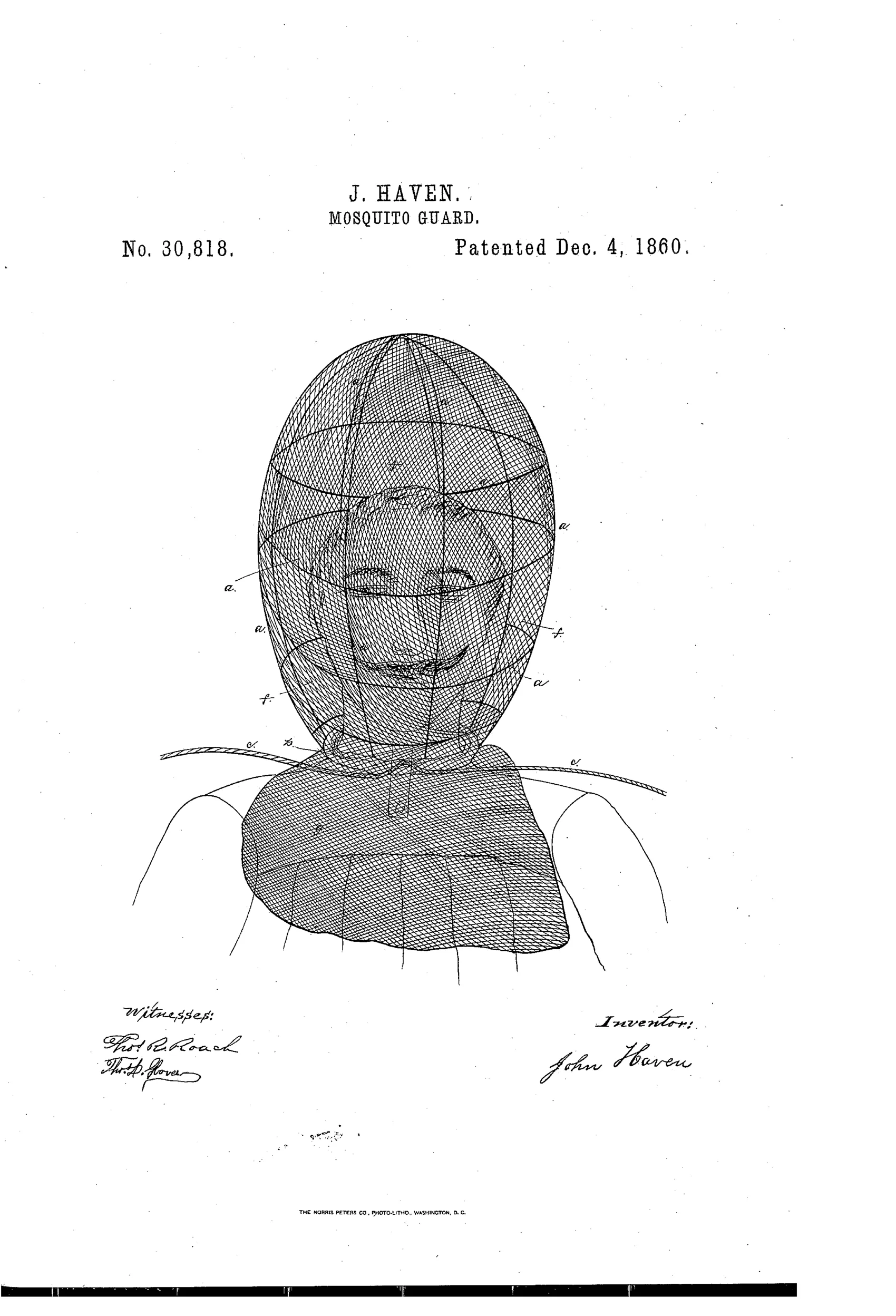
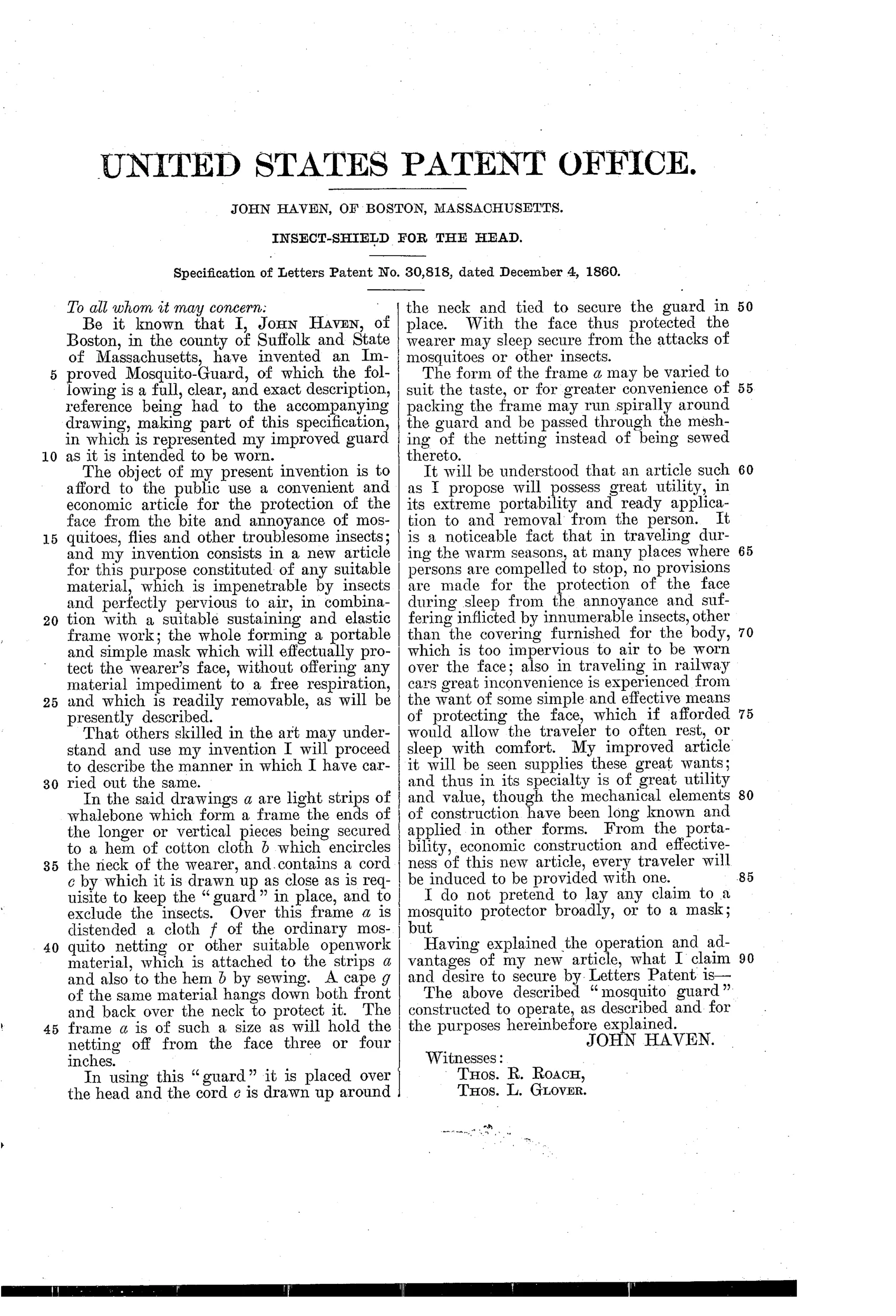
A frame of light whalebone strips forms a vertical support around the head, with ends secured to a cotton hem that encircles the neck. Mosquito netting or other open-work material is distended over this frame and sewn to the strips and hem, holding the netting three or four inches from the face. A cord in the neck hem is drawn tight to secure the guard in place, and a cape of the same netting hangs down front and back to protect the neck.
⬡ What was claimed
“The above described "mosquito guard" constructed to operate, as described and for the purposes hereinbefore explained.”
In plain English: The claim covers the mosquito guard device built and used in the manner described in the patent.
⬡ In the inventor’s words
“With the face thus protected the wearer may sleep secure from the attacks of mosquitoes or other insects.”— John Haven, from the specification
Fate unknown
No marked example or advertisement for Haven's guard is documented; a surviving specimen or period trade listing would settle whether it went beyond paper.
⬡ Commentary
Strictly speaking this is a mosquito guard, not beekeeping gear — but every beekeeper will recognize the problem Haven is solving. Netting that touches the skin is useless; a mosquito (or a bee) simply stings through it. Haven's answer is a light whalebone frame that holds the mesh three to four inches off the face, with a drawstring hem at the neck and a cape of netting draped over the shoulders to close the gap. That standoff distance is the entire engineering content of the modern bee veil, stated plainly in 1860, the same decade the movable-frame revolution was making protective gear a mass-market necessity.
The drawing rewards a close look. The face is visible through the mesh because the whalebone ribs run like lines of longitude and latitude over an egg-shaped cage — it is a globe frame, self-supporting, needing no hat brim beneath it. Later commercial bee veils mostly took the cheaper route of hanging netting from a hat and stiffening it with wire rings; Haven's fully framed dome is actually the fancier solution, closer to today's fencing-style hooded veils.
As a patent it is a dead end in name and a survivor in principle. Whalebone gave way to spring steel and screen wire, but the geometry — rigid ribs, cinched neck, shoulder cape — is what every sting-proof veil still does. A charming, slightly eerie sheet, that serene face smiling through the mesh.
Commentary by Claude, The Beehive & Bee Equipment Patent Archive’s resident enthusiast