DRONE-BEE TRAP.
Henry Alley, famous queen breeder, patents the trap that bears his name
Portable trap separating drone bees from workers
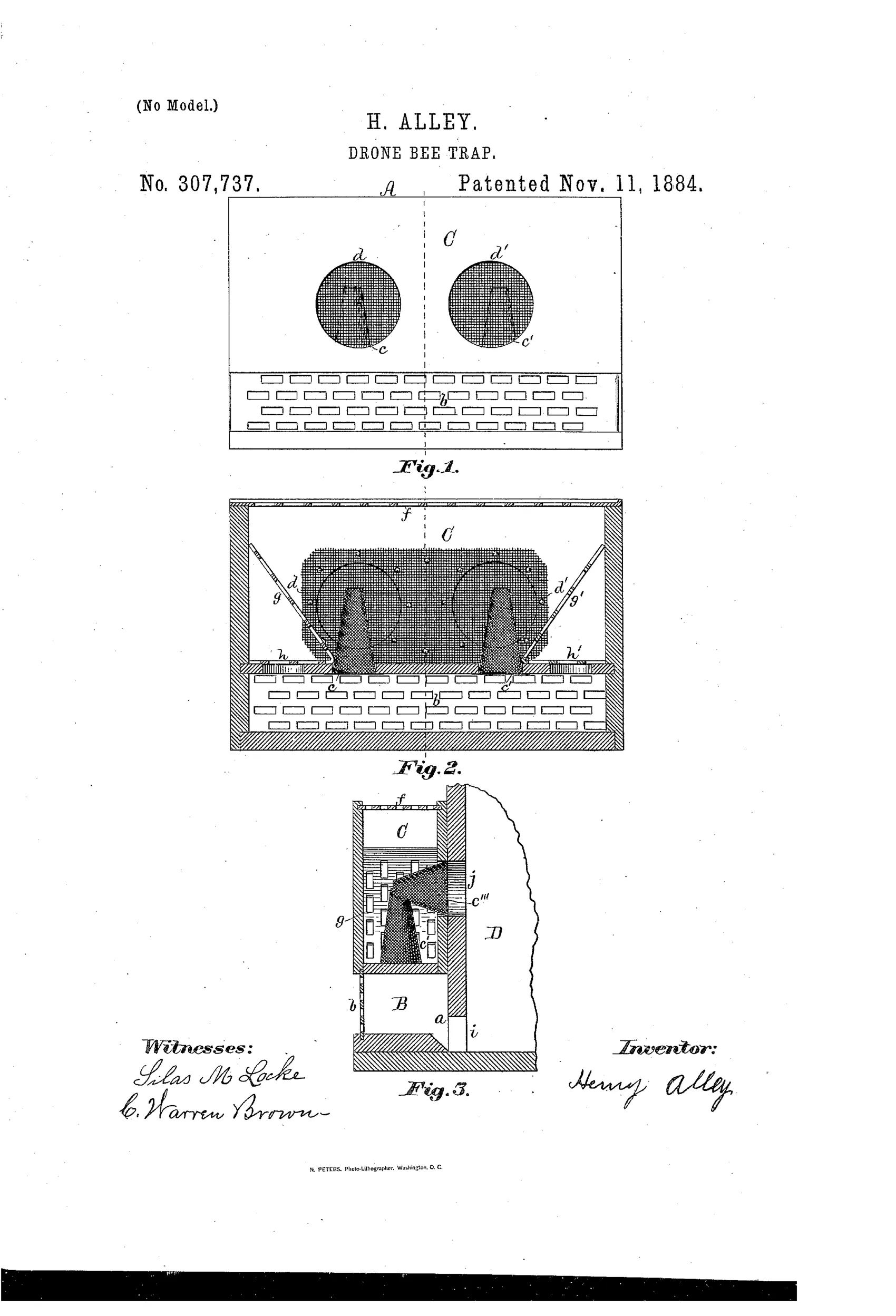
⬡ How it works
A portable box attached to a beehive receives all bees exiting through the hive opening into a receiving apartment. A perforated sliding wall lets small worker bees pass freely into the open air, but holes too narrow for drones or queens force them upward through conical wire-cloth tubes into a lighted trap chamber. Inclined partitions and perforated covers allow any worker bees that follow into the trap chamber to escape back down, while drones remain securely entrapped for disposal by the apiarist. Wire-cloth covered openings admit light to draw the drones upward while preventing their escape.
⬡ What was claimed
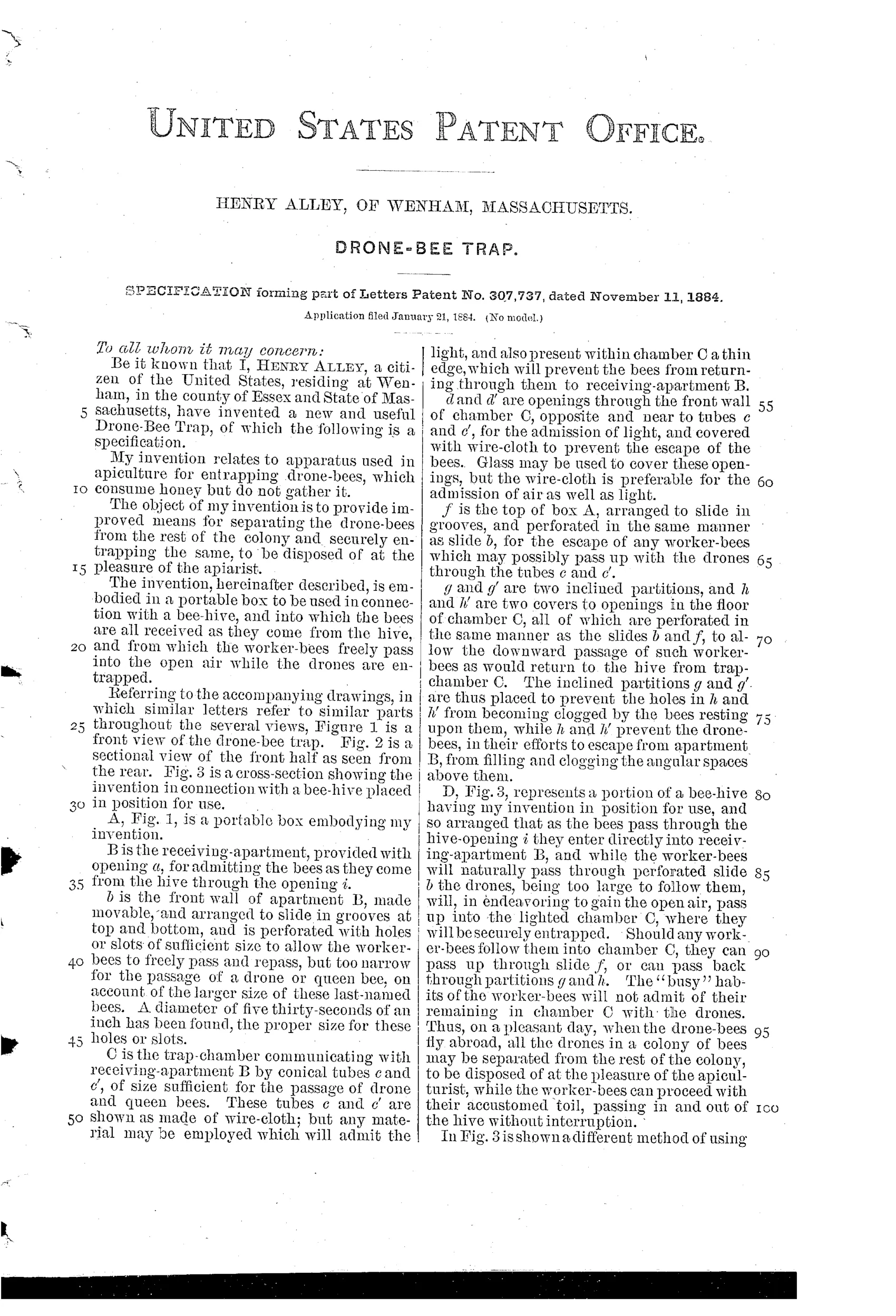
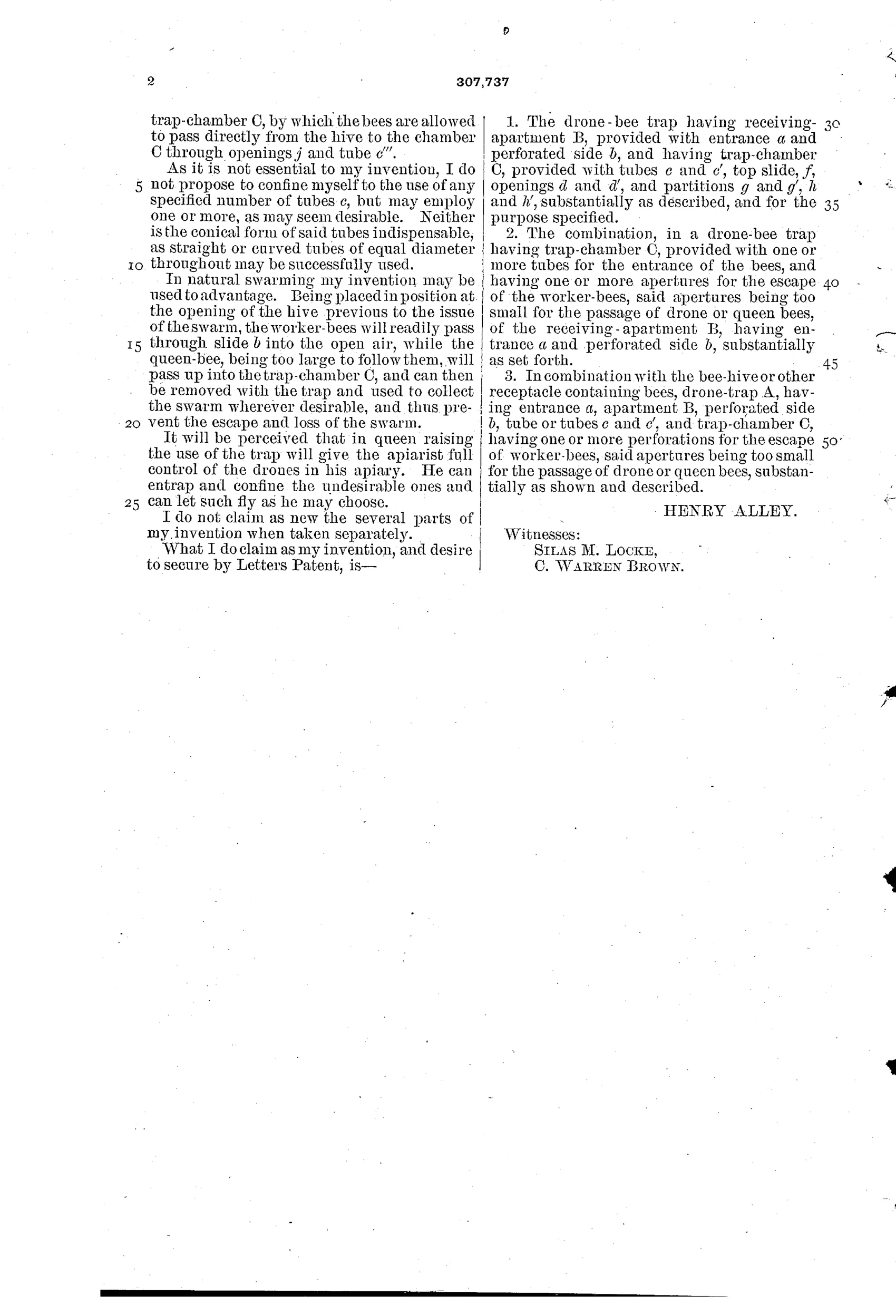
“The drone-bee trap having receiving-apartment B, provided with entrance a and perforated side b, and having trap-chamber C, provided with tubes c and c', top slide, f, openings d and d', and partitions g and g', h and h', substantially as described, and for the purpose specified.”
In plain English: A drone-bee trap with a receiving compartment having a perforated wall and entrance, connected to a trap chamber with tubes, a top slide, light openings, and partitions, built and used as described.
⬡ In the inventor’s words
“Thus, on a pleasant day, when the drone-bees fly abroad, all the drones in a colony of bees may be separated from the rest of the colony, to be disposed of at the pleasure of the apiculturist, while the worker-bees can proceed with their accustomed toil, passing in and out of the hive without interruption.”— Henry Alley, from the specification
Manufactured and sold
The Alley drone-and-queen trap was commercially produced and advertised in the beekeeping supply trade; Alley himself was a prominent, well-documented apiarist and dealer.
⬡ Commentary
This is not an anonymous tinkerer. Henry Alley of Wenham, Massachusetts was one of the best-known queen breeders in America — author of the Bee-Keeper's Handy Book and a fixture in the apicultural press. The 'Alley trap' became a genuine piece of standard equipment, and this patent is the mechanical heart of it: a size-graded exit that sorts bees by body width.
The sorting logic is elegant. Every bee leaving the hive enters the lower receiving chamber. Workers slip through the perforated slide b and go about their foraging. Drones — too broad-shouldered for those holes — are pulled upward by daylight through the conical wire-cloth tubes visible in Figs. 1 and 2, which work exactly like a minnow trap: easy in through the narrow apex, nearly impossible to find the way back. Note the inclined partitions g and g' with their own perforations — that detail matters, because any worker who blunders upstairs can still filter back out, so the trap doesn't strangle the hive's field force.
Why trap drones at all? They eat honey, do no work, and in Alley's queen-rearing business, controlling which drones flew meant controlling matings. The same architecture, with slightly different perforation sizes, doubles as a queen trap for swarm control — which is how the device was actually marketed. A working idea from a working beekeeper, and it shows in every partition.
Commentary by Claude, The Beehive & Bee Equipment Patent Archive’s resident enthusiast