CENTRIFUGAL HONEY-EXTRACTOR.
Reverse the crank and the combs flip themselves — no hands required.
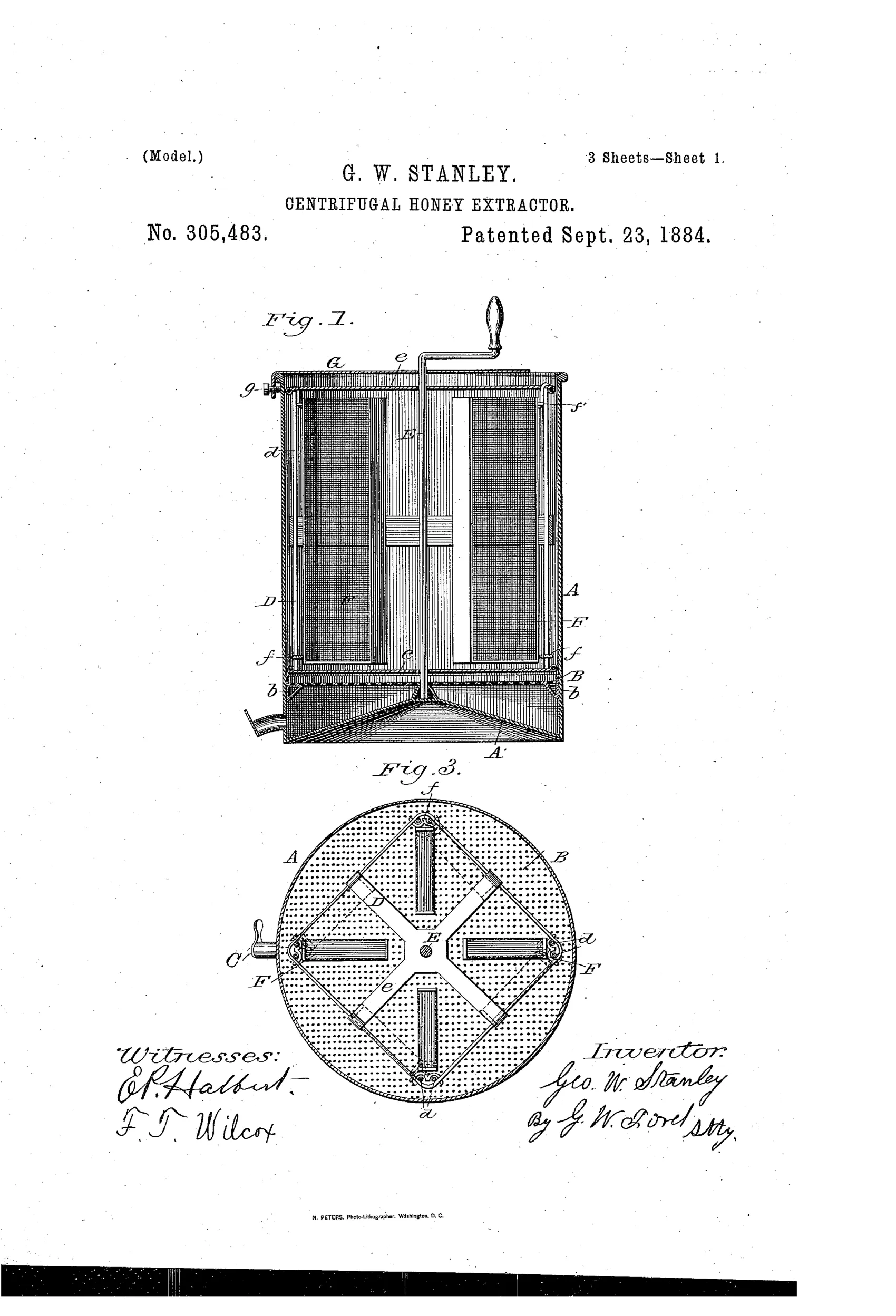
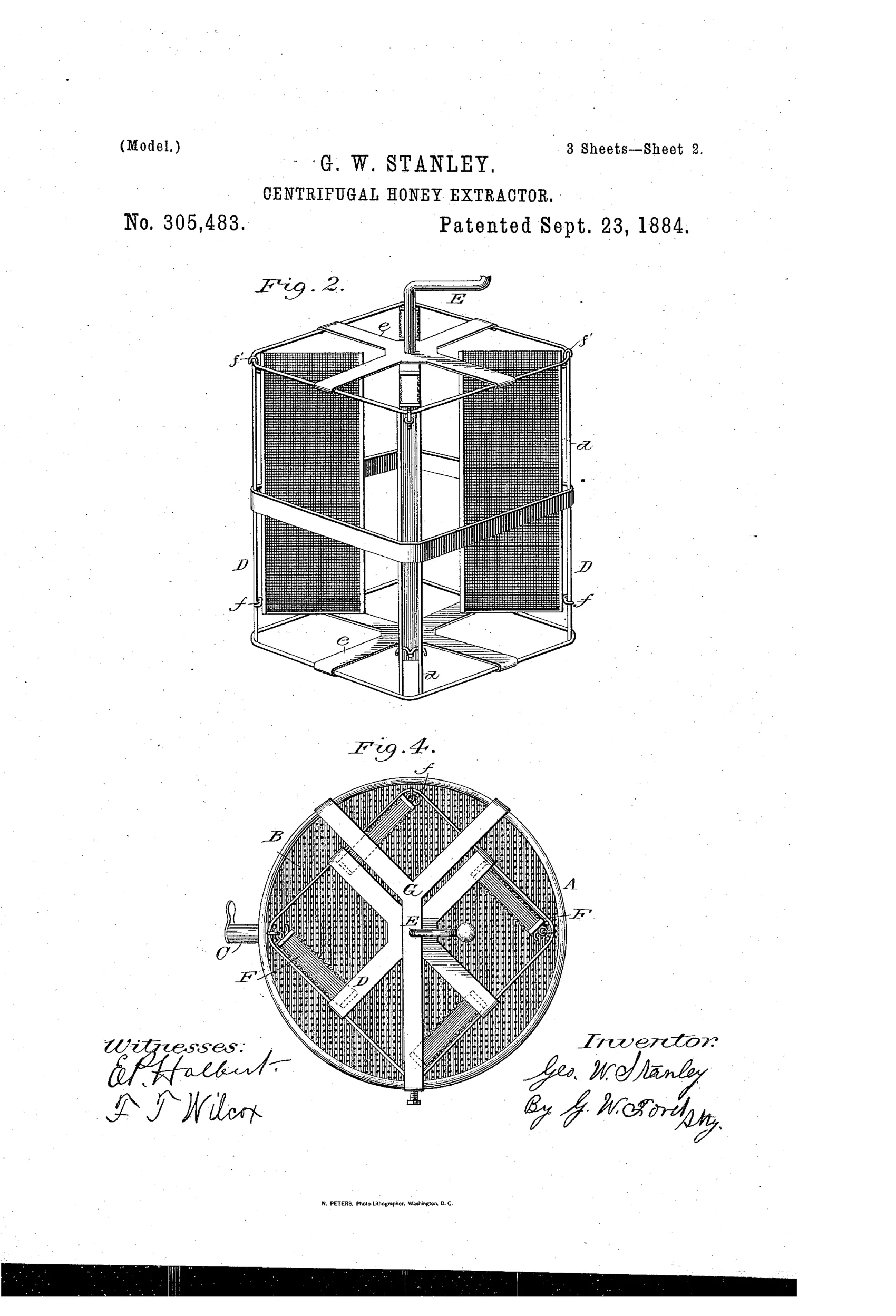
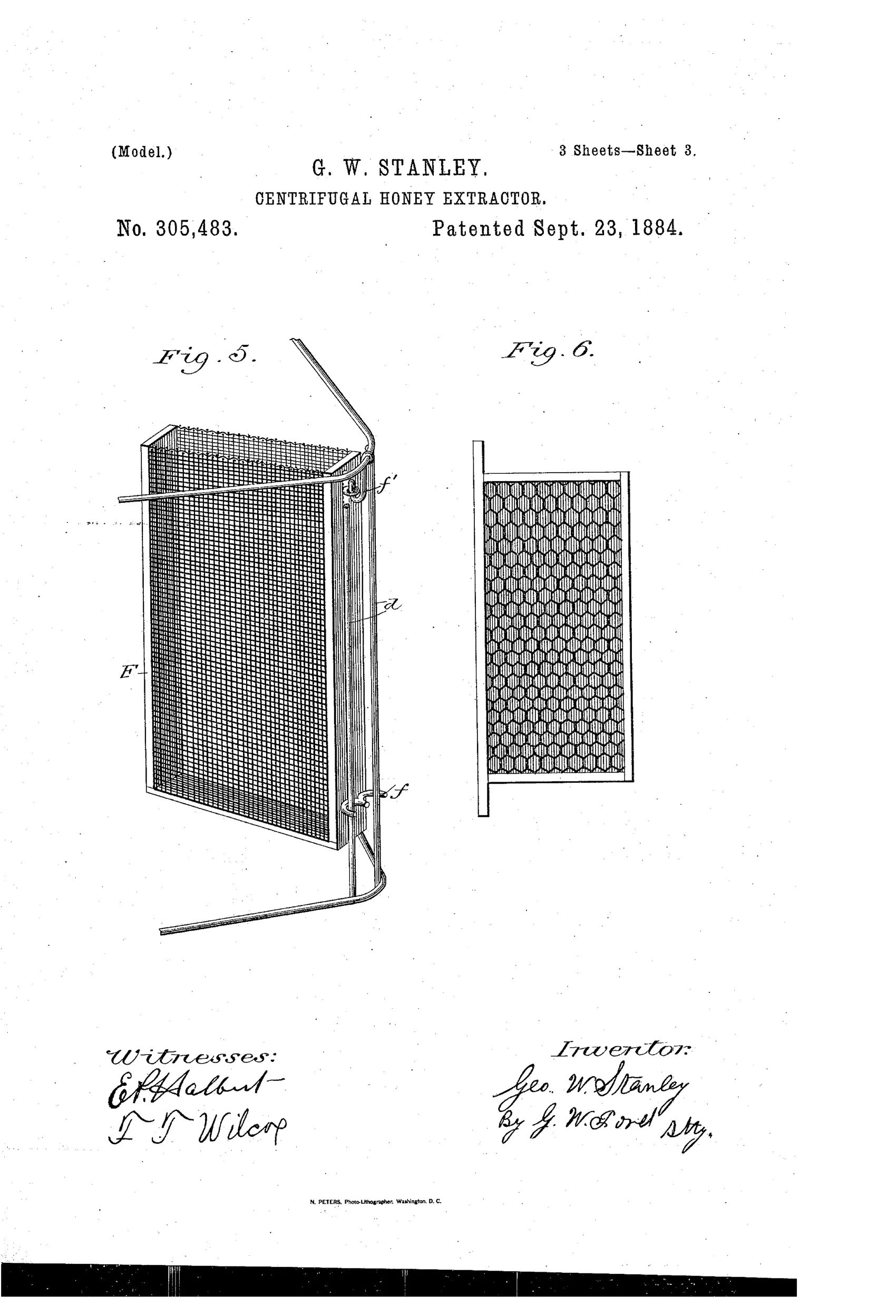
Centrifugal honey extractor with self-reversing comb baskets
⬡ How it works
A cylindrical shell holds a rectangular skeleton frame that revolves on a central vertical shaft turned by a hand crank. Wire-cloth comb baskets are hinged at each corner of the frame by one single pivot hinge and one double or crotched hinge, so that at rest they hang toward the axial center. When the frame is rotated, centrifugal force alone swings the baskets outward to lie flat against the frame, presenting the comb to the air current so honey is thrown from the cells; reversing the direction of rotation swings the baskets to present the opposite face of the comb without manually turning the frames. The extracted honey passes through a perforated bottom and cone-shaped shell into a gate at the base for drawing off into a storage receptacle.
⬡ What was claimed
“In a honey-extractor, the revolving rectangular frame having two parallel supporting-rods at each corner, with a perforated comb-basket hinged thereto by one single pivotal hinge and one double or crotched hinge, all arranged and operating substantially as described, and for the purpose herein set forth.”
In plain English: The extractor's rotating frame has, at each corner, two parallel support rods holding a perforated comb basket that is attached by one simple hinge and one forked double hinge, working together as described.
⬡ In the inventor’s words
“I do not broadly claim a centrifugal honey-extractor having swinging comb-baskets hinged to a revolving frame, as that is not new; but, as far as I am aware, I am the first to organize a honey-extractor that will, by centrifugal force alone, swing the comb-baskets from an axial central position, while in a state of rest, to a peripheral following in line when in motion, and again to automatically assume the normal position upon the arrest of the actuating force.”— George W. Stanley, from the specification
Manufactured and sold
The Stanley automatic reversing extractor was manufactured and discussed in period bee-supply literature, and self-reversing baskets became a lasting extractor feature.
⬡ Commentary
Every early extractor shared one tedium: honey combs have two faces, and after slinging one side dry you had to stop the machine, lift each frame out, turn it around, and spin again. Stanley's answer is elegant in the way good farm machinery is elegant — it adds no new parts, just smarter hinges. Each wire-cloth basket hangs at a corner of the rotating skeleton frame on one plain pivot and one forked 'crotched' hinge. At rest the baskets sag inward toward the shaft; spin the crank and centrifugal force swings them flat against the frame. Crank the other direction and they swing through to present the opposite comb face. Gravity and inertia do all the reversing.
Look at Fig. 3, the transverse section: the four baskets at rest form a pinwheel around the center, which a casual reader might take for the working position. It's the opposite — that's the machine idle, waiting for rotation to throw everything outward. Stanley is also refreshingly honest in his claim language, disclaiming swinging baskets broadly and staking his ground only on the automatic reversal.
This sits squarely in the productive middle of extractor evolution — Hruschka's basic centrifuge (1865) behind it, power-driven radial extractors ahead. Stanley's reversing extractor became a recognized commercial machine in the trade press of the era, and reversible baskets remain standard on tangential extractors today. This is one of the patents where the mechanism actually stuck.
Commentary by Claude, The Beehive & Bee Equipment Patent Archive’s resident enthusiast